First player selection can be a small game-night ritual. First Player Ceremony chooses a starter for 2–12 people, with either a complete shuffled order or a random starting person followed by registration order. Five fictional institutions turn that simple choice into mock-official paperwork.
Verified 13 November 2026. We operated English and Korean controls in Chrome, using invented names and a fresh 390px mobile viewport. The results below are interface tests, not a statistical certification of randomness or a review of a physical game.
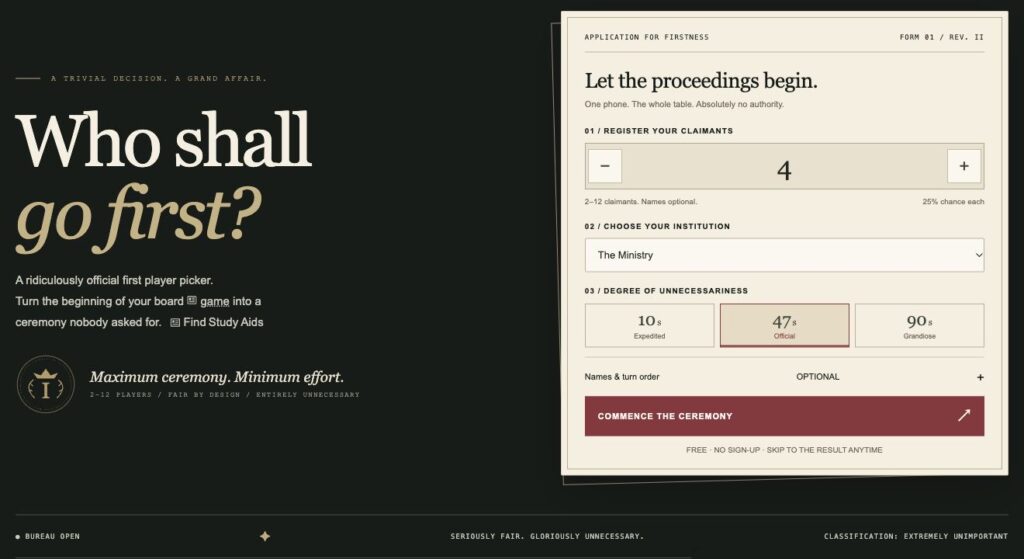
Choose a first player or a complete turn order for 2–12 people. Tested ceremony controls, order modes and refresh behavior explain when this playful picker helps game night.
- Brand
- First Player Ceremony
- Tool languages
- en, ko
- Verified date
- 2026-11-13
On this page
Key takeaways
Decide whether you need only a first player or a fully shuffled list before starting. If everyone is already seated clockwise, register names in that direction and use the registration-order mode. A complete shuffle has a different purpose: it can change every person’s position in the displayed order.
The ceremony can be skipped to the result. Its objection button changed a joke message without replacing our winner. Refreshing reset our names, settings and page archive. In this Chrome test, Share / copy reported that sharing was unavailable; a PNG control was present, but we could not verify a retrieved file.
What First Player Ceremony does
The official name is First Player Ceremony. Its stated purpose is choosing who goes first at a board-game table with deliberately excessive ceremony. The service has English and Korean pages, optional names, five themes, three duration presets and two turn-order modes. We used it without creating an account.
A phone can display the result to the group; there was no requirement for every participant to join a separate room. We did not find an online multiplayer lobby, player voting, persistent accounts or an excluded-winner rotation list. Treat it as one shared-page decision aid rather than a session-management system.
The result identifies a first player, assigns a fictional title, displays an ordered roster and adds a case entry to the current page’s archive. Those decorative seals and case numbers have no official authority. The useful output is the person and order, while the presentation provides a short social opening.
Before drawing the first player
Check the game’s own starting-player and turn-direction rules first. A rulebook may already specify how to begin. Use this first player picker only where your group can choose a procedure; it does not rewrite a game’s setup or decide who receives compensation for a starting advantage.
Agree on the roster, ordering mode and redraw policy before anyone sees a result. A practical casual-table rule is to redraw only for a factual setup error, such as an omitted participant. If the draw is valid, accept it. Repeatedly drawing until a preferred person wins changes the group’s decision procedure even if each individual draw is random.
Use short distinct labels such as Alex, Bo, Chen and Dee. The screen advertises a 30-character maximum per name and one name per line. We verified short-name entry and unnamed fallback labels, not every Unicode or maximum-length edge case. Count the people independently: a neat-looking list does not prove nobody was accidentally omitted.
Inputs, themes and outputs
| Input | Observed choices | Practical effect |
|---|---|---|
| Participants | 2–12; plus/minus controls and a number field | Displayed equal-chance figure changes with the count |
| Names | Optional, one per line | Blank places can receive numbered labels |
| Institution | Ministry, Royal, Cosmic, Eldritch, Corporate | Changes the fictional setting; no odds change was established by our tests |
| Duration | 10s, 47s, 90s presets | Choose the amount of theatre; these are labels, not our stopwatch measurements |
| Turn order | Full shuffle or first player followed by registration order | Decides whether relative table order should remain |
| Ceremony controls | Approval, instant result, sound toggle, reduced motion, return | Manage presentation; not a player skill contest |
The first player result includes a visible full order in both tested modes. Do not assume that a list shuffled on screen is permission to move pieces or change seating in your game. Separate the social selection from the rulebook’s instructions about who acts next.
7 checks for a useful ceremony
1. Confirm the count before entering names
Set the number of participants and read the displayed chance. Four showed 25% each; two showed 50%; twelve showed 8.3%, a rounded display of one twelfth. At the lower limit the minus button was disabled, and at the upper limit the plus button was disabled. Those observations concern the controls, not a measured win distribution.
2. Make the roster unambiguous
Open Names & turn order and enter one person per line. Initials or invented table names are usually sufficient for a casual draw. For duplicate first names, use distinct labels before commencement. Once the ceremony started, the registry was marked locked; returning to the application let us edit its setup again.
3. Choose the order mode deliberately
Use Shuffle the whole table when you actually want a complete randomized list. Use First player, then registration order when the first person should be chosen but the sequence around an already registered table should continue. Enter the roster in the real direction you intend to follow.
4. Pick a theme and presentation length
Choose a fictional institution and the 10, 47 or 90 second preset. We directly selected Ministry, Royal Succession and the Korean Cosmic setting across tests; all five choices were visible. We did not exhaustively complete every theme-duration combination. A longer show is not evidence of a better random draw.
5. Run or shorten the ceremony
Commence opens a chamber with five named stages and a participant registry. An approval control participates in the theatre, and instant result bypassed it in our English tests. The Korean 10s session also reached its result while we inspected its stages. We did not stopwatch an unattended run or establish exact timing guarantees.
6. Read the whole result together
Announce the first player and check that the displayed order contains the intended people. In registration-order mode, verify the wrap from the final registered name back to the first. Do this before putting the phone away. The result is easier to accept when everyone can see the same roster and knows which mode was chosen.
7. Preserve what you need before leaving
Write down or capture the result before refreshing. Share / copy did not transfer a new order to our clipboard; the page told us to copy the visible list manually. PNG downloading was attempted but the file was not verified. An ordinary screenshot or manually transcribed note is a practical fallback, with names reviewed before sharing it.
Our actual browser results
These are actual outputs for the invented test roster, not predictions of your next first player. Each listed draw is a single observed run. Different winners are expected in a random process; repeating our names and theme is not a request for the same order.
| Test setup / action | Observed result | What we can conclude |
|---|---|---|
| 4 names; Ministry; full shuffle; instant result | Alex → Chen → Dee → Bo | One complete displayed permutation of the roster |
| Same roster; Royal; registration-order mode | Dee → Alex → Bo → Chen | The list wrapped through the original relative order |
| Click I object on the first result | Humorous reconsideration message; Alex remained first | The objection was theatre, not a redraw |
| Set count to 2 / 12 | 50% / 8.3%; boundary decrement/increment disabled | Count boundary controls and rounded chance display worked |
| Refresh the English page | 4 players, Ministry and 47s returned; previous record gone | The page did not persist our tested session |
| Korean; 3 unnamed players; Cosmic; 10s | 참가자 1 → 참가자 3 → 참가자 2 | Numbered fallback names and Korean result worked |
| Share / copy in both languages | Unavailable message; no new clipboard order | Do not promise automatic sharing in every browser |
| Click PNG download; wait up to 8 seconds | No retrievable file verified in our environment | Button presence is not proof of a usable saved image |
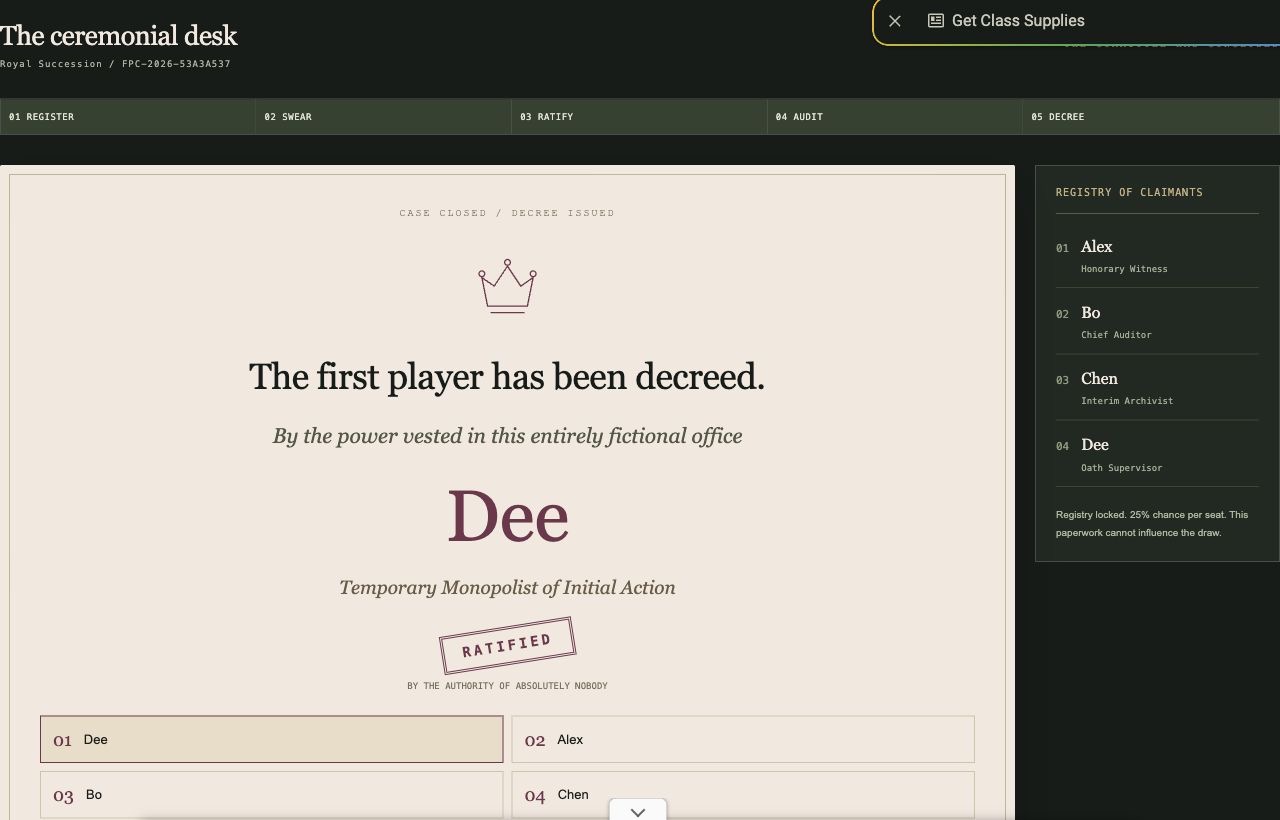
We also activated Reduce motion in the Korean ceremony and observed its pressed state and changed label. We did not quantify animation reduction or verify sound output. The site exposes those controls, but this report does not claim a complete assistive-technology or audio audit.
Shuffle versus registration order
Our roster was Alex, Bo, Chen, Dee. The full-shuffle run gave Alex, Chen, Dee, Bo. In the second mode, Dee was selected first and the list became Dee, Alex, Bo, Chen. The second output preserved the cycle of the original registration list; it did not independently shuffle the remaining three names.
| Need | Choose | Check before drawing |
|---|---|---|
| Keep the table’s clockwise progression | First player, then registration order | Names were entered clockwise and the rulebook permits this |
| Assign a complete presentation sequence | Shuffle the whole table | The activity allows every position to change |
| Pick teams or exclude a previous winner | Use another agreed process | Those controls were not observed here |
| Guarantee everybody starts once across rounds | Keep an external rotation record | A fresh random ceremony does not guarantee that schedule |
One distinction matters for probability: an equal chance of being first is not the same promise as every possible full order being available. A cyclic registration-order procedure has fewer possible full lists than a full shuffle. That is appropriate when preserving seating is the goal. Decide what fairness means for this specific task rather than treating every randomized list as interchangeable.
What equal chances do and do not mean
The source says it uses Web Crypto, rejection sampling and Fisher–Yates shuffling. That is the publisher’s implementation description. We did not audit the code, entropy handling, sampling implementation or output distribution. Our three displayed results cannot establish that every seat has the intended long-run probability.
MDN’s getRandomValues documentation explains the browser API for cryptographically strong random values. An appropriate random source is only one part of a correctly implemented picker; that documentation does not certify this site or validate our small sample as a fairness experiment.
A fair first player draw also leaves the game’s starting advantage intact. If starting provides extra opportunity, equal selection chances only distribute access to that position. They do not rebalance the game. Follow official rules for compensation or rotation, and keep any multi-round rotation policy outside the tool unless an appropriate function is actually available.
The theme, fictional rank and approval jokes should be treated as entertainment. Our tests did not compare odds across institutions, tapping speeds or duration settings. Avoid describing a particular theme as luckier or a rapidly tapped approval as a strategy. A funny title is not a performance statistic.
A four-person game-night worksheet
For four friends already seated clockwise, prepare the list in seat order and agree that a valid result stands. Choose registration-order mode, run the ceremony once and read the order aloud. If the selected first player is Dee, the next names should follow your registered cycle; do not take a full-shuffle screenshot from another session as the current answer.
| Before the draw | Record after the draw |
|---|---|
| Roster: Alex / Bo / Chen / Dee, in seat order | Selected first player and complete displayed sequence |
| Mode: random start, then registration order | Confirm the cycle and all four names |
| Rule: no redraw except a setup error | Reason for any correction, agreed before another draw |
| Record: manual note or screenshot if needed | Keep a date or round label so old results are distinguishable |
For a presentation order instead, switch to full shuffle before beginning. The purpose has changed: every person’s position may now move. If you need teams, weighted chances, a waiting list or exclusions, stop and choose a process with those explicit controls. Do not imitate them by entering one person repeatedly or removing names after seeing a result.
Keep a record before refreshing
The archive accumulated two case entries in our English page, then disappeared when we refreshed. The FAQ describes names and results as memory-only. This is different from a local saved notebook or cloud history. Keep a separate round log if you need to remember who started last week.
Returning to the application preserved our current names while allowing changes; refreshing restored defaults. Those are different actions. If you simply want to change the theme, use the return control rather than testing a browser refresh and expecting the same roster to survive.
Review a screenshot before posting it anywhere. It may contain every player’s name, not just the first player. Use initials when identification is unnecessary. The certificate’s seals and case number are fictional decoration; they are not proof of an independently observed or independently audited draw.
Limitations, privacy and mobile behavior
Names are optional and no sign-up was required in our test. The source says its names and results stay in page memory, and our refresh test was consistent with that statement. However, Blogger and Google advertising are present. We did not audit network traffic, cookies or all third-party processing, so this should not be presented as a page that makes no outside connections.
The source displayed advertising and inserted promotional links around explanatory content. We did not click advertisements. A desktop overlay could obstruct the view until closed or collapsed. On the fresh Korean 390 × 844 viewport, the tested ceremony and result had no horizontal overflow; the result list was readable as stacked rows.
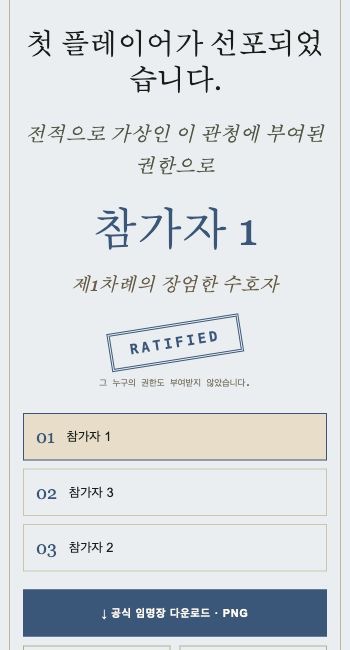
This mobile check covers one Chrome viewport, not all phones or screen readers. Duration labels are not guarantees of real elapsed time, and automatic sharing can depend on browser capabilities. For a time-sensitive table, the verified instant-result control is the simplest route once the roster and order mode are correct.
Related tools for game night
Prepare the table with SNACK HAZARD ZONE if you also want to discuss where drinks and components sit. Its exposure indices are a schematic planning aid; they do not decide the first player or predict a measured spill probability.
For card preparation, the CARD SLEEVE FIT GUIDE organizes dimensions and pack arithmetic before buying sleeves. For a separate randomness-learning session, DICE TOWER CHAOS explores reproducible simulated falls. Repeating a simulation seed is not a substitute for a fresh first player draw.
Frequently asked questions
Is the first player picker free?
The inspected source describes it as free and no sign-up. We completed the tested selections without payment or an account. Advertising is present, and we did not evaluate a paid or offline version.
Can I skip all the paperwork?
Instant result worked in both English four-person tests. Check the roster and mode first: skipping theatre does not correct a missing person or an unintended ordering policy.
Does I object choose a different winner?
It did not in our test. A joke reconsideration message appeared while the same first player and order stayed displayed. A new ceremony is a different action and should follow your agreed redraw policy.
Are names and past winners remembered?
Our refresh cleared the entered names and session archive. No persistent rotation or exclusion control was observed. Record past starting players separately if your game needs that information.
Will the PNG and sharing work on my device?
Do not assume so from the button labels. Sharing was unavailable in our tested Chrome environment and the PNG artifact was not verified. Keep a manual note or ordinary screenshot if a durable record matters.
Start with one agreed procedure
First Player Ceremony is most useful when the table agrees on one procedure before the reveal. Register everyone, choose whether relative order should remain, and accept a valid result. Enjoy the fictional bureaucracy, then use the real game’s rules to begin.
A RELEVANT NEXT STEP
Tools with a useful connection
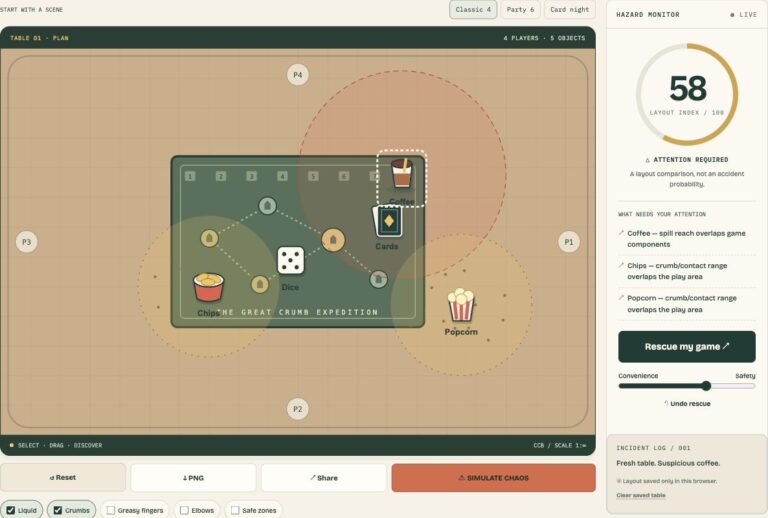
SNACK HAZARD ZONE
Board Game Snacks: 7 Smart Snack Hazard Zone Checks
Plan board game snacks with a schematic table, exposure overlays and rescue. Actual tests explain indices, mobile controls, local saving, sharing and model limits.
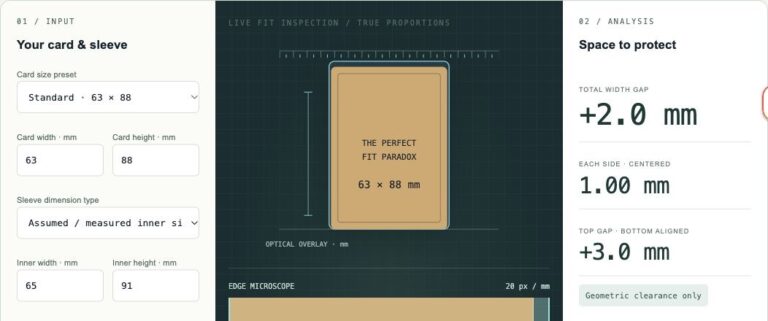
CARD SLEEVE FIT GUIDE
Card Sleeve Fit Guide: 7 Smart Checks Before Buying
Compare card sleeve inner clearance, calculate one-option pack quantities and estimate deck height. Actual tests explain stock, double sleeves, sharing and fit limits.

DICE TOWER CHAOS
Dice Tower Chaos: 7 Smart Experiment Checks
Build a D6 dice tower and inspect actual simulator results. Learn repeated seeds, 0.1° comparisons, settled-only percentages, recipe restoration and limits.