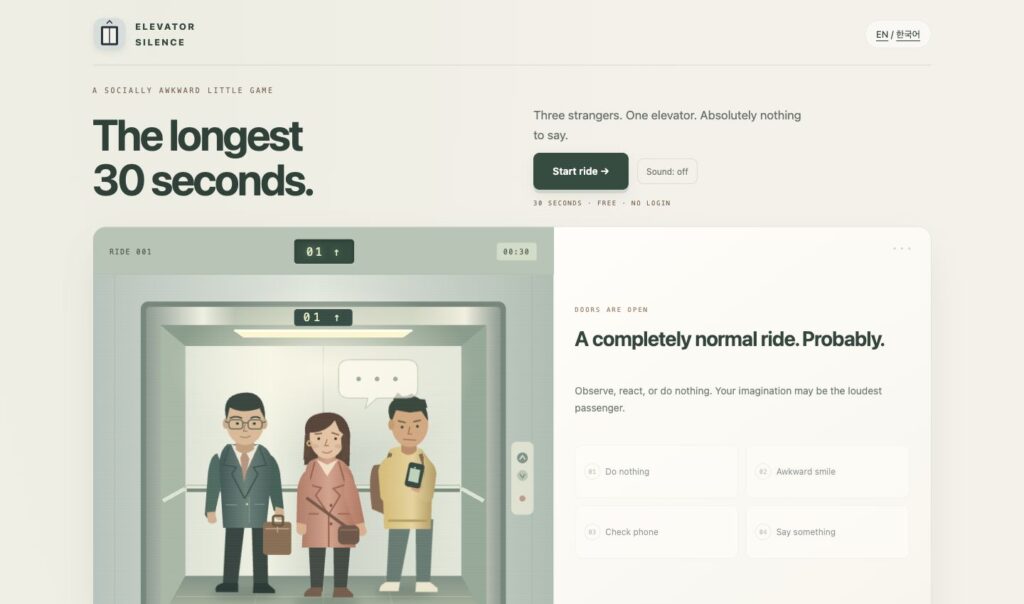
Play Elevator Silence with clear expectations. Three actual rides, keyboard and Korean mobile checks explain fictional panic, hidden room awkwardness, one-choice events and report limits.
- Brand
- Elevator Silence
- Tool languages
- en, ko
- Verified date
- 2026-11-08
Elevator Silence turns an ordinary quiet lift into a short, fictional comedy game. You have four preset reactions, a visible Inner panic meter and a room score that stays hidden until arrival. Play it for a small interactive break, or compare how the game presents imagined pressure and an uneventful ending. The report describes this invented ride, not the thoughts of real strangers.
Hands-on check: 8 November 2026, Chrome. We completed two English rides and one Korean ride, including a fresh 390px mobile test. The first used no reaction buttons; the second used speaking, smiling and phone-checking; the Korean ride included an explicit Do nothing choice. We tested keyboard activation, one-choice locking, replay, the sound toggle and report preparation. Exported image contents, actual audio quality, native sharing and precise background-tab pause timing were not independently verified. All screenshots below are real screens.
Table of Contents
Key takeaways before the elevator doors close
- The official name is Elevator Silence. Normal Ride is the available mode in the reviewed version.
- The source describes a 30-second trip from floor 1 to 12, with five events sampled from twelve. We completed the trip; we did not catalog all twelve events.
- Waiting without pressing a button can reach a complete ending. An explicit Do nothing button is also a selectable reaction.
- Our no-input report showed 66% Inner panic and 9% Room awkwardness. The difference is part of the fictional presentation, not a measured social judgment.
- Only one reaction was accepted per event in our tests. The four buttons then disabled until another event.
- Sound starts off. The source discloses browser gameplay alongside Blogger and advertising data processing; those are different privacy scopes.
What Elevator Silence is useful for
A quiet room can make a tiny action feel disproportionately significant. This game puts that familiar comic situation into a compact interaction: three illustrated passengers, an upward floor display, a countdown and four possible reactions. It is useful when you want a brief game with readable feedback rather than a long setup, an account or a complex control scheme.
Its distinctive mechanic is the separation between visible internal pressure and the room result. During play, Room vibe says it will be revealed at arrival. The finished report labels the second number Room awkwardness. Reading only the live panic meter misses the joke and gives an incomplete account of what the game is doing. Let the ride finish before interpreting its outcome.
The illustrated passengers and the statements about their thoughts are authored fiction. The source explicitly describes the game as social comedy, with no leaderboard, purchases or psychological testing. In our session, there was no account, payment, text-entry dialogue or voice recording required to play. Say something is a preset action button; it did not ask us to compose or speak a line.
Prepare the screen, sound and a small comparison note
Choose English or Korean before starting. Keep the event text and the four reactions in view; reading the heading matters more than trying to infer an answer from the passenger illustration alone. The source presents phone play as supported, and we checked the Korean interface at 390×844. A narrow page stacks the scene and response area vertically, so locate the controls before the countdown begins.
Sound was off on the landing screen. We changed the control to on and back to off, verifying the label and pressed state rather than evaluating the generated audio. In a shared room, leaving it off avoids adding a sound requirement to a game about silence. Do not assume that a successful toggle proves audio will play identically through every device, speaker or browser policy.
If you want to compare rides, prepare a short note with the language, ride number, event, chosen reaction and final scores. Record nonresponse separately from an explicit Do nothing press. They can look similar to a spectator, but one is an input and the other is waiting. Do not invent a complete response log from the ending title; the report is a summary, not a verified replay archive.
| Before boarding | What to check | Why it matters |
|---|---|---|
| Language | EN or 한국어 | Read prompts before the response window passes |
| Sound | Off by default; optional toggle | The game can be played without sound |
| Controls | Four preset buttons, keyboard activation possible | Say something is not a voice or typing task |
| Comparison record | Events, reactions and final report | Scores alone do not identify a strategy |
How to play Elevator Silence: 7 essential checks
1. Start one normal ride
Press Start ride. The countdown begins at 00:30 and the display starts at floor 01. The initial Inner panic reading we saw was 24%. This is an initial game value, not a question about your own feelings. Before starting, the reaction buttons are disabled. Once an event appears, their active state tells you that the current prompt is ready for a response.
2. Read the current event before reacting
Our second ride began with both people starting to say hello. Another event involved apparent eye contact in the mirror; another involved disconnected headphones. The same four buttons stayed available across those contexts. That repeated control layout makes the game easy to learn, but it does not mean that the same action has one fixed meaning in every scene.
3. Choose once, then watch the lock state
Activate Do nothing, Awkward smile, Check phone or Say something. We used Enter on the buttons. After a response, all four were disabled for that event and a short acknowledgement appeared. This is useful feedback: rapid repeated presses are not four separate decisions. Wait for the next prompt rather than assuming the page has stopped responding when the current choices lock.
4. Try waiting as a complete play style
For our first ride, we pressed Start and made no reaction inputs through arrival. It still completed at floor 12 with a report. This establishes that nonresponse is a supported path through the tested ride. It does not establish that every silent run has the same score, because event selection and the timing of other actions can differ.
5. Read both numbers at arrival
At00:00, the buttons disabled and the arrival message appeared. Below it, the report provided Inner panic, Room awkwardness, a Survival grade, an ending title and Longest quiet streak. Our first title was The Silence Artist. Do not stop at the live panel: even at arrival it still showed the placeholder Reveal at arrival, while the actual room number was in the separate report.
6. Replay with a recorded question
Use Ride again for another trip. We tried three active reactions in the second run: speaking at an overlapping hello, smiling at mirror eye contact and checking the phone after a headphone disconnect. Some other moments passed without a selected input. A useful question is how the two fictional meters diverge, not which button proves that you are socially skilled.
7. Preserve the result with the right expectations
Save card produced Your report card is ready in our test. We did not inspect the downloaded image, so this review does not certify its dimensions or exact contents. Share report was visible, but we did not send a report to another person or validate the native sharing path. If a result matters, keep its visible numbers and verify your own saved artifact before closing the page.
Actual Elevator Silence results from three rides
| Tested run | Panic / room awkwardness | Report outcome |
|---|---|---|
| English 001: no reaction inputs | 66% /9% | The Silence Artist; A+;30s longest quiet streak |
| English 002: three selected reactions | 53% /7% | The Considerate Passenger; A+;10s longest quiet streak |
| Korean 003: one explicit Do nothing, then waiting | 63% /9% | 침묵의 장인; A+;30s longest quiet streak |
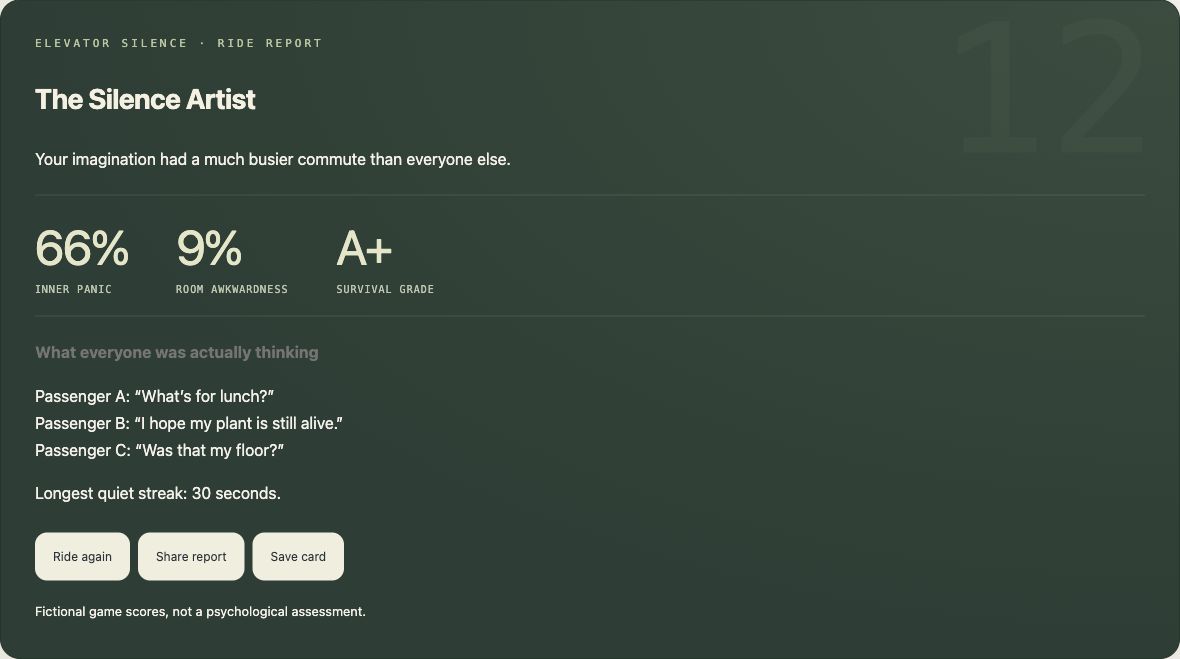
All three reports gave A+, despite different panic values and the second run’s different title. That is evidence against reading the grade as a precise ranking of these three performances. We also saw the same invented lunch, houseplant and floor-related passenger thoughts in the reviewed endings. They are written comic lines, not observations or a system for inferring another person’s mind.
The first two results differ by 13 percentage points of panic and 2 points of room awkwardness; those are simple calculations from the displayed reports. They do not show the causal benefit of speaking, smiling or using a phone. We did not hold the event sequence, response timing or random state constant. These are descriptive play sessions, not a controlled experiment on a winning strategy.
Read the scores without inventing an etiquette rule
Inner panic is a visible fictional pressure meter. Room awkwardness is the separate revealed outcome. Their numerical scales look comparable because both use percentages, but the page does not provide a calibration that turns either into a real social measurement. Do not subtract them to create an anxiety diagnosis, a confidence rating or a prediction about an actual elevator encounter.
Timing is another source of confusion. The page says waiting raises imagined pressure, so a number seen after pressing a reaction can include time that passed before the press. We observed changing readouts during active play, but did not derive a scoring formula or isolate per-button effects. A before-and-after number taken several seconds apart is not enough to identify an exact action bonus or penalty.
The Korean test also clarifies explicit inaction. We selected 아무것도 안 하기 when a small dog was looking at the player. The interface acknowledged the choice, showed 21% at that moment and disabled the four reactions. We then let the remaining ride proceed without more selected responses. Its final 63% is not the immediate result of that one press; it is the ending of the whole session.
For a better personal comparison, record the prompt text and response at each observed moment, mark any missed windows and keep language and sound settings consistent. More records may make the game’s variation easier to discuss, but they would still describe a fictional system. This review did not test every event-action combination, establish an optimal policy or verify a repeatable seed control.
Mobile choices, keyboard use and interruption limits
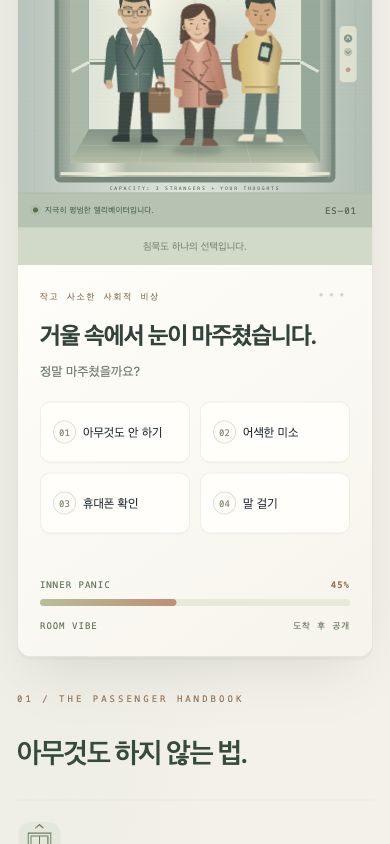
The Korean mobile page had a document width of 390px at a 390×844 viewport, with no horizontal overflow in the tested state. The four choices fitted inside the response card. Because the scene is above the controls, a player may need to scroll to read both. Get oriented before starting; otherwise, time spent finding a button can be mistaken for a deliberate silent choice.
Keyboard Enter activation worked in our tests. The source also advertises Tab navigation and reduced-motion preferences. We did not complete a full screen-reader or motion-preference audit, so those broader claims remain source-described rather than independently certified here. The text prompt, button labels and numeric result are useful alternatives to relying on illustration color or audio alone.
The FAQ says a ride pauses when switching tabs and that closing the page ends the session. We did not establish precise background-pause timing in this browser session. For context, MDN’s Page Visibility documentation explains that hidden-page handling and background timer policies can affect web activity. That general explanation does not verify this game’s implementation. Use the in-game countdown when returning, rather than treating elapsed wall-clock time as a finished ride.
Distinguish ride count, a saved card and privacy
After reloading the English page, we saw the initial landing state rather than the previous report. Starting the Korean ride subsequently showed RIDE003, following 001 and 002. That observed sequence supports persistence of the ride count in this browser. It does not establish that an unfinished session, a result history or previous choices can be restored after closing or reloading.
A screenshot of the report is a static record. A saved card is an export that should be opened and checked. Sharing is a separate action involving the report you select. None should be assumed to provide an editable continuation of the ride. This distinction is especially useful if you are writing a review, comparing two endings or planning to show the result in a group.
The source says gameplay runs in the browser, requests no name and does not upload choices. We verified that no account or name entry was needed for the tested flow, but did not perform a network audit to independently prove the whole transmission claim. Its privacy section separately discloses Blogger and Google AdSense cookies, identifiers and usage processing, and advertising was visible during our visit.
The linked Google Privacy Policy covers Google services and their data practices; consult it alongside the site’s own disclosure. “Local gameplay” should not be rewritten as “no external requests” or “no advertising tracking.” A short game can have simple player inputs while its hosting and advertising still involve other services.
When to choose this elevator game or another short activity
| What you want | Use this route | Keep the boundary clear |
|---|---|---|
| A brief comic ride about quiet | Elevator Silence Normal Ride | Scores belong to invented passengers and rules |
| A game about repeated elevator controls | Elevator Button Lab | Different mechanics and modes; no shared result system |
| A turn-taking scenario | Conversation Collision | Overlapping speech is its central interaction |
| A door courtesy timing challenge | Door Holding Distance | Holding, releasing and handing over are different controls |
Elevator Silence is strongest when you want a minimal set of reactions and an anticlimax. It is less useful if you need long-form dialogue, a persistent campaign, an event editor or a documented scoring equation; those were not available in the reviewed interface. The source presents Normal Ride as the available mode, so do not promise additional modes based on screenshots of other elevator games.
For a group discussion, invite people to describe what the game displayed rather than disclose personal anxiety scores. A simple prompt is to name the event, explain which response was chosen and distinguish the internal meter from the room report. A game score is not evidence about someone’s manners or personality, and a funny ending does not need to become a competition.
Related tools for another everyday social comedy
- Elevator Button Lab guide: explore pressing, waiting and door-control feedback when you want an elevator game with different mechanics.
- Conversation Collision guide: move from quiet to the awkward moment when two people speak together, with its own response system.
- Door Holding Distance guide: try a separate timing game about holding, releasing and handing over a door.
These are separate activities. We did not test any transfer of reports, scores or saved data between them. Choose by the interaction you want to explore, rather than assuming that similar fictional grades share a common scale.
Elevator Silence FAQ
Can I finish without pressing a reaction?
Yes in our tested first ride. It reached floor 12 and produced 66% panic,9% room awkwardness and an A+ report. Those exact numbers are not promised for every silent run.
Why do the buttons stop responding after one choice?
All four disabled after a response in our tests. Wait for the next event. Repeated presses during that locked period are not additional decisions.
Does a high panic value mean I played badly?
It is a fictional meter. Our three reports had different panic values but all gave A+. Read the separate room result and ending text, and avoid interpreting either as a real personal assessment.
Was the downloaded card independently verified?
The Save card control showed a preparation message. We did not inspect the exported image, and native sharing was not validated or used to send a report.
Can I play in Korean on a phone-sized screen?
We completed a Korean ride at a fresh 390px viewport and operated its explicit Do nothing choice. The page fit horizontally. This is a Chrome responsive test, not certification for every device or assistive technology.
Take one ride and read the whole ending
Start with sound off, read the prompts and either select one reaction per event or let a quiet ride unfold. At arrival, compare the live meter with the actual report below it. The most useful conclusion may simply be that the game made a normal 30 seconds feel much busier than its fictional room result.
Verification record: three completed rides and actual screenshots checked 8November 2026. Report values are observed game outputs; percentage-point differences are editorial arithmetic. All twelve events, a complete scoring model, audio quality, exact background-pause behavior, export file contents and native sharing remain unverified.
A RELEVANT NEXT STEP
Tools with a useful connection
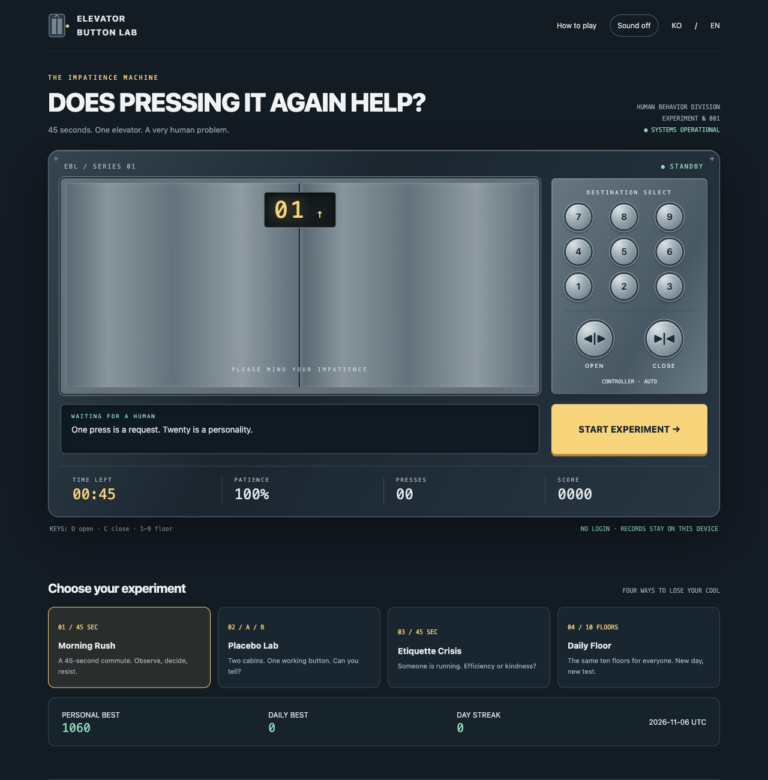
Elevator Button Lab
Elevator Button Game: 4 Fun Modes & Essential Tips
Explore Elevator Button Lab through four modes, actual repeat-input and boarding tests, a fictional A/B comparison and real PNG output. Learn what the feedback means and where it stops.
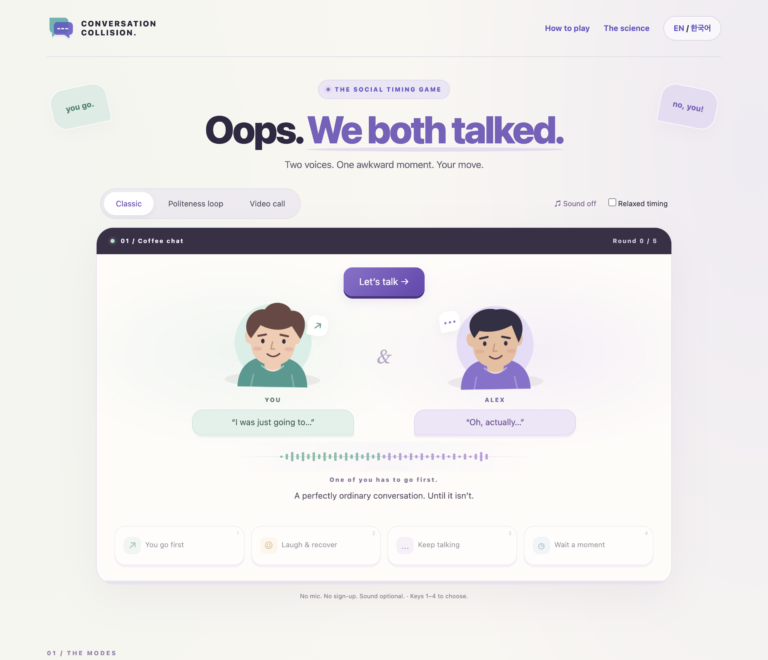
Conversation Collision
Conversation Collision: A Conversation Timing Game in 5 Steps
Explore overlapping speech through a five-round conversation timing game. Compare four responses, three modes and our matched English/Korean tests without treating scores as a personality assessment.
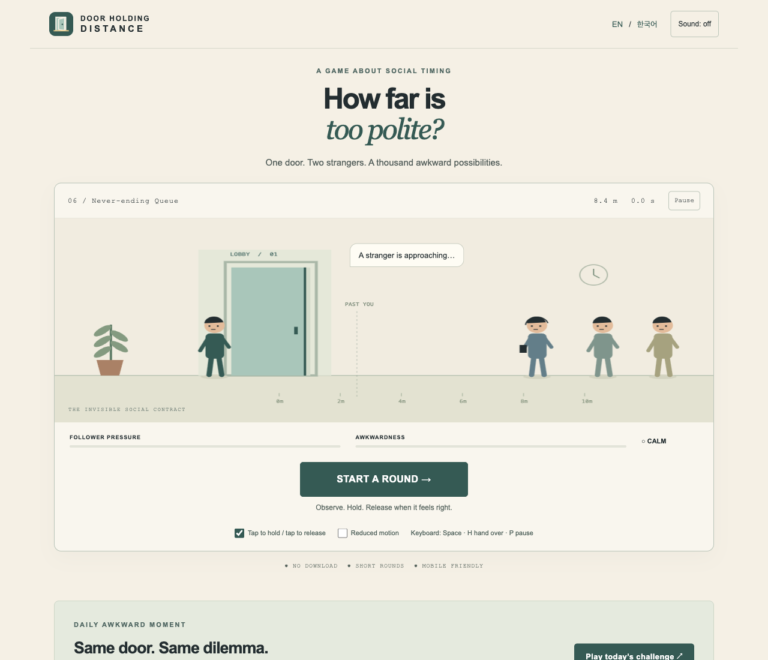
Door Holding Distance
Door Holding Game: 8 Fun Scenarios, Better Timing
Play with everyday courtesy in Door Holding Distance: eight scenarios, tap-to-hold controls and playful feedback. Read our real handover test, controls and limits.