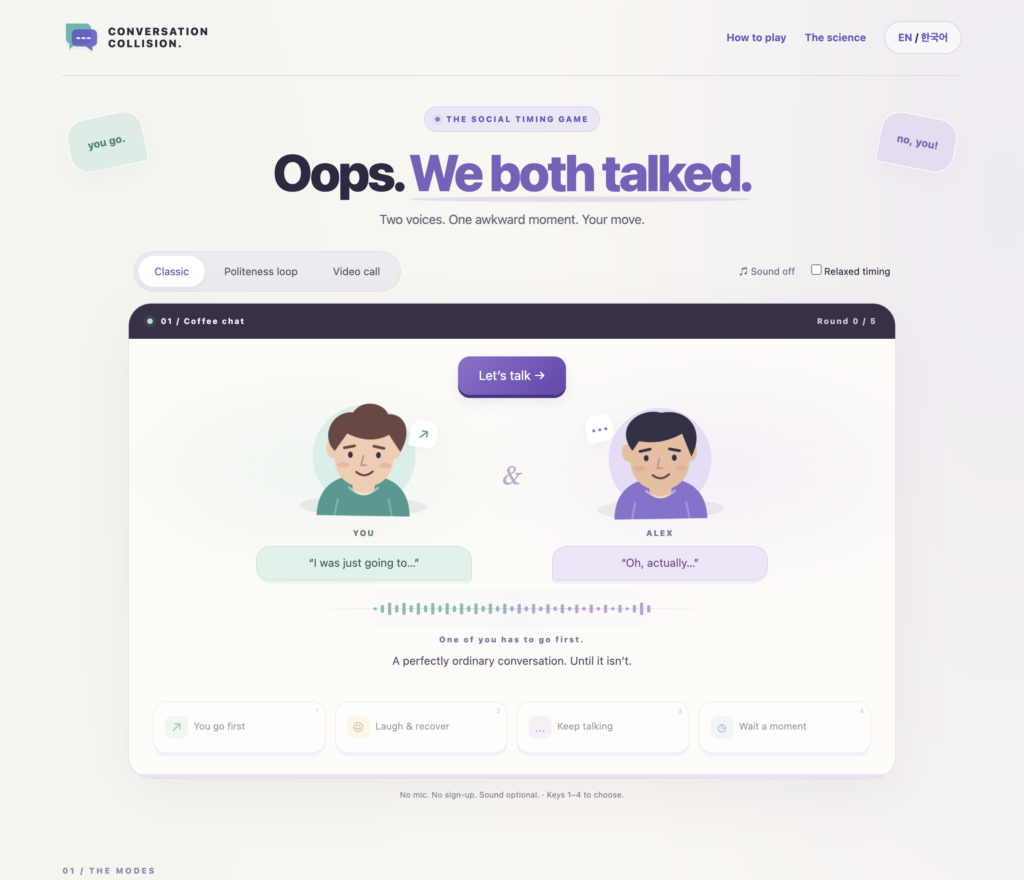
Explore overlapping speech through a five-round conversation timing game. Compare four responses, three modes and our matched English/Korean tests without treating scores as a personality assessment.
- Brand
- Conversation Collision
- Tool languages
- en, ko
- Verified date
- 2026-11-05
Conversation Collision is a conversation timing game about the awkward instant when two people begin speaking together. Choose whether to yield, laugh, continue or wait, then read the animated partner’s reaction. It turns a familiar social mix-up into a short, rule-based game—not a recording of your voice or a test of your personality.
Play Conversation Collision ↗ · Open the Korean game ↗
Hands-on verification: November 5, 2026. We completed Classic in both languages with Relaxed timing, tested the first Politeness loop and Video call situations, and used the numeric-key control. This library and the original tool share a creator. The review explains observed behavior and limitations rather than presenting an independent third-party endorsement.
On this page
Key takeaways
- Five short situations make one Classic session. Read the situation and partner description before choosing.
- Relaxed timing removes the pressure to respond quickly and makes the timing component neutral according to the source FAQ. Our completed tests used this option.
- The four choices are actions inside a designed scenario. None is a universal rule for real conversations.
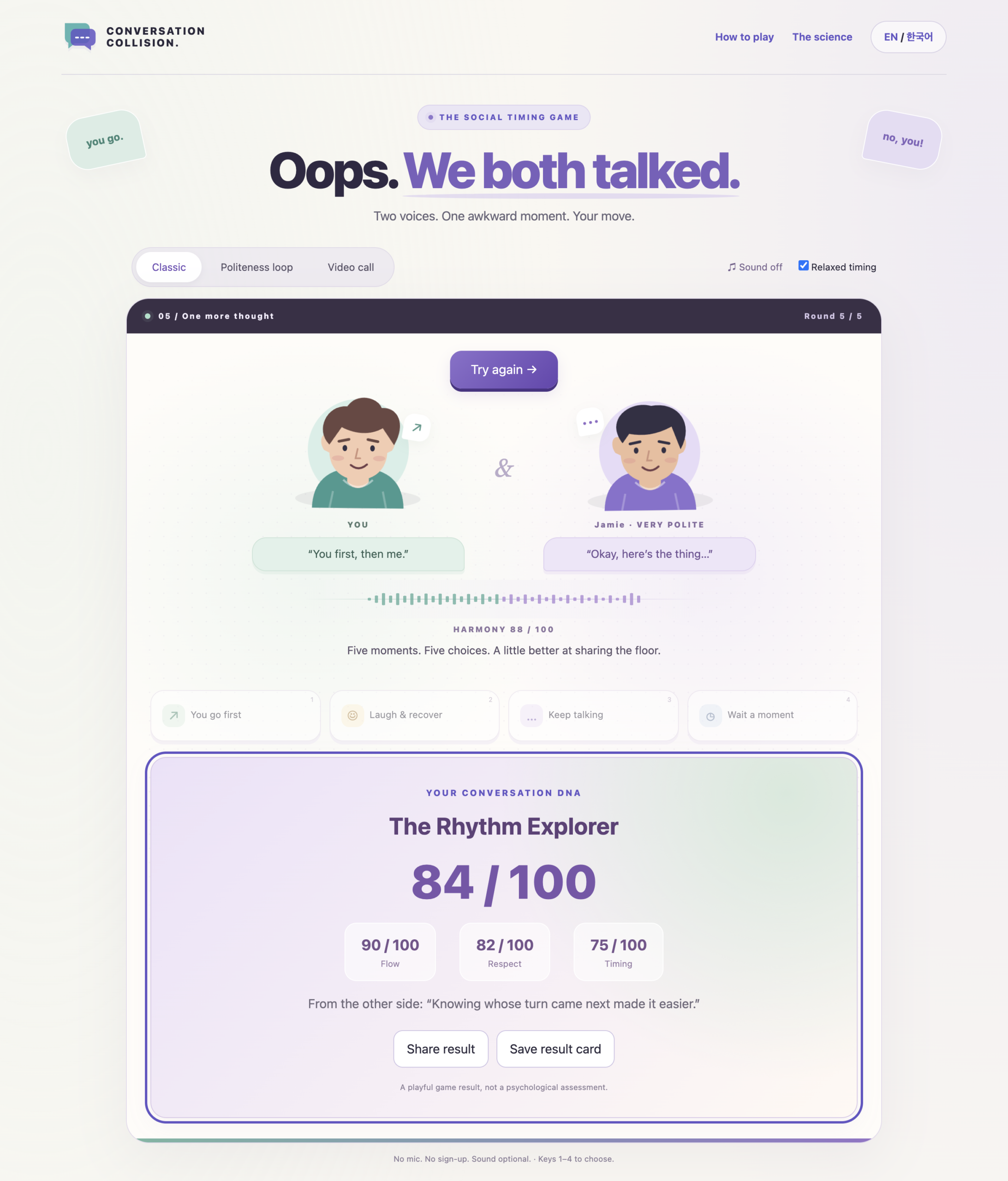
- Our matched English and Korean runs produced 84/100 overall, with Flow 90, Respect 82 and Timing 75. These are game outputs, not measured social skills.
- Video call simulates delay locally. Its displayed milliseconds do not diagnose your connection or record a real call.
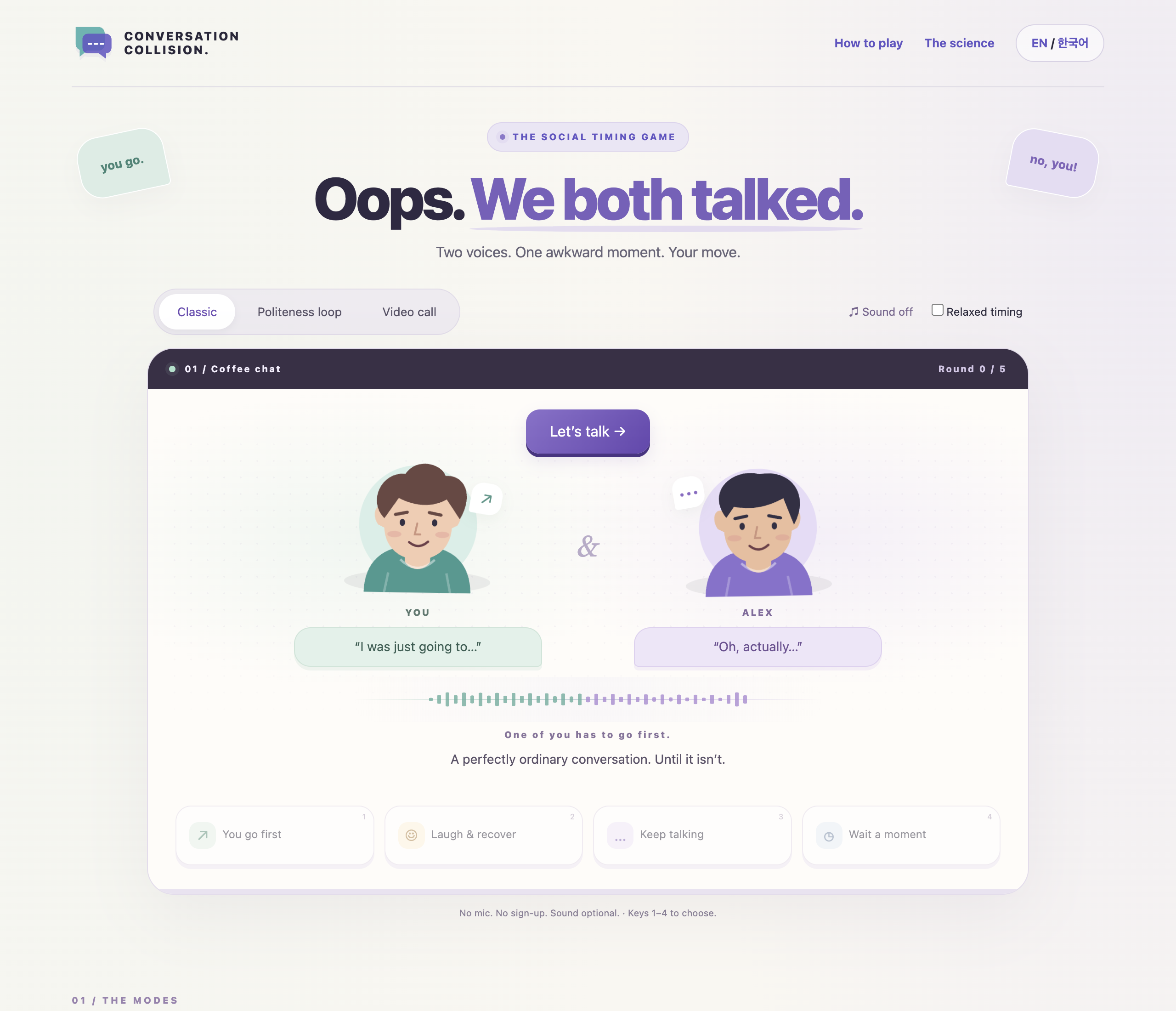
What this conversation timing game actually does
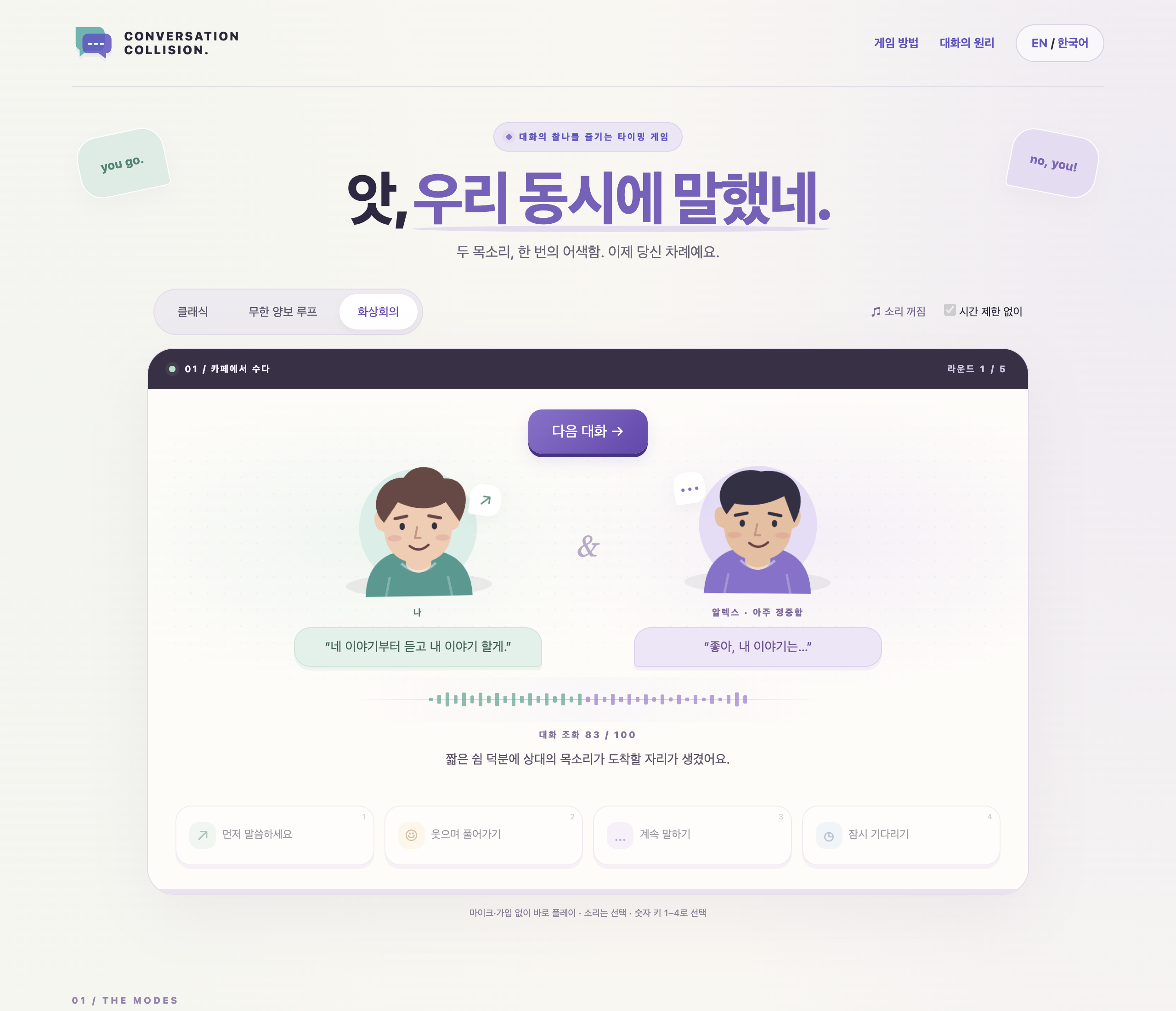
The input is a choice, not a transcript. An animated pair begins to talk at the same time, and you decide how your character responds. The game then changes the speech bubbles, reaction text and round score. At the end of five rounds it presents a conversation-DNA label and a breakdown of Flow, Respect and Timing.
This makes the conversation timing game suitable for a playful solo break or a low-pressure prompt for discussing turn-taking. It is not a live multiplayer room, speech-recognition tool, interview evaluator or microphone-based rehearsal. You do not need another person to be online, and the partner’s response is part of the game design rather than a human assessment.
The most useful feature is the connection between an action and its explanation. A score alone can tempt you to chase a number. Reading why a response worked in a particular scene gives you something more concrete to compare on a replay. Keep the fictional context attached to the explanation instead of turning it into a general judgment about yourself.
Before you start: language, sound and relaxed timing
Choose the interface you can read comfortably. The English page is at the root of the source site; the Korean version is a separate page. The library article is also separate from the game. Switching between language versions is navigation, so do not rely on it to preserve an unfinished run. Finish or record your own observations first.
Leave sound off if you are in a shared space. Our full sessions were completed without turning sound on, so the central choice-and-feedback workflow did not require audio. We did not verify the quality of every sound effect. The source does not ask for camera, microphone, account or a name to begin the game; that does not mean the surrounding advertising page has no third-party data processing.
For your first run, enable Relaxed timing before pressing Let’s talk. It stays unavailable for changes while the session is active, so choose it at the setup stage. The source says this mode allows you to take your time and neutralizes the timing component. It is a useful way to study the wording without mixing reading speed with choice strategy. Normal timed scoring was not part of our matched test.
Conversation timing game: 5 steps to a useful session
- 1. Select Classic. Learn the basic action-and-reaction sequence before exploring modes with different goals.
- 2. Set the reading conditions. Pick the language, optional sound and Relaxed timing before you start.
- 3. Wait for the collision cue. The introduction is animated. Choose when the actions become available rather than repeatedly pressing an inactive button.
- 4. Read before moving on. Use You go first, Laugh & recover, Keep talking or Wait a moment. Inspect the resulting speech bubbles and explanation, then select Next conversation.
- 5. Open the final result. After round five, select See my conversation DNA. Distinguish the last round’s harmony from the overall result and its component scores.
The conversation timing game labels its actions with keys 1–4. In the Korean Video call test, pressing 4 selected Wait a moment and produced the corresponding feedback. Touch or button activation is another route. When testing on your own device, move focus out of unrelated controls and wait for the active choice stage before expecting a shortcut to work.
The practical target for a first session is simply to understand the loop: situation, collision, choice, feedback, next situation, final result. You do not need to obtain the highest score to complete it. If a page advertisement interrupts the flow, dismiss it through its actual close control when available; do not confuse an advertisement’s Open button with a game action.
Our five-round test in English and Korean
We used the same action order in English and Korean: laugh, continue, wait, yield, laugh. Both sessions used Classic with Relaxed timing. The scenes and partner descriptions changed across rounds, so the following observations are not a controlled ranking of the four buttons. They are a reproducible record of one complete route through the conversation timing game.
| Round and scene | Our action | Observed harmony |
|---|---|---|
| 1 · Coffee chat; very polite partner | Laugh & recover | 88 / 100 |
| 2 · First meeting; shy partner | Keep talking | 72 / 100 |
| 3 · Team meeting; enthusiastic partner | Wait a moment | 83 / 100 |
| 4 · Important news | You go first | 90 / 100 |
| 5 · One more thought; very polite partner | Laugh & recover | 88 / 100 |
The English result was The Rhythm Explorer; the Korean result was 대화 리듬 탐험가. Each showed 84/100 overall, Flow 90, Respect 82 and Timing 75. This confirms that the tested choice sequence produced corresponding outputs in the two interfaces. It does not prove that every branch, animation, timer value or result label is identical across languages.
A useful detail appeared in round two: Keep talking was explained as finishing briefly and handing the turn to a quieter partner. That is more specific than “interrupting is good.” Round four’s yield was a clear handoff in an important-news situation. The explanation, partner and scene make the result meaningful; the button label by itself leaves out that context.
How to interpret the score without labeling yourself
The FAQ describes Classic and Video call harmony as a combination of Flow 45%, Respect 35% and Timing 20%. For our final component values, 90×0.45 + 82×0.35 + 75×0.20 = 84.2, consistent with the displayed rounded 84. We checked that arithmetic for this run; we did not independently audit every internal scoring branch or the ordinary timed mode.
Do not confuse the final card with the last round. Our final action showed harmony 88, while the overall card showed 84. Both numbers can be correct because they describe different scopes. Likewise, a Timing 75 from a relaxed session is not evidence that we reacted within a measured number of milliseconds: the source says that component becomes neutral in Relaxed timing.
A conversation timing game can offer a memorable metaphor without measuring a personal trait. “Rhythm Explorer” is the game’s label for this playthrough. It is not a clinical category, evidence of confidence, proof of listening skill or a suitable basis for comparing colleagues. Use it as a prompt—what did I choose here?—rather than as an identity.
There is also an experimental-design trap: we chose different actions in different scenes. A 90 in round four and 72 in round two do not isolate the action as the cause of the difference. To investigate a strategy, replay with one planned change and compare the same scene and timing setting. Even then, the conclusion concerns this game’s rules, not a guaranteed outcome with real people.
Classic, Politeness loop and Video call compared
| Mode | What to look for | What we actually checked |
|---|---|---|
| Classic | Situation-specific feedback and five-round result | Full English and Korean relaxed sessions |
| Politeness loop | The game rewards mutual-yield loops separately | Korean first situation; yielding produced loop record × 0 |
| Video call | Uncertainty created by simulated delay | Korean first situation displayed 650 ms; numeric 4 chose wait and returned 83 |
The Politeness loop observation is worth keeping: one press of You go first did not guarantee a chain in our tested relaxed round. The output instead described a natural handoff and recorded zero loops. Do not promise a particular chain length from a single action. We did not complete every loop-mode branch or establish an optimal strategy.
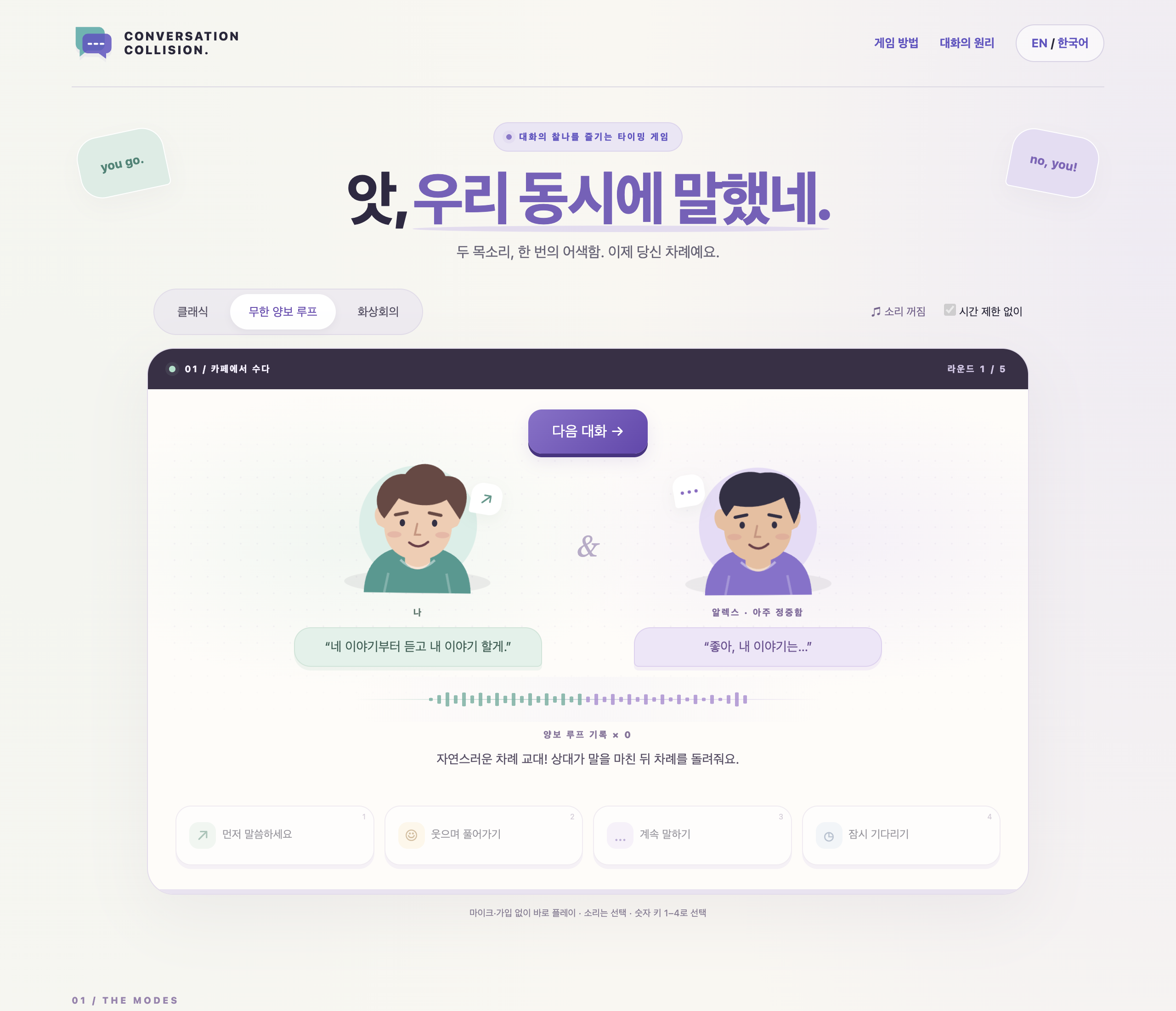
In Video call, the page displayed a simulated 650 ms delay before the first choice. Pressing 4 selected a short wait and returned harmony 83 with an explanation about leaving room for the other voice. The conversation timing game was not connected to another caller. This number is a scenario setting, not a ping test, latency measurement or diagnosis of meeting software.
A practical reflection exercise after a meeting
Imagine leaving a team call where two people repeatedly said “sorry, you go.” That is a suggested use case, not a real meeting we observed. Open a relaxed Classic session and note which action feels natural before checking the feedback. Afterwards, write one concrete sentence you might use to make a handoff clearer, such as naming whose point comes first and when you will return.
Keep the exercise voluntary. In a group, discuss the designed scene rather than asking people to reveal an uncomfortable personal event. “What might this character need?” is a more useful prompt than “who here is bad at listening?” The game can supply an icebreaker, but we found no evidence that its score validates a training program or predicts workplace behavior.
For a second run, choose one question rather than a vague goal of being better at conversation. For example: what does the explanation say when I briefly finish a point with the shy partner? Record the exact scene and setting. This turns a playful replay into a comparison you can understand, while keeping real-world claims proportionate to the evidence.
A short debrief can be enough: identify the cue you noticed, the action you chose and the explanation you received. If you want to discuss a real meeting afterwards, keep that separate from the fictional score. No game label should be presented as permission to interrupt a person or as an obligation to remain silent when they need to speak.
7 useful checks for a better replay
- Keep the reading setting fixed. Compare relaxed runs with relaxed runs; do not attribute a timer-setting difference to social strategy.
- Compare the same scene. Partner descriptions and context matter in the game. Changing both scene and action creates an ambiguous comparison.
- Use feedback as the unit of learning. Note the explanation, not only the harmony number.
- Try all four actions across play. Our complete route exercised each choice, but not every possible action in every scene.
- Separate the modes’ goals. A long mutual-yield loop is a different game objective from a smooth Classic handoff.
- Keep the final breakdown. Flow, Respect and Timing describe the run more clearly than a result nickname alone.
- Stop when the useful question is answered. Repeatedly chasing a high number adds little if you no longer read the reactions.
Limitations, privacy and accessibility
This is a small browser game with a finite set of designed reactions. It cannot listen to your tone, infer another person’s intentions, account for all cultures or relationships, or judge whether an interruption is necessary. It is not therapy, a diagnostic instrument, an employment screening tool or a substitute for feedback from an actual conversation partner.
The source links to the research paper Universals and cultural variation in turn-taking in conversation. That study provides background on conversational timing across languages. It does not validate this game’s personality labels, component weights or effectiveness as a training intervention. Research inspiration and product validation are different kinds of evidence.
The source says a best-score number may be stored locally on the device and provides a clear-scores control. We did not verify persistence across browsers or exercise deletion. Do not assume that clearing a saved game score removes Blogger or advertising cookies. We observed third-party advertising, including an interstitial that interrupted testing. No independent network audit was performed.
Result-sharing and card-saving controls are visible. We did not send a share. An attempted card save was interrupted by advertising and did not produce a confirmed download during our check, so we do not mark exporting as verified. If you need to keep a result, first confirm that your own browser actually saved the expected file; do not treat a click as proof of success.
For accessibility, the core flow has text feedback and numbered choices, and the source documents reduced-motion support. We verified playing without sound and the numeric 4 action, not screen-reader compatibility, every focus path or every reduced-motion animation. On a small screen, use a comfortable reading setting and inspect the action labels rather than tapping by location alone.
Related tools and alternatives
For another timing-based game with a different task, see our Group Photo Chaos guide. It asks you to catch a group’s shared ready moment; Conversation Collision asks you to choose a response to overlapping turns. Both can support a discussion of timing and readable cues, but a photo-game result is not a communication score.
An ordinary role-play with a willing partner offers something this solo game cannot: actual, negotiated feedback about a real exchange. A written meeting handoff rule can also be more useful than a game when the immediate problem is unclear speaking order. The conversation timing game is the lighter option when you want a quick, private fictional scenario before discussing the idea with anyone else.
Read How It Works and our Editorial Standards for how this library records observations and separates them from hypothetical examples. Links here point to published material rather than empty or future tool pages.
Conversation timing game FAQ and final checklist
Is this a conversation timing game or a personality test? It is a game. Conversation DNA describes choices in that playthrough, not a validated psychological trait.
Do I need to speak aloud? No microphone or voice input was requested in our tests. You choose actions with controls or supported number keys. Sound is optional for the central workflow.
Does the conversation timing game measure my internet delay? No. Video call displays simulated delay inside a fictional scene. It is not testing your actual connection.
Is yielding always the best move? Do not assume so. Context changes, and the loop mode has a different objective. Our zero-loop yield is a useful reminder that one button does not guarantee a particular outcome.
What should I do if I feel rushed? Enable Relaxed timing before starting. Our complete matched sessions used it, so their outputs should not be presented as normal timed-reaction results.
What is the simplest first task? Play one relaxed Classic session, read every explanation and distinguish the final result from the last-round score. Replay one scene with a deliberate question if you want to explore further.
Open the conversation timing game and try a relaxed session ↗
A RELEVANT NEXT STEP
Tools with a useful connection
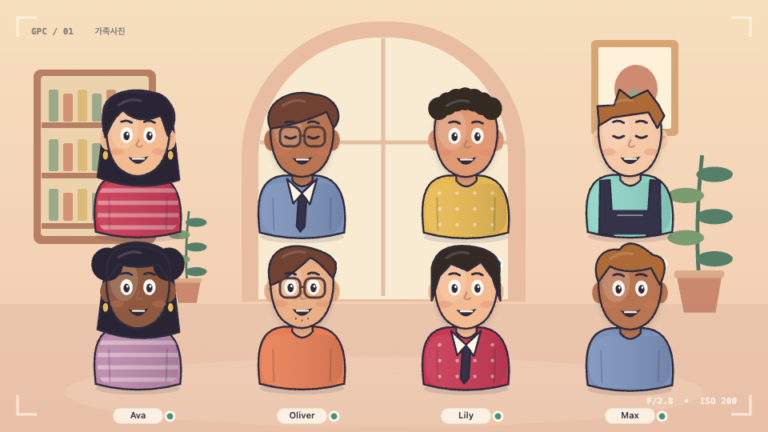
Group Photo Chaos
Group Photo Game: 5 Fun Ways to Master the Timing
Catch the shared ready moment in an animated group portrait. A tested guide to timing, shutter delay, replay and reading the score.
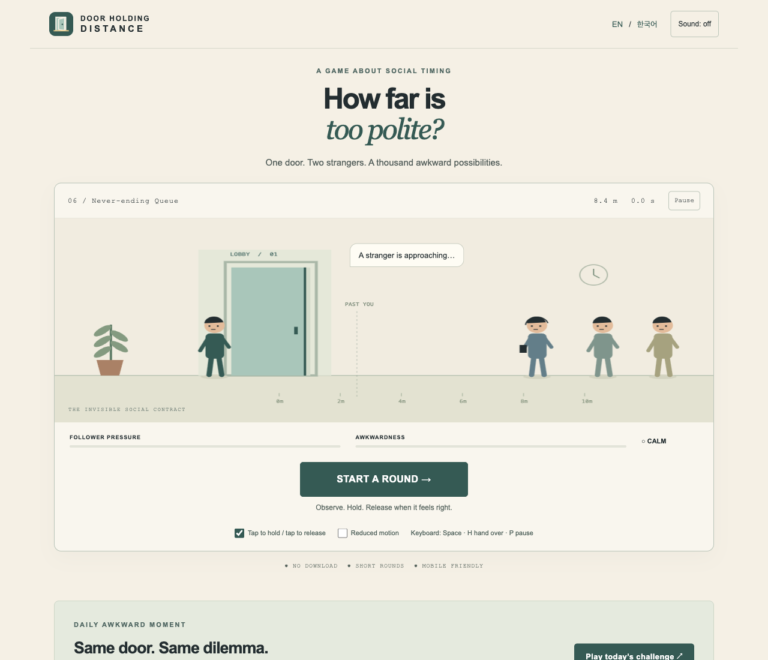
Door Holding Distance
Door Holding Game: 8 Fun Scenarios, Better Timing
Play with everyday courtesy in Door Holding Distance: eight scenarios, tap-to-hold controls and playful feedback. Read our real handover test, controls and limits.
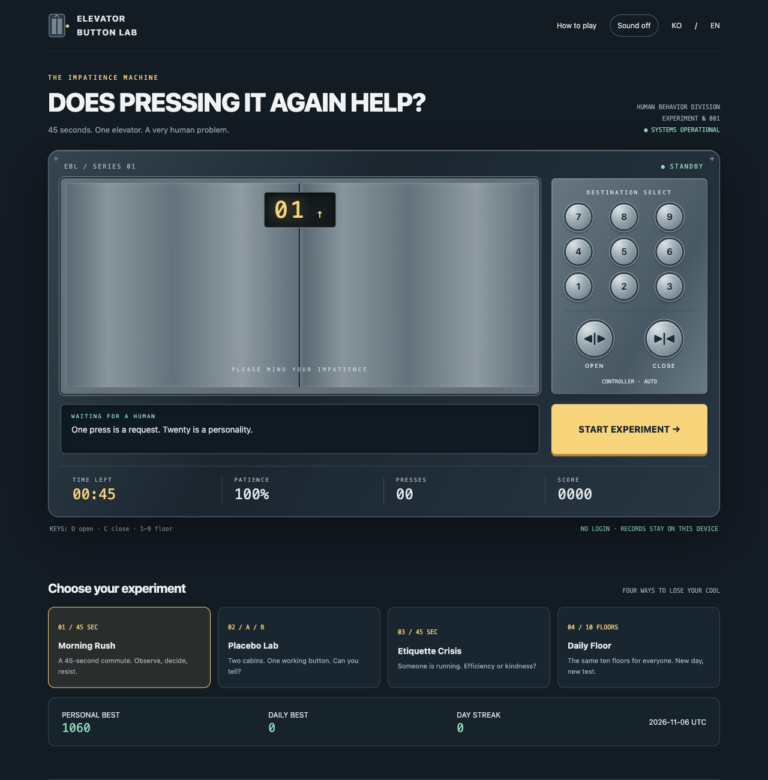
Elevator Button Lab
Elevator Button Game: 4 Fun Modes & Essential Tips
Explore Elevator Button Lab through four modes, actual repeat-input and boarding tests, a fictional A/B comparison and real PNG output. Learn what the feedback means and where it stops.