WHO KNEW? is a manual character knowledge map for mystery writers and story editors. Record who knows a fact, when their belief changes and what source supports it. Compare a detective with the reader, then inspect the gaps before revising a reveal.
Verified 13 November 2026 in Chrome, including Korean controls at 390px. We built an original case, Editorial Test: The Archive Key, with three observers, one objective clue and six events. Chapter states, reader concealment, second-order beliefs, event editing, Undo, audit flags and local recovery were tested. No published novel or manuscript was analyzed automatically. This library and the original tool share a creator.
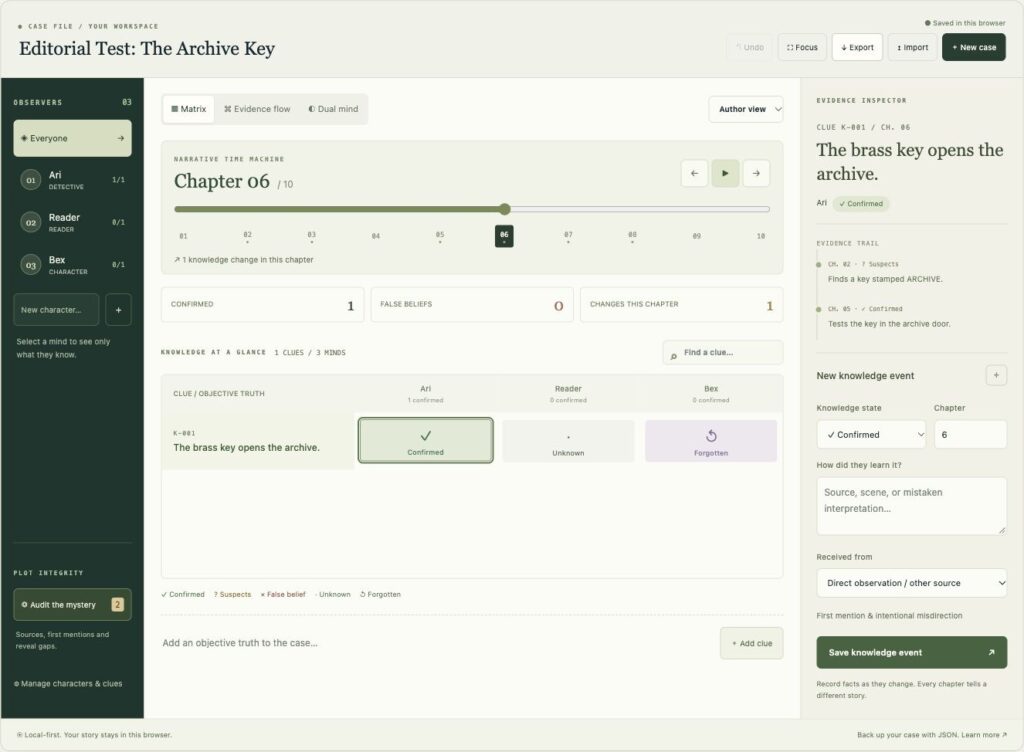
Track character knowledge by chapter in WHO KNEW? Actual states, reader-lens, wrong-assumption and revision tests explain what the matrix and audit can—and cannot—establish.
- Brand
- WHO KNEW?
- Tool languages
- en,ko
- Verified date
- 2026-11-13
In this guide
Key takeaways for character knowledge
Use a character knowledge matrix when a scene depends on an information difference: the detective knows what opens a door, the witness has the wrong explanation and the reader has not seen a usable clue. A relationship chart can show who trusts whom without explaining any of those differences. Here the unit is a recorded fact and each observer’s changing state.
The most useful distinction is between objective truth, a person’s current knowledge and that person’s belief about someone else’s knowledge. At chapter 7 in our case, Ari was Confirmed and Reader was Suspects. We recorded Ari as assuming Reader was already Confirmed; the tool labeled that assumption wrong. At chapter 8, the same recorded assumption matched the reader’s new state.
The audit checks your entered records, not your prose. We deliberately recorded a first mention in chapter 1 before acquisition in chapter 2, and delayed the reader’s usable clue beyond the detective’s discovery. Two flags appeared. They are reasons to inspect the manuscript, not proof that the novel is unfair or that an unflagged novel is consistent.
What WHO KNEW? actually tracks
The official name is WHO KNEW?, subtitled The Epistemic Atlas. The studio includes a clue-by-observer matrix, evidence-flow view, Dual mind comparison, chapter controls, event inspector, case inventory and mystery audit. The supplied library contains the broken-clock, false-witness and sealed-letter cases.
Five knowledge states are available: Confirmed, Suspects, False belief, Unknown and Forgotten. Each event has an acquisition chapter, source note and an optional recorded sender. Additional fields cover first mention and intentional misdirection. A manager lets you rename characters and clues and assign Character, Detective or Culprit roles; Reader is a special observer in the blank case.
Confirmed means the state you assigned in this model. It is not an AI finding, an evidence-quality score or a statement that the tool verified your story’s facts. The objective truth also comes from you. If that truth changes during revision, inspect all notes and state assignments that depend on it.
Prepare truths, observers and chapter conventions
Begin with one precise proposition. Our objective clue was “The brass key opens the archive.” The incorrect interpretation was stored in Bex’s source note, not substituted for the objective clue. This lets a single row show both the true proposition and a character’s mistaken relationship to it.
Choose a chapter convention before entering events. A chapter can mean a numbered episode if that is your consistent reading unit. Decide whether a state applies at the end of that chapter and record the relevant scene in the source note. The test used the tool’s ten-chapter blank-case workspace; we did not establish the maximum practical project size.
Name observers consistently and give Reader an explicit event when the audience receives a usable clue. Do not assume that the protagonist discovering something automatically updates reader knowledge. A viewpoint can withhold a discovery, while a separate scene can let the reader get ahead of the cast.
Use short original scene descriptions for a first experiment. There is no need to upload a manuscript to learn the workflow. Keep a separate draft identifier and scene reference in your revision notes so the character knowledge record can be checked against the actual text later.
7 essential checks for your first knowledge case
1. Create a disposable case and define the cast
New case shows a replacement confirmation. Back up work you need before accepting it. Our blank case contained Detective, Reader and one placeholder truth. In Manage characters & clues we renamed Detective to Ari, retained the Detective role, renamed the clue and added Bex. We titled the case Editorial Test: The Archive Key.
2. Record the first suspicion with a source
Click Ari’s cell for the archive-key clue, choose Suspects, enter chapter 2 and write “Finds a key stamped ARCHIVE.” Save the knowledge event. We also deliberately entered first mention 1 to create a known audit issue. A new event with an empty source was blocked by the required source field in our test.
3. Add changes as separate events
Use the plus control for a new event rather than overwriting an existing one. Ari became Confirmed in chapter 5 after testing the door. Bex became False belief in chapter 3 and Forgotten in chapter 6. Reader became Suspects in chapter 7 and Confirmed in chapter 8. Each event received a short source explanation.
4. Replay a few known chapter states
Move to chapters 3, 6 and 8 and read the matrix. At 3, Ari suspected, Reader was unknown and Bex held a false belief. At 6, Ari was confirmed, Reader remained unknown and Bex had forgotten. At 8, Ari and Reader were confirmed while Bex remained forgotten. Check a known example before expanding the case.
5. Compare two minds and their assumptions
Choose Dual mind with Ari as Observer A and Reader as Observer B. At chapter 7, one of one clues differed. We saved Ari’s assumption that Reader was Confirmed, while Reader was actually Suspects. The second-order panel reported a wrong belief. This is a manually recorded assumption, not an inference from dialogue.
6. Inspect the audit and the relevant scene
Our first-mention mismatch and delayed reader clue produced two audit flags. Follow the evidence and read the source notes before changing a record. In Korean mobile editing, marking the chapter-2 event intentional reduced the count to one; Undo restored two. An intention flag records an editorial decision, rather than repairing the underlying chronology.
7. Prove recovery and inspect a real backup
Wait for the saved-in-this-browser status and reload a small test case. Our case and events appeared again in English and Korean. The view returned to Matrix/Author at chapter 6 and Undo history was unavailable after reload. JSON export was attempted, but no completed download artifact became available through the browser connection within eight seconds.
Our actual six-event case
The following state table comes from the same original archive-key case. Its six events were Ari at chapters 2 and 5, Bex at 3 and 6, and Reader at 7 and 8. The rows report current state at each selected chapter, not the number of facts ever learned.
| Chapter | Ari / Detective | Reader | Bex |
|---|---|---|---|
| 3 | Suspects | Unknown | False belief |
| 6 | Confirmed | Unknown | Forgotten |
| 7 | Confirmed | Suspects | Forgotten |
| 8 | Confirmed | Confirmed | Forgotten |
The source notes described a stamped key, a mistaken cellar interpretation, a door test, forgetting a discussion, seeing the key in a pocket and finally seeing the archive door open. They are fictional editorial fixtures. No real witness, reader study or published story was involved.
Changing Ari’s existing Confirmed event from chapter 5 to chapter 4 made the chapter-4 cell Confirmed. Undo restored Suspects at chapter 4 and returned the later event to chapter 5. This checked the actual editing path, rather than creating a second confirmation and assuming that it moved the first one.
Unknown, mistaken and forgotten are different states
Unknown means no applicable knowledge is recorded at that point. Forgotten is a later state you explicitly enter. In our case, Bex’s chapter-3 false belief did not disappear from history when chapter 6 became Forgotten. A current false-belief count of zero therefore did not mean Bex had never been mistaken.
Use False belief to describe the observer’s interpretation in the source note. The row itself still contains the objective proposition. Without that note, the mark can be ambiguous: does the person deny the true fact, believe a different explanation, or accept a false source? The tool cannot fill in that reasoning from a symbol alone.
A change from Suspects to Confirmed should correspond to a reason you can point to in the scene. State labels are a useful shorthand for revision, but adding a label is not the same as writing the discovery into the manuscript. A separate source note helps you distinguish an intended event from one the draft actually communicates.
Compare knowledge with beliefs about another mind
Dual mind compares actual recorded states. Its second-order section records what Observer A thinks about Observer B. These are separate claims: Ari knows the archive fact, Reader only suspects it, and Ari incorrectly thinks Reader knows. Keeping them separate supports dramatic irony and misunderstandings without rewriting the objective clue.
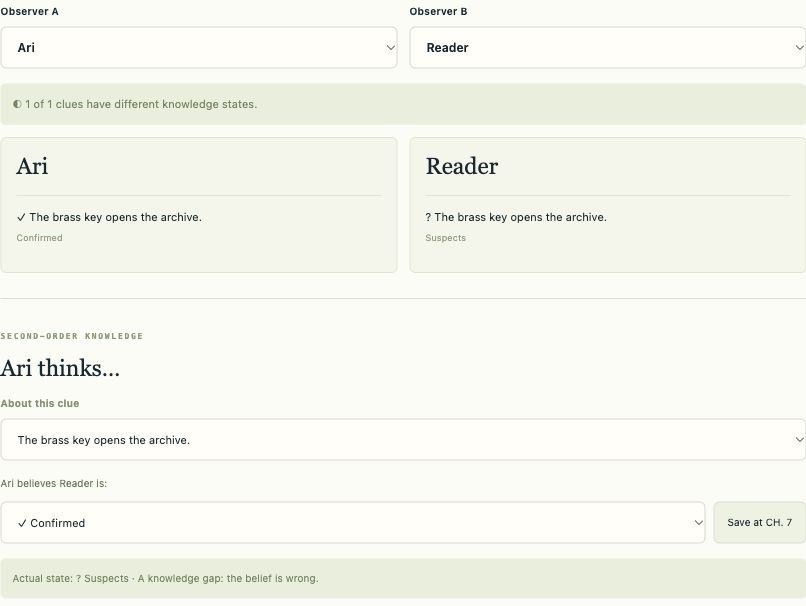
At chapter 8, the comparison reported zero differing clues, and the saved assumption matched Reader’s Confirmed state. This does not prove that the characters communicated successfully. It says the two manually entered records align at that selected point. Inspect the dialogue or scene if the distinction matters to a reveal.
A useful working question is “What does this character think the other person has already seen?” Add the source in your manuscript notes even though this assumption control does not replace an ordinary event source. Keep actual knowledge, inferred knowledge and the author’s plan visibly distinct.
Reader lens and the limits of concealment
Reader lens narrowed our matrix to Reader. At chapter 6, the clue label became Unrevealed clue and the state was Unknown. At chapter 7, once Reader had a Suspects event, the full objective clue text appeared. It did not wait for the chapter-8 Confirmed event.
That behavior makes the wording of a clue important. If the objective label itself states a final twist, revealing it at the first suspicion may disclose more than your intended audience should see. Inspect the exact display before presenting it to a writing group. Do not assume that Confirmed is the only state that can reveal a label.
The lens is a presentation tool, not access control. The author view remains available, and the source describes JSON as the complete editable case. In Author view we could inspect a chapter-5 event while the matrix was at chapter 4. Keep full author data separate from any limited screen you plan to share.
Read audit flags as questions about your records
The audit flagged our recorded first mention at chapter 1 before acquisition at chapter 2 as Impossible knowledge. It also flagged the archive clue because Reader had no usable clue at the detective’s chapter-5 discovery. Those flags were expected from deliberately constructed test records.
The FAQ also describes checks for missing sources and transfers without a recorded sender event. We verified the source field’s required-input behavior, but did not construct and validate every audit category or an imported malformed case. A sender link is a record to inspect; it does not authenticate the sender’s statement.
Marking the chapter-2 event intentional in the Korean interface reduced our audit count from two to one. Undo restored the original two flags. A smaller flag count can reflect an intention marker, not a more consistent story. Retain the editorial explanation and review it again if later revisions remove the intended misdirection.
Move a discovery without adding a duplicate event
Select the existing history entry to enter editing mode. The save button changes to Update knowledge event. Changing the chapter there moves that record; using the plus control instead creates a new event. Check the timeline and history afterward to confirm that the original discovery is not still present in two places.
Our 5-to-4 move changed the earlier matrix as expected, and Undo reversed it. A chapter move can affect the reader gap, first mention and what another character reasonably believes. Recheck those connected records rather than reviewing only the edited cell.
Evidence flow offers another way to inspect chronology. At chapter 4 it showed the recorded evidence-to-Ari suspicion and evidence-to-Bex false belief, with the false-belief connection dashed. The ledger described those sources. We did not verify a complex network of person-to-person transfers in this review.
A practical mystery revision worksheet
| Revision question | Record to inspect | Decision for the manuscript |
|---|---|---|
| Does someone speak too early? | First mention, acquisition and source scene | Move the line, move the discovery or explain the intended deception. |
| Is the reader behind the detective? | Reader events at the detective’s discovery chapter | Add a usable clue or retain a deliberate withholding with a clear purpose. |
| Does a misunderstanding work? | Actual pair states and the saved assumption about the other mind | Prepare the information gap in the prose instead of relying on the diagram. |
Use this worksheet alongside a draft identifier and scene reference. A character knowledge map can reveal that two records disagree, but only the manuscript tells you whether the disagreement is an error, an unreliable statement or the intended engine of suspense.
For a group review, let readers describe what they knew before showing the full author matrix. Otherwise the objective clue label may teach them the answer and contaminate the discussion. The tool does not measure actual reader comprehension; its Reader column is still an author-entered model.
Local recovery and export limits
The FAQ states that case data stays in this browser’s local storage and is shared by the English and Korean pages on the domain. We confirmed the original case, events and saved second-order assumption after reload and language change. This is local continuity, not a cloud account or cross-device synchronization.
The documented outputs are complete editable JSON, event CSV, a current-matrix PNG and a report through the browser print dialog. We attempted JSON with an eight-second wait for a completed download artifact; no file became available. JSON contents, import round trip, CSV, PNG and PDF/print output remain unverified.
Before replacing a case with a sample or clearing browser data, inspect a real downloaded backup and rehearse opening a disposable copy. Our reload also reset the visible working view and removed Undo history. A remembered screen position and a recoverable case are different things.
The source says the tool does not upload the case, while Blogger and Google advertising services may process visit and advertising data. We did not audit network traffic or storage implementation. Do not describe the entire page as having no external connections. The workbench requires no manuscript upload for the workflow we tested.
English, Korean and mobile inspection
The Korean interface retained our English case title and user-entered names, while translating controls and state labels. At a fresh 390 × 844 viewport the document width was 390px. A matrix cell opened an inspection sheet with existing history, source fields and a close button.
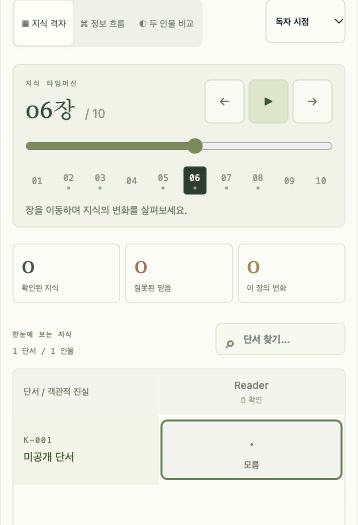
We edited the existing chapter-2 intention marker through that sheet and verified the changed audit count, then used Undo. On a crowded screen, confirm that Save or Update has actually completed: the saved status and changed record are better evidence than a button click alone. Advertising overlays appeared during the session.
This was a responsive Chrome check, not a physical-device or cross-browser certification. Language switching does not translate your own clue text or source notes. Use localized records intentionally if you plan a separate-language audience view.
Choose a knowledge map, relationship chart or ledger
Use this tool when evidence and belief changes are the problem. Use a relationship map when the question concerns an alliance, conflict or changing connection. Use a spreadsheet if you need extensive custom fields, revision history or a long source bibliography. A paper ledger can be enough for a short case.
WHO KNEW? adds rapid chapter replay, explicit state categories and second-order comparisons in one workspace. Its cost is manual maintenance: unrecorded facts and scenes are outside the model. Start with the smallest set of clues that helps answer an actual revision question.
Related tools for relationships and pacing
UNTIL HERE’s relationship map follows chapter-revealed evidence behind character connections. Use it beside this knowledge matrix when a changed alliance depends on who learned a secret. Keep the same chapter convention; no automatic project exchange was tested.
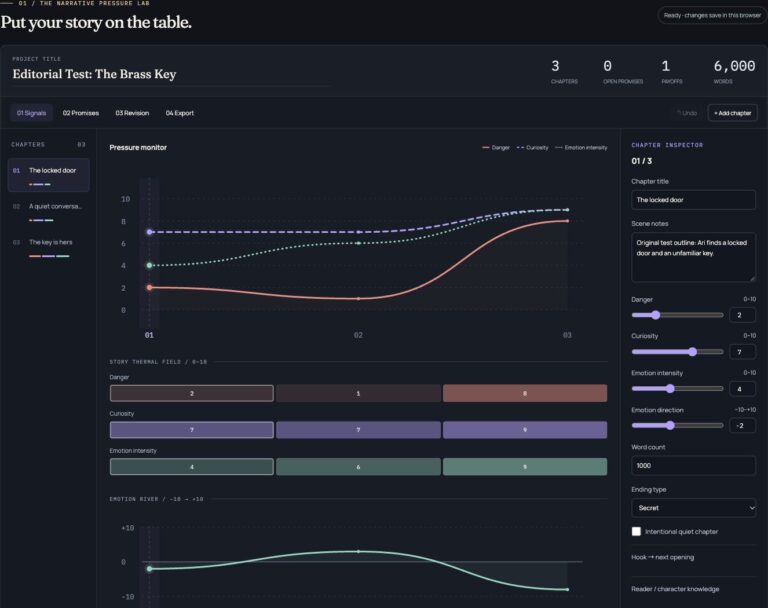
CLIFFHANGER HEATMAP follows chapter pressure and question-to-payoff threads. After checking who knows the answer here, inspect whether the reveal arrives with the pacing you intended there. Those manually assigned signals do not become objective measures of literary quality.
Frequently asked questions
Does WHO KNEW? read a manuscript and discover plot holes?
No. You enter truths, states, chapters and sources. The audit applies rules to those records. It cannot verify unrecorded prose or certify a novel’s fairness, consistency or quality.
Is Reader lens a safe way to send a full author project?
Treat it as a display aid. At chapter 7 our full clue label appeared while Reader only suspected it. JSON is documented as the full editable case, and Author view remains accessible. Inspect and prepare the actual material you share.
Why is Forgotten different from Unknown?
Forgotten records a later loss of knowledge that you explicitly enter. Unknown can describe the absence of an applicable event. Our Bex history retained the earlier false belief even when the current cell showed Forgotten.
Does a wrong assumption mean the objective truth is wrong?
No. In our test Ari’s assumption concerned Reader’s state. The archive-key proposition stayed the same. Separate the objective clue from actual and assumed knowledge before deciding what to revise.
Start with one truth and three observers
Start with one truth, a detective, a witness and Reader. Record a suspicion, a confirmation and a deliberately different audience reveal. If the character knowledge map helps you explain one scene’s information gap more clearly, extend it to the next clue.
A RELEVANT NEXT STEP
Tools with a useful connection
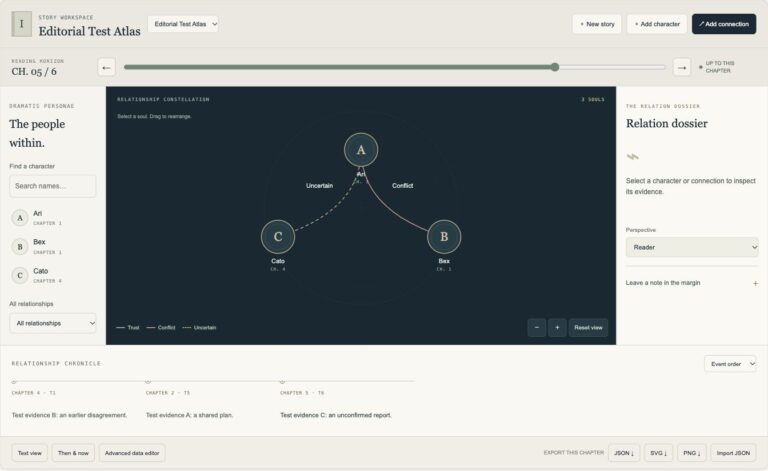
UNTIL HERE — The Unfinished Atlas
Relationship Map: 7 Essential Checks for Better Reading
Build a chapter-aware character relationship map in UNTIL HERE. Actual tests separate reveal order from event time, compare changing connections and explain reader exports versus full author backups.
CLIFFHANGER HEATMAP
Pacing Map: 7 Essential Checks for Better Chapters
Make chapter pacing visible in Cliffhanger Heatmap. Actual three-chapter tests explain separate tension signals, setup/payoff links, reordered scenes, baselines and browser-local recovery.
Focus Garden
Pomodoro Timer: 7 Essential Checks for Better Focus
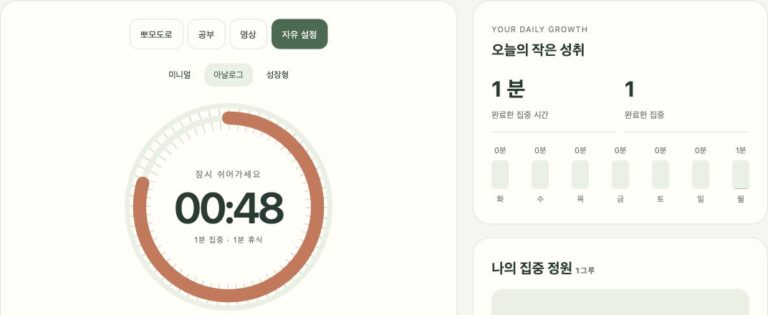
Use Focus Garden’s Korean controls with an English guide. Our real one-minute focus and break tests explain manual transitions, completion records, reload, pause, sharing and alarm limits.