CLIFFHANGER HEATMAP is a manual chapter pacing workbench. Record danger, curiosity and emotion, connect a question to its clues and payoff, then compare the effect of moving chapters. It helps you make revision decisions from your own observations.
Checked 13 November 2026 in Chrome. We used the supplied sample and an original three-chapter outline, Editorial Test: The Brass Key. Reordering, Undo, baseline behavior, local recovery and Korean editing at 390px were tested. No manuscript was analyzed by AI and no reader response was measured. This library and the original tool share a creator.
Make chapter pacing visible in Cliffhanger Heatmap. Actual three-chapter tests explain separate tension signals, setup/payoff links, reordered scenes, baselines and browser-local recovery.
- Brand
- CLIFFHANGER HEATMAP
- Tool languages
- en,ko
- Verified date
- 2026-11-13
In this guide
Key takeaways for chapter pacing
A pacing graph is useful when “the middle feels slow” is too vague to guide an edit. Separate the kind of pressure from its strength: a conversation can have little physical danger but leave an important question unresolved. The instrument visualizes observations that you enter; it does not discover the right values for you.
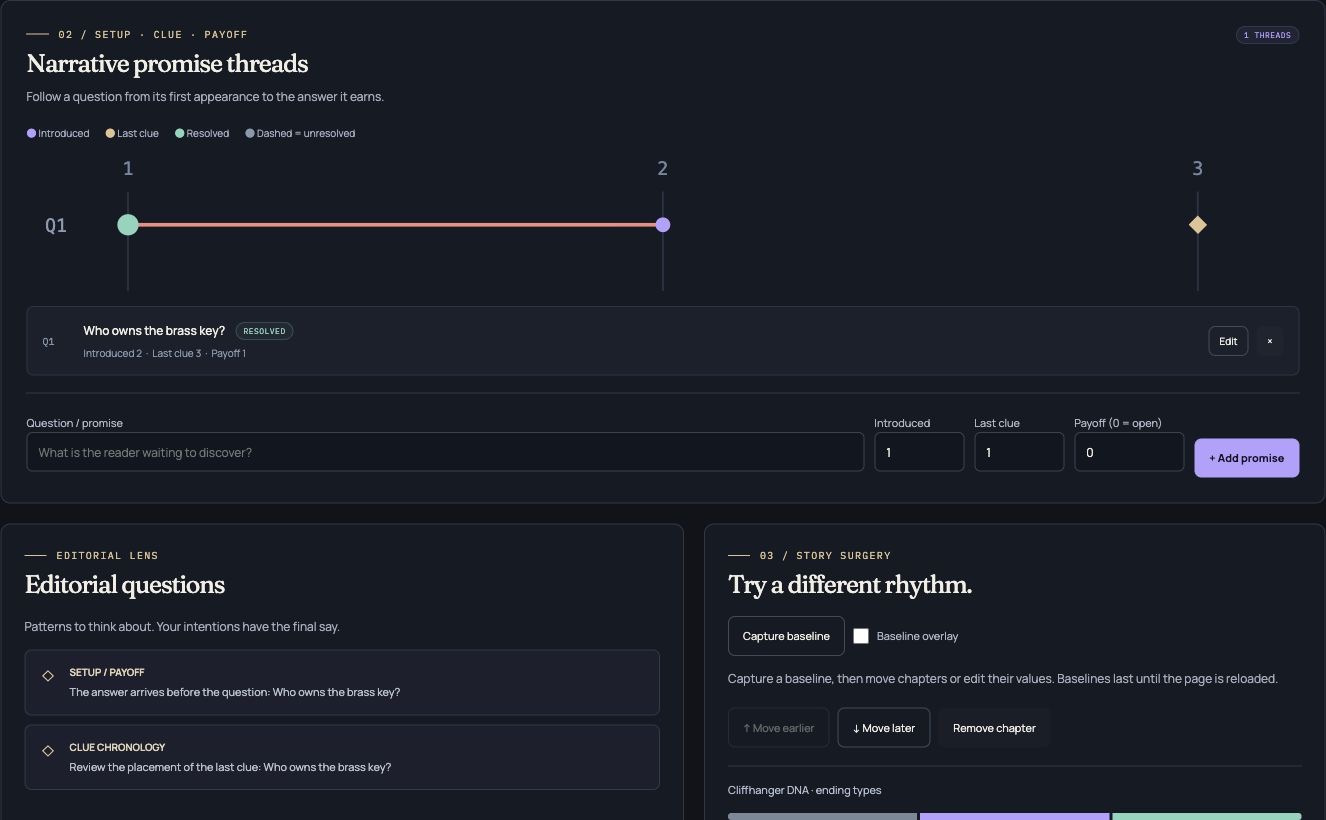
Promise tracking adds a concrete continuity check. In our test, a question began in chapter 1, returned as a clue in chapter 2 and resolved in chapter 3. Moving the answer chapter to first position preserved those chapter links and produced setup/payoff and clue-chronology warnings. The warning came from entered structure, not from reading the prose.
Project data survived reload and appeared on the Korean page. A captured comparison baseline did not survive reload, matching the visible guidance. JSON, PNG and SVG export controls exist, but our JSON attempt yielded no completed download artifact after eight seconds. We did not verify exported files or round-trip import.
What CLIFFHANGER HEATMAP does
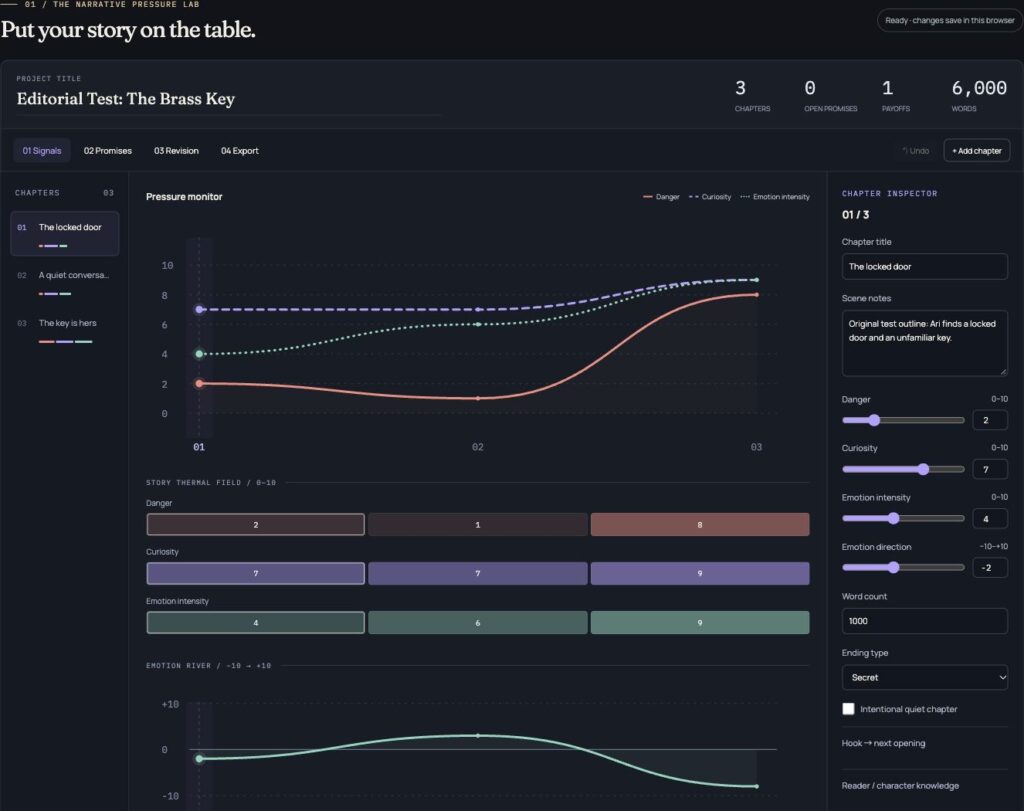
The official name is CLIFFHANGER HEATMAP, with the subtitle The Ink & Pulse Observatory. Its workspace combines a chapter list, three pressure curves, a thermal grid, an emotion-direction river, a chapter inspector, promise timelines, editorial prompts and revision controls. English and Korean interfaces are available without signing in.
Danger, Curiosity and Emotion intensity use a zero-to-ten scale. Emotion direction runs from minus ten to plus ten. The inspector also accepts word count, ending type, scene notes, an intentional quiet-chapter flag, the question at the ending, the response in the opening, and separate reader/character knowledge notes. These are manual editorial records.
Six ending types are offered: Danger, Secret, Twist, Emotion, Choice and Resolution. The ending-type strip counts your selections; it is not a recommended genre formula. A mystery and a reflective family story can have very different pacing patterns without either being defective. Keep the intended reader experience beside the numbers.
Prepare a consistent observation rubric
Choose what one unit means: a chapter, episode or another consistently defined reading segment. Do not alternate between whole chapters and individual scenes without noting the difference. The tool labels units as chapters; a consistent interpretation makes its pacing curves easier to discuss with an editor.
Write a short scoring rubric before entering a long book. For example, danger could mean immediate threat, curiosity could mean the urgency of an unanswered question, and emotional intensity could mean the strength of feeling rather than whether that feeling is pleasant. These are suggested definitions for your worksheet, not standards supplied or validated by the tool.
Use short original notes for a first test. There is no need to paste an unpublished manuscript. Prepare a chapter title, a brief expectation change and the relevant question. Decide how to count words outside the application; this is a numeric input, not an automatic count of prose in the notes.
A baseline should represent a specific draft and a consistent observation method. If you score a first draft by the protagonist’s feelings and a second by the reader’s feelings, an apparent pacing improvement may simply reflect a changed rubric. Name the draft and retain the reason for each meaningful score change.
7 essential checks for your first pacing map
1. Learn the sample before replacing your project
Explore the sample to see how eight chapters and three promise threads fit together. Start a blank story opens a replacement confirmation; continue only after backing up work you need. Our blank story began with one chapter and default values. We renamed it Editorial Test: The Brass Key.
2. Enter one chapter and check the visible result
Name the first chapter The locked door. Our test used Danger 2, Curiosity 7, Emotion intensity 4, Emotion direction −2 and 1,000 words, with ending type Secret. We added a short note about Ari finding an unfamiliar key. Check the numeric controls, curve labels and data table after entering values.
3. Add a deliberately different middle chapter
Use + Add chapter. Our second chapter, A quiet conversation, had values 1, 7, 6 and +3, with 3,000 words and ending type Emotion. We marked it Intentional quiet chapter. Its low danger and maintained curiosity make it a useful example of why one combined tension number can conceal a purposeful scene.
4. Add an answer and connect the promise
Our third chapter, The key is hers, used values 8, 9, 9 and −8, 2,000 words and Resolution. Under Narrative promise threads we entered “Who owns the brass key?”, Introduced 1, Last clue 2 and Payoff 3. A payoff value of zero represents an open promise. The new card showed a resolved thread.
5. Capture the pacing baseline before changing order
Press Capture baseline and enable Baseline overlay. The interface identifies gray dashed curves as the original chapter order and values. A baseline is a temporary comparison aid, not a second permanently saved draft. Capture it before the revision you want to inspect, and document which draft it represents.
6. Reorder, read the warning and reverse the experiment
Select the third chapter and press Move earlier twice. Our promise card changed to Introduced 2, Last clue 3, Payoff 1. The tool flagged an answer before its question and asked us to review clue placement. We moved the answer back with Move later twice, restoring the original relationship.
7. Verify recovery and your actual backup file
Wait for the saved-in-this-browser status, then reload a small test project. Our chapter values, notes and promise returned; the baseline disappeared. Try an export and independently inspect the file before treating it as a backup. The presence of an export control alone does not establish successful recovery.
Our actual three-chapter test
This original outline is a functional test, not a claim that the story is effective. We chose contrasting values to make the pacing controls easy to inspect. The word counts were confirmed in the accessible data table and added to a displayed total of 6,000.
| Chapter | Entered observations | Editorial purpose |
|---|---|---|
| The locked door | Danger 2; Curiosity 7; Intensity 4; Direction −2; 1,000 words; Secret | Introduce the key question. |
| A quiet conversation | Danger 1; Curiosity 7; Intensity 6; Direction +3; 3,000 words; Emotion; quiet flag on | Maintain interest while immediate danger falls. |
| The key is hers | Danger 8; Curiosity 9; Intensity 9; Direction −8; 2,000 words; Resolution | Resolve the question with a strong negative emotional turn. |
Changing the third chapter’s danger from 8 to 10 updated its displayed heatmap value. Undo returned the number to 8. We also entered separate reader and character knowledge notes and later edited the middle chapter’s note in Korean. The localized page retained the same project, chapter titles and 6,000-word total.
When the third chapter became the first, the promise remained marked Resolved while chronology warnings appeared. This distinction is useful: having a payoff recorded and having it placed after its setup are separate conditions. A resolved badge is not a complete pacing or continuity approval.
Separate danger, curiosity and emotion
The quiet middle chapter had danger 1 and curiosity 7. That shape is intentional in our outline: the character can be physically safe while the reader is waiting for an answer. Raising the danger value merely to make the curve look busy would erase that distinction rather than improve the pacing.
Emotion intensity and emotion direction answer different questions. Our final chapter had intensity 9 and direction −8: strong feeling with negative direction. A low intensity is not automatically a negative mood, and a negative direction is not a low-quality scene. Read the river and pressure curves as different observations.
Ending type is another independent category. Resolution can close one question while a new threat raises danger; a quiet chapter can end with a meaningful choice. The tool lets you record these combinations. Your scene notes should explain why the combination serves the story rather than force every visual signal to move together.
Follow a question from setup to payoff
A useful promise is a question you can recognize when it is answered. “Who owns the brass key?” is easier to track than “make this intriguing.” Record the first introduction, the last relevant clue and the payoff. Zero keeps the question open when its answer lies beyond the current outline.
The sample contains two open promises and one payoff. One of its visible prompts asks whether a long-unrevisited question needs a reminder. That is an editorial question, not an instruction to resolve every mystery immediately. A delayed answer can be purposeful if the reader has enough reason to keep carrying the question.
Chapter links stayed attached to the original chapters in our reorder test. This saves manual renumbering of the promise when moving a chapter, but it does not decide whether the new arrangement makes narrative sense. Inspect the timeline and warning text after any structural pacing change.
Compare pacing revisions without losing context
Use a baseline for one clearly stated experiment: move an answer later, lower immediate danger in a recovery chapter, or change the length of a clue-bearing section. Inspect the overlay and the promise timeline together. A smoother curve can still introduce an answer before the question that makes it meaningful.
The source explicitly says baselines last until page reload. We confirmed that behavior: project content remained, while the overlay checkbox returned off and the session-baseline state was gone. Save a separate record of important comparisons before leaving the page. We did not test whether a baseline is included in an exported file.
Undo restored a tested numeric edit, but it should not replace a backup workflow. After a reload, our Undo button was disabled. Keep a verified project backup before a substantial pacing experiment, particularly before replacing the story with the sample or a blank project.
Chapter spacing and reading length
Reading-time spacing changes chapter placement based on the entered lengths. With 1,000, 3,000 and 2,000 words, toggling it changed the displayed horizontal positions. The values are still your supplied counts; the application did not measure how long a reader took to finish any chapter.
Equal chapter spacing helps compare chapter-to-chapter patterns. Length-aware spacing asks a different pacing question: how much reading lies around a pause, clue or emotional turn? A brief lull and a long quiet section can occupy different amounts of the reader’s time even if their observation scores match.
Use a consistent word-count method and confirm the total. In our browser session, direct keyboard entry committed the intended counts reliably, and the data table confirmed them. If a field looks changed but the total has not followed, leave the field and inspect the saved table before continuing. Do not infer counts from the title or notes.
A practical revision worksheet
| Revision question | Record beside the graph | Decision to make |
|---|---|---|
| Is the middle losing interest? | Which question remains urgent, and when is it recalled? | Strengthen a clue, clarify the question or preserve a deliberate pause. |
| Does the ending hand off well? | The ending question and the next opening’s response | Acknowledge, partly answer or deliberately delay the expectation. |
| Did reordering damage setup? | Promise positions and chronology warnings | Move the setup, revise the reveal or justify a purposeful structure. |
The Hook → next opening section contains an ending-question field and a response-in-this-chapter’s-opening field. Respect the wording: the opening response belongs to the current chapter, while an ending question points forward. Review adjacent chapters together to evaluate the handoff.
Reader and character knowledge notes support a manual dramatic-irony check. In our original outline we noted that the reader could know Ari owned the key before Ari recognized it. The tool stores these notes; it does not compare their meaning or prove that the manuscript communicates the gap.
Local saving, recovery and export limits
The FAQ states that project data is stored in this browser’s local storage, shared by English and Korean pages on the domain, and not uploaded by the writing tool. We confirmed project continuity across reload and language change. This is not an account-based cloud library or cross-device synchronization.
JSON is documented as a project you can reopen; PNG and SVG are documented as labeled visual exports. We clicked JSON and waited eight seconds for a completed download artifact through the browser connection, but none became available. File contents, image output and import round-trip behavior therefore remain unverified in this review.
For important pacing work, inspect an actual downloaded file and test reopening a disposable copy. Browser clearing, a different profile or private mode can remove access to local data, according to the source. Replacing a project and deleting local data are consequential actions; our test did not use Delete local project.
English, Korean and mobile editing
At 390 × 844, the Korean document width was 390px. Chapter buttons, the selected-chapter editing shortcut and the inspector worked. The quiet-chapter flag and 3,000-word count remained on the second chapter, and a new Korean note produced the saved-in-this-browser status.
The graph itself uses a wider internal scrolling area: we observed a 480px chart inside a 333px-wide container with horizontal overflow set to auto. The page did not overflow horizontally. Navigate the chart area when the last chapter is outside the visible portion; the heatmap and data table provide additional ways to check the values.
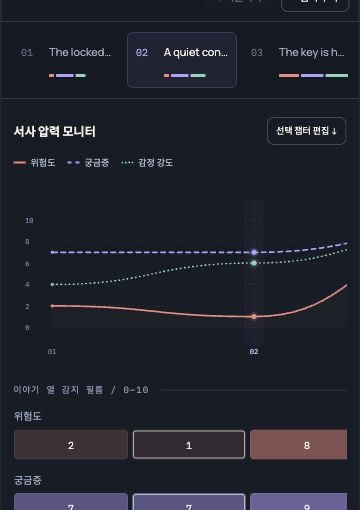
Changing language localizes controls but does not translate your own chapter names or notes. Our English test names remained intact. This was a responsive Chrome check, not a physical-device or cross-browser certification. Advertising overlays appeared and could obscure controls during the session.
When a spreadsheet or index cards work better
Index cards are convenient when the immediate task is moving scene summaries around a table. A spreadsheet is useful for extensive custom formulas, comments and revision history. CLIFFHANGER HEATMAP is useful when you want the pacing curves, question timeline and editable chapter order in one compact workspace.
These methods can work together. Keep manuscript versions in your established writing system, record a small set of observations here, and discuss one changed segment at a time. Avoid transferring a whole project solely to obtain a graph if a short chapter worksheet already answers the editing question.
Privacy and important limitations
The FAQ describes local project processing, but we did not audit network traffic or storage implementation. The Blogger site includes Google services and advertising, and its privacy guidance distinguishes their cookies and technical visit data from the writing workflow. Do not describe the entire page as having no external connections.
No automatic manuscript analysis, reader-response prediction or literary-quality scoring is provided, according to the FAQ. The values are subjective observations. They can make a discussion more precise without becoming objective evidence that one chapter is better than another. No optimal pacing curve or universal genre threshold was verified.
Other practical limits include browser-local project storage, session-only baselines, manual word counts and unverified exported-file recovery. A clean prompt panel means no matching rule was flagged in the entered data; it does not certify the manuscript or detect every forgotten thread.
Related tools for story continuity
Use UNTIL HERE’s relationship map to inspect when a reader learns the evidence behind a character relationship. Bring a consistent chapter convention to both tools. It answers a different continuity question from a pacing score and has no automatic connection to this project.
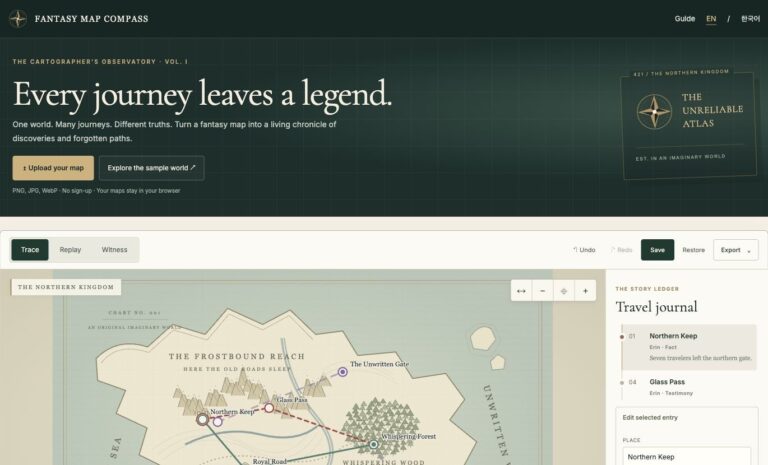
Use FANTASY MAP COMPASS when a chapter move changes a character’s travel schedule. Check geography and assumed travel time there, then return here to inspect the reveal and emotional sequence. Both are manual models; neither imports the other’s project automatically.
Frequently asked questions
Will the tool read my novel and find cliffhangers?
No. You enter the observations and promise links. The tool draws them and asks rule-based questions. It does not read a manuscript or establish a measured reader response.
Should every chapter have high danger?
That is not a rule demonstrated by this tool. Our quiet middle chapter combined danger 1 with curiosity 7 and a deliberate quiet flag. Use the graph to articulate the intended experience, then evaluate it against the actual prose.
Why is a resolved promise still generating a warning?
A recorded payoff can be placed before the setup after reordering. Our card remained resolved at positions 2/3/1, while warnings identified the chronology problem. Check status and placement separately.
Can I return tomorrow to the comparison baseline?
Not through the session baseline we tested. Reload retained the project but removed that baseline. Keep your own comparison record and verify any exported backup before relying on it.
Start with one question and three chapters
Start with three short chapters and one concrete question. Enter contrasting observations, capture a baseline and move the answer once. If the pacing map helps you explain the revision in plain language, expand it to the next section of the story.
A RELEVANT NEXT STEP
Tools with a useful connection
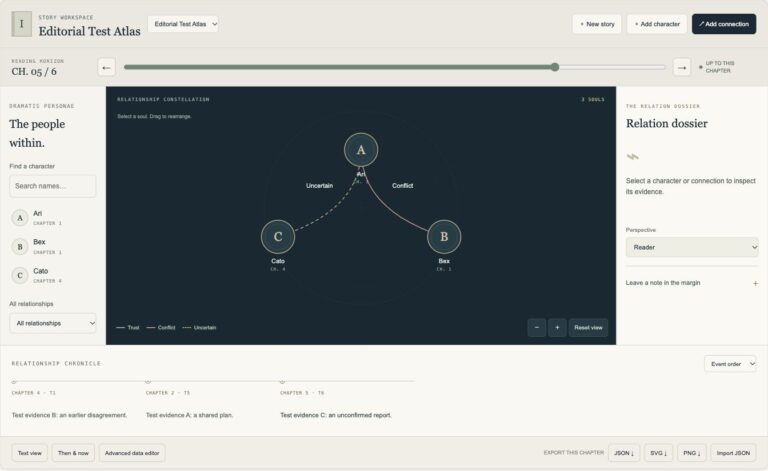
UNTIL HERE — The Unfinished Atlas
Relationship Map: 7 Essential Checks for Better Reading
Build a chapter-aware character relationship map in UNTIL HERE. Actual tests separate reveal order from event time, compare changing connections and explain reader exports versus full author backups.
FANTASY MAP COMPASS
Journey Map: 7 Essential Checks for Better Worldbuilding
Map a fictional journey with dated stops, chapters and witness accounts. Actual distance, speed, filter and recovery tests show where the atlas helps and where manual checks remain essential.
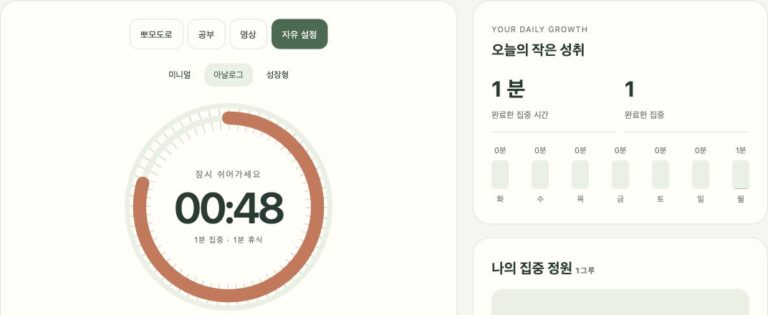
Focus Garden
Pomodoro Timer: 7 Essential Checks for Better Focus
Use Focus Garden’s Korean controls with an English guide. Our real one-minute focus and break tests explain manual transitions, completion records, reload, pause, sharing and alarm limits.