THE MIDNIGHT CATALOGUE is a book sorting game that asks you to place classics on century, genre or theme shelves. Read a clue, choose a shelf and inspect the explanation. Its useful reward is a small archive of discovered books alongside the score.
Verified 13 November 2026 in Chrome, including a five-book daily case in the Korean interface at 390 px. We completed a ten-book Quick Sort round, tested genre and theme choices, copied a result and checked saved reading status. These are one-session observations, not evidence of improved literary knowledge. This library and the original game share a creator.
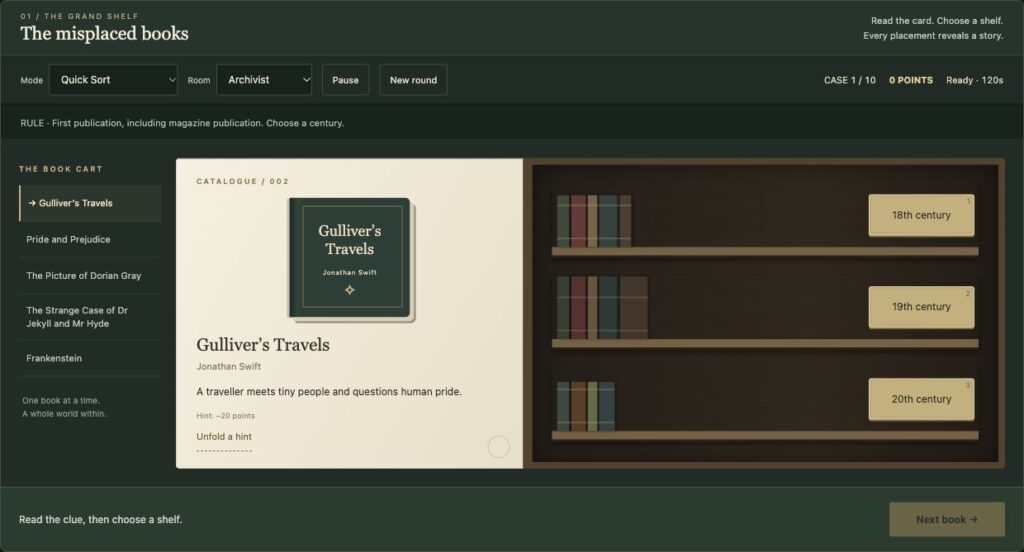
Play a literary sorting puzzle in THE MIDNIGHT CATALOGUE. Actual rounds explain hints, retries, accepted alternatives, daily dates and the difference between scores, discoveries and reading status.
- Brand
- THE MIDNIGHT CATALOGUE
- Tool languages
- en,ko
- Verified date
- 2026-11-13
In this guide
Key takeaways
The sorting rule changes with the mode. Century shelves use first publication, including magazine appearances. Genre and theme shelves use the game’s curated interpretations and can accept more than one answer. Check the rule above the book before treating the title as a date or genre question.
A retry can complete the placement without turning the original attempt into a first-try success. Our ten-book round finished with 940 points and 90% first-attempt accuracy after one hint and one incorrect initial placement. Points and accuracy therefore need separate explanations.
Five different discoveries unlocked the secret thematic wing in our test. A discovery is not a claim that you have read the book. The archive has separate Discovered, Want to read and Read states; our Want to read selection survived reload and the switch to Korean.
The daily case follows a UTC date. The Korean page explicitly identifies the reset as 09:00 in Korea. We completed the dated five-book case for 13 November with 500 points, but did not observe an actual midnight rollover or compare separate users’ devices.
What this book sorting game does
The workspace combines a mode selector, room selector, clue card, shelf buttons, hint, feedback and a next-book control. A desktop book cart previews a few queued titles. The source describes a selection of 18 classics; we did not play every work or audit the complete catalogue.
The sorting interaction turns a familiar book title into a question. When did its first publication belong? Which genre is supported by this clue? Which theme connects a respectable doctor with a hidden double life? Correct and accepted alternative placements reveal a short explanation and a source link.
That makes the game suitable for a brief literary puzzle break or a discussion starter before choosing something to read. It does not establish whether you have understood an entire novel. A score reflects the tested sorting decisions and game rules, not a formal measure of comprehension or reading ability.
Read the rule before sorting a book
In century sorting, use the work’s first-publication context rather than the date printed on your translation or reissue. The game explicitly includes magazine publication. Our Dorian Gray retry revealed a note distinguishing its magazine appearance from the expanded book edition.
The century boundary matters. In our test The Wonderful Wizard of Oz displayed 1900 and was accepted on the nineteenth-century shelf; the feedback explained that the twentieth starts in 1901. The game defines nineteenth-century sorting as 1801–1900. Do not substitute “the 1800s” without checking the boundary.
For genre sorting, begin with the current clue rather than insisting that a work has one universal label. We placed Jane Eyre on Gothic and received Perfect Placement. In the thematic mode, Responsibility was a Valid Alternative for the Jekyll and Hyde card. Both results were accepted and added 100 points in the tested situations.
If the title is unfamiliar, use the hint and read the explanation afterward. The displayed hint cost was 20 points, and our hinted first placement earned 80. Decide whether your session is about learning the classification or maximizing an unassisted score; those are different activities.
Choose a mode for the question you want to explore
| Mode | What the interface offers | What we verified |
|---|---|---|
| Quick Sort | Ten-book round with a 120-second timer | Completed ten books; paused/resumed; result card 940 |
| Century Detective | Date-oriented sorting | Selector present; no separate full-mode run |
| Genre Paradox | Supported genres; potentially several valid shelves | Science fiction and Gothic placements accepted; no timer |
| Ghost Librarian | Thematic clues and a secret wing | Unlocked at five discoveries; accepted Responsibility alternative |
| Endless Archive | Continuing sorting without a round limit, according to the FAQ | Not stress-tested or played as a long session |
| Daily Misfile | Five books for a dated case | Korean mobile case completed at 500; completion persisted |
The room selector offered Apprentice, Archivist and Keeper. Our English tests used Archivist and the Korean session used its localized equivalent. We did not compare the difficulty tiers, so no claim is made about their exact clue or scoring differences.
7 essential checks for your first sorting session
1. Choose a sorting mode and read its rule
Start with Quick Sort if you want the timed ten-book format, or a tested untimed mode when you want to read at leisure. Check the rule text every time you change modes. A century question and a thematic question can show the same novel while requiring different reasoning.
2. Read the selected card, not just the queued titles
The active clue card identifies the current book and author. In the tested desktop view, cart entries were disabled previews rather than buttons for freely selecting another title. On mobile, use the active card and shelf controls instead of looking for the full desktop cart.
3. Use the hint deliberately
Open the hint if you need another clue. For Robinson Crusoe, it revealed the first-publication year and the correct century placement gave 80 points. The interface said the hint cost 20. We did not infer an entire scoring formula from this single example; read the actual total after your move.
4. Place the book and inspect the explanation
Choose a visible shelf button. We deliberately tried Dorian Gray on the wrong century, received a retry prompt and then placed it successfully. The explanation contained edition context and a source link. A completed placement is an opportunity to check why it was accepted, not just move quickly to the next card.
5. Resume explicitly after pausing
Pause froze the timed round. We could move to another card while paused, but attempted shelf choices had no effect until Resume was used. Because the card display alone was not a reliable sign that play had resumed, check the button’s current action before continuing a timed sorting session.
6. Open the result card at the end
After the tenth accepted placement, the next control became Open my library card. Opening it displayed the round result and updated Best round to 940. In the daily case, the equivalent Korean control changed the ledger from unopened to completed with best 500. Do not leave before checking that final state.
7. Mark one book for actual reading
Use the private archive to select Want to read or Read. We marked Robinson Crusoe as Want to read, searched for it and verified the choice after reload and a language switch. Turn one sorting discovery into a specific reading intention rather than treating a game result as proof that the book is already read.
Actual play: 940 points and a 500-point daily case
| Test | Observed result | Practical meaning |
|---|---|---|
| Quick Sort, ten books | 940 points; nine of ten correct on first attempt | Retry completion and first-attempt accuracy differ |
| First card with hint | 80 points after a correct placement | A hint affected this result without making it wrong |
| Wrong then correct Dorian Gray placement | Total moved from 80 before the sequence to 140 afterward | Retrying was allowed; the sequence did not yield a clean 100-point gain |
| Five unique discoveries | Secret-wing button became enabled; current accuracy 80% | Unlocking depends on distinct discoveries, not a perfect round |
| Korean daily case, five books | 500 points with five green results; completed ledger persisted | Mobile shelf-button workflow and daily completion worked |

Our play order matters when reading the statistics. Immediately after the Quick Sort round the archive showed ten discoveries,90% first-attempt accuracy and best 940. Further genre and theme attempts brought cumulative accuracy to 92% while discoveries stayed at ten. After the daily case it showed 14 discoveries,94% and the same best 940.
Separate points, first attempts and discoveries
Three measures answer different questions. Round points summarize the current sorting run. First-attempt accuracy records whether the first placement was accepted, even when a later retry succeeds. Discoveries count distinct works in the archive, so encountering a familiar title again need not add another discovery.
The observed change from 90% to 92% after additional play shows why the archive percentage should not be read as the current round’s percentage. Likewise, a 500-point daily case did not replace our higher 940-point best. Keep the mode, number of books and use of hints beside any score you discuss.
Perfect Placement and Valid Alternative both count as correct according to the source. We directly observed 100 points for the thematic alternative in Ghost Librarian. That label recognizes an accepted interpretation within this game; it does not mean every genre or theme someone could reasonably discuss is included in the answer set.
Our result card contained a color row with one yellow square and nine green squares. The copied text kept the date, mode, count, score, color row and source URL. It did not include the book titles. We did not test every possible color outcome or use the card to infer a hidden ranking system.
Genres and themes are supported interpretations
Century sorting has an explicit date rule, while genre and theme sorting depend on editorial choices. Treat the feedback as a starting point for discussion. A novel may support a romance reading and a Gothic reading, but the available shelves and the current clue still constrain the move you can make.
Our strongest alternative-answer test used The Strange Case of Dr Jekyll and Mr Hyde in Ghost Librarian. Responsibility was accepted as Valid Alternative; the feedback connected its double-life story with Gothic fear, experimentation and identity. This verifies a particular accepted move rather than every possible interpretation of the novel.
After a surprising answer, follow the source link and read beyond the clue. We checked that the game’s Oz link opened Project Gutenberg’s page for The Wonderful Wizard of Oz, where the title, author and reading options were present. The ebook page is a route into the text; a few game sentences are not a substitute for the work.
Daily dates and spoiler-free sharing
The page describes one five-book case for everyone, refreshed at midnight UTC. In Korea that corresponds to 09:00, as the Korean interface states. Use the displayed date rather than assuming your device’s local midnight changes the puzzle. We verified the 13 November 2026 case and saved completion, not the next day’s transition.
The English opening and Korean daily session showed the same observed sequence on this browser. This is consistent with the shared daily-case design, but we did not compare separate users or independently controlled clocks. Do not interpret our test as a server-wide fairness or synchronization audit.
Copy spoiler-free result worked in the English test: the copied text omitted titles and classifications. That makes it a better starting point for sharing a result than a screenshot containing revealed answers. Inspect what you actually copy, and avoid attaching a solved daily shelf image if your group has not played yet.
Save library card was attempted, but no completed download artifact became available through the browser tool within eight seconds. We therefore did not inspect the saved file or verify its format. A visible result card and working text copy are the confirmed handoff methods in this review.
Keep a useful reading archive
The archive distinguishes discovering a work, wanting to read it and having read it. Use those labels honestly. Solving a sorting clue can introduce a title without demonstrating that you finished its text. The search filtered our archive to Robinson Crusoe, and its Want to read selection remained after reload.
English and Korean shared the same observed archive on this domain. The Korean page localized titles and status labels while retaining the reading choice and best score. This was a same-browser test; no account login, cloud synchronization or transfer to another device was established.
Reload started a new Quick Sort round in our session rather than resuming the unfinished mode. The saved archive, reading status, best score and completed daily ledger remained. Preserve a separate reading list if those intentions matter to you; we did not verify an editable archive export or import route.
Korean, mobile play and persistence
At a fresh 390 × 844 Korean viewport, both the viewport and document width were 390 px. We answered all five daily questions using shelf buttons and Next, then opened the result card. This was Chrome viewport emulation, not a physical-phone test. We did not rely on dragging or keyboard shortcuts.
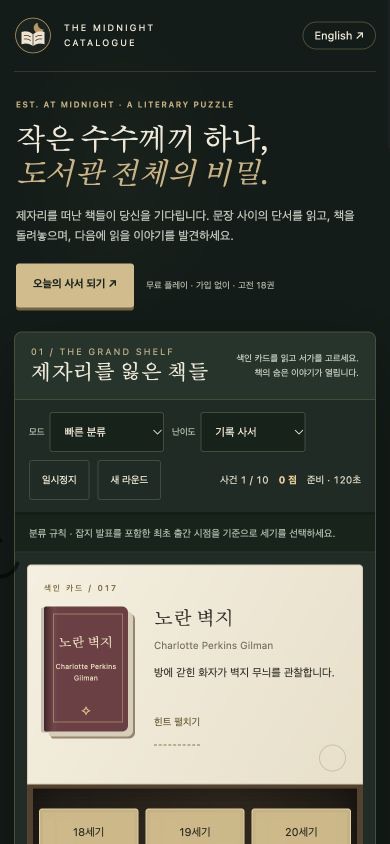
The shelf buttons provide a complete route without dragging. The desktop FAQ also advertises drag-and-drop, and the page lists keyboard shortcuts. Those alternatives were not directly tested, so our verified instructions use the visible buttons and explicit Next control.
The mobile layout reduces the desktop book-cart presentation and keeps the selected card near the shelves. Check the rule and current title before tapping, particularly after switching modes. We did not audit every screen reader, keyboard focus path, difficulty tier or storage-blocked environment.
When a quiz, reading journal or catalogue fits better
| Your task | Useful approach | Why |
|---|---|---|
| A short discovery puzzle | The Midnight Catalogue | Curated sorting choices, feedback and a small local archive |
| Recall of your own notes | A source-linked quiz workflow | You control the statements being tested |
| Understand a novel’s argument or relationships | Read the text and maintain evidence notes | A classification answer cannot establish full comprehension |
| Manage a personal collection or book inventory | A dedicated catalogue or spreadsheet | We did not establish custom-title entry, ISBN lookup or collection import here |
For a reading group, a practical sorting exercise is to explain one accepted answer and one plausible alternative, then consult the text. Keep that discussion separate from speed or points. This is a suggested activity, not a measured improvement in knowledge, motivation or memory.
Privacy and confirmed limitations
The source says progress is stored locally when browser storage is available, with no account or cloud sync. Reload and language-switch observations were consistent with local persistence. We did not perform a network or security audit, and the page includes Blogger and Google advertising services that may use cookies under their policies.
Clearing site data can remove these records according to the FAQ. We did not clear the test archive or test blocked storage; the claim that the game continues for the current visit without storage is source guidance, not a result we reproduced. Avoid treating the local archive as your only durable reading record.
The complete 18-work answer set, every room, full Century Detective and Endless Archive sessions, daily rollover, downloaded card contents and physical-device gestures remain unverified. Advertisements interrupted parts of the investigation. Close advertising overlays and identify the actual game controls before continuing.
This is a curated literary sorting game, not a neutral authority on all genres. Its source links and explanations are useful routes into reading, but a score does not establish that a reader has completed the works or mastered literary interpretation.
Related tools for the next chapter
After choosing a novel to read, use UNTIL HERE’s character relationship map guide to maintain scene evidence up to your current chapter. It separates reveal order from event time and supports manual relationship tracking. That is a different stage of reading from the sorting puzzle; no direct integration was tested.
For a sentence that changes meaning on rereading, see MARGINALIA GHOST’s reading-note image guide. It pairs your passage with a response and can layer earlier notes for matching passages. Use original or permission-cleared text and inspect the page before sharing.
Frequently asked questions
Does the game sort any book I upload?
The inspected game uses a curated set described as 18 classics. We did not establish book upload, ISBN search or custom-catalogue creation. Play it as a literary puzzle rather than assuming it manages an arbitrary collection.
Why did a correct retry leave a yellow result?
Our incorrect initial Dorian Gray placement was followed by a successful retry, while first-attempt accuracy remained below 100%. Completing a placement does not retroactively make the initial attempt correct.
Can more than one shelf be correct?
Yes, within the supported choices. We observed a 100-point Valid Alternative in the thematic mode, and genre feedback also accepted the tested Gothic placement. The game’s curated set does not include every possible scholarly interpretation.
Why is a 1900 book sorted into the nineteenth century?
The game defines that century as 1801–1900. Our Oz placement followed that rule, and the feedback said the twentieth starts in 1901. Use the displayed first-publication rule rather than a later edition’s date.
When does the daily case change in Korea?
The source states midnight UTC, shown as 09:00 in the Korean interface. We checked a dated case and persistence after completion, but did not watch the rollover occur.
Will my scores and reading list follow me to another device?
No cloud synchronization was established. The source describes browser-local records, and our tests covered reload and language switching on the same origin. Keep important reading intentions separately.
Try one sorting round, then follow one book
Start with the rule, make one placement and read its explanation. Finish the result-card step, mark one discovery as Want to read and follow a source into the actual work. That turns a short sorting session into a clear next reading action without confusing game success with having read the book.
A RELEVANT NEXT STEP
Tools with a useful connection
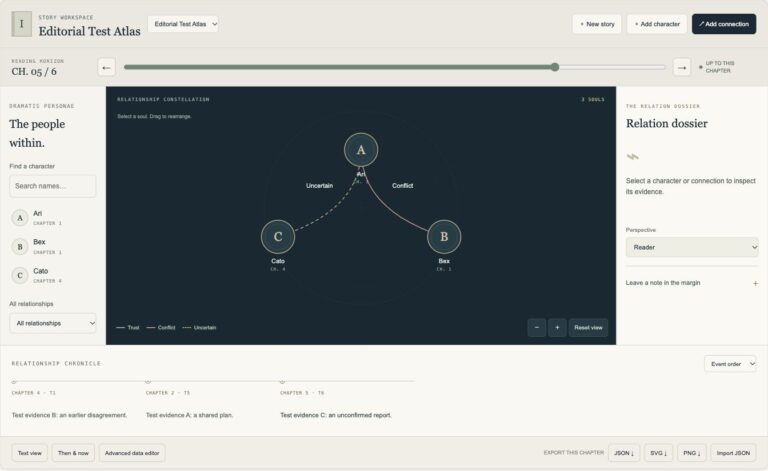
UNTIL HERE — The Unfinished Atlas
Relationship Map: 7 Essential Checks for Better Reading
Build a chapter-aware character relationship map in UNTIL HERE. Actual tests separate reveal order from event time, compare changing connections and explain reader exports versus full author backups.
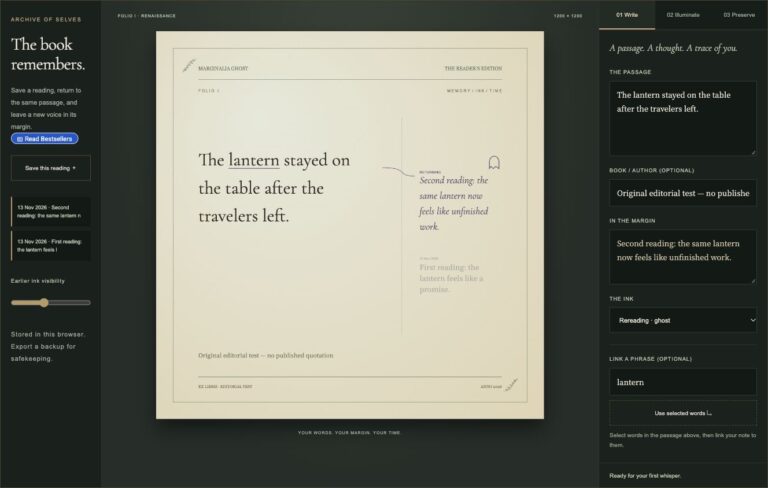
MARGINALIA GHOST
Marginalia: 7 Essential Checks for Better Reading Notes
Create a marginalia image with your passage and reading response. Real tests examine matching-passage history, ink visibility, mobile writing and the difference between images and project backups.
DominoMind Studio
Domino Game: 7 Essential Checks for Better Play
Play DominoMind Studio with a clear plan: a real eight-tile finish, a legal dead end and tested score addition explain hints, MoveLab, classic rules, local records and mobile controls.