DominoMind Studio is a domino game with a daily chain puzzle, computer play and a local scorekeeper. Select a tile, then choose an end to place it. Start with the eight-tile puzzle if you want a small, untimed problem and useful feedback on why a legal move can still block the finish.
Tested 11 November 2026 in Chrome. We completed the daily puzzle, deliberately made and undid a dead end, inspected classic MoveLab feedback and tested Korean mobile score addition and undo. Images are actual captures. Downloaded result-image contents and every classic rule variant were not verified.
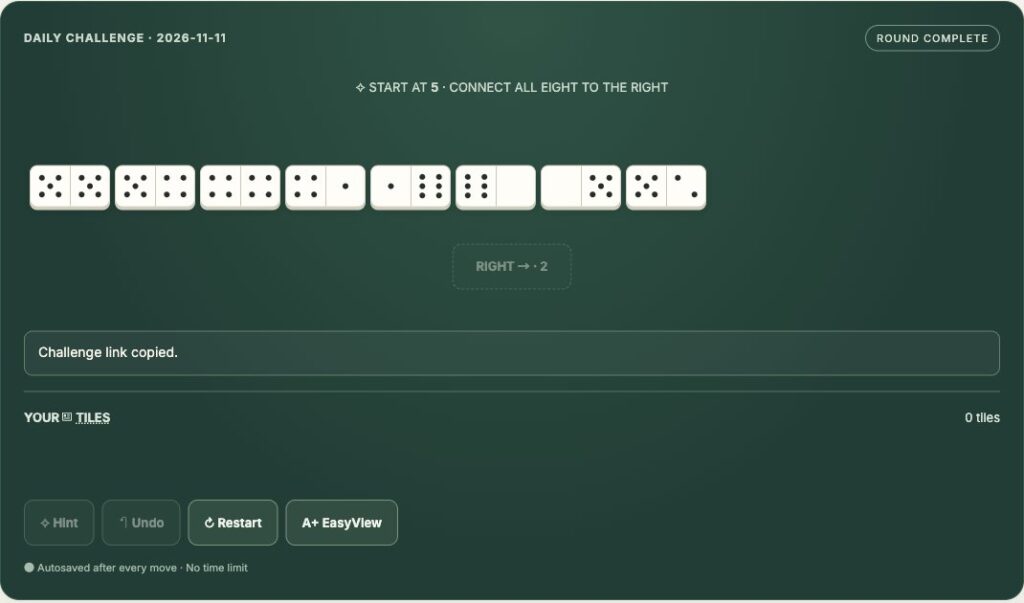
Play DominoMind Studio with a clear plan: a real eight-tile finish, a legal dead end and tested score addition explain hints, MoveLab, classic rules, local records and mobile controls.
- Brand
- DominoMind Studio
- Tool languages
- en, ko
- Verified date
- 2026-11-11
Table of Contents
Key takeaways
This is single-chain dominoes, not Mexican Train. The source explicitly excludes trains, public markers, spinners and double-satisfaction rules. The domain name is not a reliable description of its game rules. Choose it for a right-growing daily puzzle or a head-to-head double-six round against the computer.
Selecting a tile is only the first input. An end button commits it. A matching number makes a move legal, but does not guarantee that every remaining tile can be used. Our first 2|5 at starting 5 left a bare 2 with no continuation; MoveLab named three feasible alternatives, and Undo removed the failed move from the review.
The completed daily result showed eight tiles, 01:03 and two hints used. Korean navigation retained the completed chain and solved/streak counts of one in the same browser. The copied challenge link was just the English page URL, without a date or route. Local progress and a generic page link should not be confused with a portable saved game.
What this domino game actually offers
The header calls it DominoMind, while the About and footer use DominoMind Studio. Its purpose is relaxed domino play with an explanation layer. Daily challenge offers eight unique tiles, a starting number and one right-hand endpoint. Classic uses a double-six set and a computer opponent. MoveLab reviews your choices; RuleLab selects draw rules and a computer level; Table Companion records scores for an offline table.
It solves several small recreational problems: finding a short puzzle without installation, understanding why a tempting move runs out of connections, and keeping an ordinary score sheet without paper. These are different activities. The scorekeeper does not automatically read physical tiles, and its low-total convention is separate from the winner-points rule described for the computer game. Decide which activity you want before entering numbers.
No account or payment was required in our tested route. The page is funded with advertising, including inserted text links and an overlay encountered during play. The publisher describes it as an independent game and makes no health or cognitive-improvement promise. Treat the feedback as game analysis, not an assessment of intelligence, memory, wellbeing or real-world decision-making ability.
Pick the right table before you start
| Activity | Input and objective | Useful starting point |
|---|---|---|
| Daily challenge | Eight tiles; use all of them from the given number, to the right | Learn selection, placement, hints and Undo. |
| Classic vs computer | Seven tiles each; match either endpoint under the chosen draw rule | Read RuleLab before starting a new round. |
| Table Companion | Manually enter up to four players’ round scores | Agree that lower cumulative totals lead. |
The source says daily puzzles change at midnight UTC and everyone receives the same set for a date. We verified the displayed 2026-11-11 puzzle and its retained language-page state, not matching puzzles on independent devices or multiple dates. We initially encountered an older saved puzzle, then explicitly selected Daily challenge to load the current date. Continue and today’s puzzle are different choices.
Choose English or Korean and inspect the displayed mode, date and starting number. If you switch to Classic, do not expect the daily chain to remain the active board: the browser saves the current game. Take a personal note before replacing a position you want to revisit. Settings say rule changes apply to the next classic game; they are not presented as a way to rewrite a round already in progress.
You do not have to drag tiles. The site describes Tab navigation with Enter or Space, and our actual placement tests used Enter on tile and end buttons. EasyView substitutes visible numbers for pips and enlarges tiles. We toggled it on the Korean 390px page and saw numbers, then restored the prior pip view. That check is narrower than a complete assistive-technology audit.
How to play in 7 deliberate steps
1. Choose Daily challenge and read its start
The tested puzzle was dated 2026-11-11 and began at 5. The hand contained 4|5, 0|5, 0|6, 1|4, 5|5, 1|6, 4|4 and 2|5. Buttons without a matching current number were disabled. Read your own date and hand; a later day can have a different problem.
2. Select a tile without expecting placement
Choose a playable tile. The selection border and status identify it, and the compatible end control becomes available. In our test, selecting 2|5 still left eight tiles in hand. It was a prepared move, not an already committed one. This distinction also matters when a hint selects a tile for you.
3. Commit through the highlighted end
Activate the right-end button in Daily. Tiles rotate automatically to match. Our 2|5 appeared on the board as 5|2, leaving seven tiles. Classic can offer left or right; the same tile can create a different future endpoint depending on where it goes. Read the end label before committing.
4. Open MoveLab when a legal move stalls
Our first placement left no matching 2. MoveLab said that the choice left no complete path and listed 4|5, 0|5 and 5|5 as feasible alternatives. It explained the remaining-path issue rather than merely marking the matching-number rule. Spoilers follow in the worked route below.
5. Undo or use a hint deliberately
Undo restored all eight tiles and removed that review entry. The next hint selected 4|5 and said it preserved a complete path, but did not place it. You still choose an end. A hint at the earlier dead end had instead advised Undo; both requests counted in the final two-hint result.
6. Finish the chain and read all result fields
We then used the eight-move route below and reached Daily challenge complete, with zero tiles left. The result showed 01:03, eight tiles played and two hints used. The time includes reading and test actions; it is not a performance benchmark or a guaranteed time for a new player.
7. Keep the record that matches your purpose
For a result record, capture the displayed fields or verify the actual image you save. For another person to open the site, Copy challenge link provided the English page URL. For an offline game, use Table Companion instead. Neither that URL nor the scorekeeper is an export of your move-by-move daily position.
Our real daily puzzle: a dead end and a complete chain
Worked-route spoilers. From start 5, placing 2|5 first consumed the only connection to 2 and left no playable continuation. The move obeyed the local matching rule, yet failed the all-eight objective. That is the clearest reason to read a future-path review separately from a legal-move highlight.

| Order | Tile selected | Oriented chain segment |
|---|---|---|
| 1 | 5|5 | 5–5 |
| 2 | 4|5 | 5–4 |
| 3 | 4|4 | 4–4 |
| 4 | 1|4 | 4–1 |
| 5 | 1|6 | 1–6 |
| 6 | 0|6 | 6–0 |
| 7 | 0|5 | 0–5 |
| 8 | 2|5 | 5–2 |
The final chain was 5–5–4–4–1–6–0–5–2. Notice that 2|5 became useful at the end, after every other tile was used. The doubles 5|5 and 4|4 were handled while their numbers were still available. This is an explanation of the actual tested arrangement, not a claim that every daily puzzle follows the same order or has only one solution.
The two hint requests were made before this route: one at the dead end and one after Undo. We chose a different first tile from the second hint’s suggestion, while still completing the puzzle. Therefore, the displayed hint count is not a count of automatically placed moves or a trace of which suggestions you followed. Record both the route and the assistance used if you want a meaningful comparison.
Exact puzzle paths versus classic heuristics
Daily MoveLab asks whether all remaining tiles can still form a complete continuation. The tested failed move produced a specific no-complete-path message and feasible alternatives. Classic reviews answer a different, limited question using a visible-hand heuristic. Do not compare the two as if they were the same strategy score or a probability of winning.
In Classic, our opening 6|6 on the right received heuristic value 14. The displayed alternatives included 4|5 R at 13, 2|5 R at 13 and 2|6 R at 12. The page states: played pips plus twice the number of remaining tiles matching the resulting ends. For that opening, six-and-six contributes twelve pips and 2|6 is one remaining matching tile, giving 12 + 2 × 1 = 14.
That arithmetic explains the displayed example; it is not an independent audit of the computer. The source says hidden opponent tiles are not used. We inspected the stated rule and visible result, not its implementation. A higher heuristic can prefer shedding pips and retaining connections without proving a globally best move, perfect play or a specific chance of beating the computer.
Classic rules and computer play
The published Classic rules use 28 double-six tiles, seven per player and the rest as stock. In the tested opening the computer had seven tiles and the stock showed fourteen. We led with 6|6; the computer connected 1|6 on the left. We then played 2|6 on the right and later 4|5 on the left, verifying both endpoints in actual play.
RuleLab offered Draw one; play if possible, Draw until playable, and Block with no drawing. Computer choices were Beginner with random legal play and Strategist using pips and connections; Strategist and Draw one were selected during our test. We inspected these choices but did not validate all combinations or difficulty balance. The guide says doubles are ordinary tiles without extra turns or spinners.
The source describes an empty hand as a win, two consecutive passes as a blocked finish, and lower remaining pips as the blocked-round winner, with equal totals a draw. The winner earns the opponent’s remaining pips. Those published rules should be distinguished from the separate scorekeeper’s low-total convention. We do not claim to have tested every possible blocked or drawn finish.
We also reached a turn with 3|3 and 1|3 in hand and endpoints 4 and 2. Neither tile was playable, so Draw a tile became available. It drew 0|4, reduced the stock from fourteen to thirteen and left our turn active with a playable-tile message. After placing it on the left, the computer later passed. This checked one draw-one flow; we did not complete or score that classic round.
Use Table Companion for a real-life score sheet
Open scorekeeper presents four editable player names, a round-score field for each and cumulative totals. We used generic Player 1–4 and invented test numbers, not personal information or a real match. The Korean mobile dialog says that lower totals lead. Agree on a scoring convention at your physical table before using it to avoid interpreting a higher total as better by habit.
| Action | Entered scores | Observed totals |
|---|---|---|
| Add first round | 10 / 20 / 30 / 40 | 10 / 20 / 30 / 40; 1 round |
| Add second round | 3 / 2 / 1 / 0 | 13 / 22 / 31 / 40; 2 rounds |
| Undo round | No new values | 10 / 20 / 30 / 40; 1 round |
| Undo again | No new values | 0 / 0 / 0 / 0; 0 rounds |
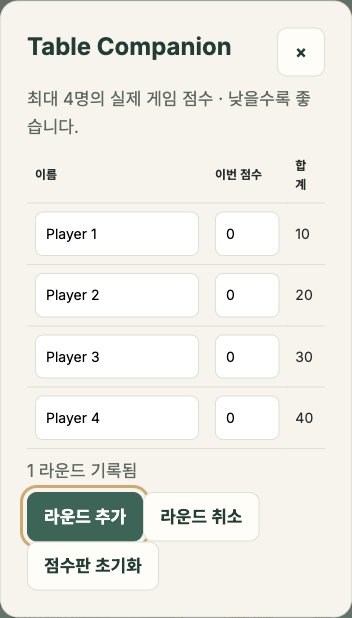
After adding a round, the entry fields returned to zero while cumulative totals remained. That makes it easy to mistake empty inputs for lost records if you look at the wrong column. Read round count and total together. Undo removed the most recent round in the observed sequence. We did not test negative values, large numbers, exports, multiple score sheets or synchronization between devices.
Results, copied links and local records
The daily result records tiles, elapsed time and hints, with Save result image and Copy challenge link controls. We activated image saving but received no inspectable completed download in the observed ten-second window. We cannot report file dimensions or contents, and this does not establish that downloads fail for everyone. The article’s images are genuine screen captures rather than a claimed downloaded result card.
The verified clipboard contained https://mexico.imporinfo.com/p/en.html. It did not contain a date, seed, move list or result statistics. Read this as a page-opening link, not evidence that a recipient receives your exact saved state. We did not send it to another person or test an independent-device opening. The site’s same-date puzzle claim remains separate from what the copied URL itself contains.
Completed daily state, 01:03, two hints and the solved/streak counts survived opening Korean in the same browser. Later a Korean reload displayed the current classic chain and remaining hand, showing that the active save had changed with mode. These tests support local continuity in this environment. They do not establish cloud accounts, backup, cross-profile migration or safe simultaneous play in multiple tabs.
Privacy, mobile and practical limitations
The privacy notice says progress, preferences, personal records and offline scores use localStorage. It separately discloses Blogger and Google service, security and advertising cookies. We verified retained visible state and played without providing a name or email; we did not audit storage code, network requests or third-party behavior. Local game records do not mean that every part of the page is free of third-party processing.
A freshly loaded Korean 390×844 view had document width 390 and no page-wide horizontal overflow. We operated EasyView and the four-player score dialog, added and undid rounds, and confirmed saved game display after reload. The dialog fit the narrow screen. Physical-phone touch, every possible long chain, every advertising placement and screen-reader paths were not fully tested.
The tested game has no demonstrated online human multiplayer, Mexican Train rules, tile-image recognition or cognitive testing. Advertised three- and ten-minute estimates are publisher guidance, not measured completion guarantees. Play at your own pace, read the active mode and avoid clicking an inserted game advertisement as though it were one of the board’s controls.
Related tools for another kind of feedback
For an explicit route-search experiment, the published Slime Mold Maze guide explains explored cells and final breadth-first-search paths. It is a useful next activity if DominoMind’s difference between an immediate connection and a full route interests you. Its grid model is a separate task, without importing domino chains.
For feedback about one changed physical-looking variable, try the Perfect Staple guide, which separates position, angle, penetration and fold. For a different untimed activity, the Brain Stroll guide covers English picture, matching and basket-memory games. These are independent activities; none provides a demonstrated score transfer or health benefit.
Frequently asked questions
Is this Mexican Train dominoes?
No. The source explicitly describes single-chain play and excludes Mexican Train’s trains, public markers and double-satisfaction rules. Judge the game by its actual guide and board, not the mexico subdomain.
Why is a matching tile still a bad daily move?
Matching the endpoint is only a local legality check. Placing 2|5 first from 5 left no remaining 2 in our puzzle. MoveLab reported no complete path, while three other first moves remained feasible.
Does Hint automatically play a tile?
The successful-path hint selected 4|5 and enabled the right endpoint. It did not place that tile. We still had to activate an end control; at a dead end, a hint advised Undo instead.
Can I use numbers instead of dots?
EasyView displayed numeric tile values in the Korean 390px test. The guide also describes larger tiles and keyboard navigation. We verified visible numbers and Enter placements, not every accessibility requirement.
Is the challenge link a saved-game link?
Our copied link was the ordinary English page URL with no date or move data. The browser retained our position locally. We did not verify a portable position, result sharing or independent-device restoration.
Which score should be low?
Table Companion says lower cumulative totals lead. The Classic guide separately says a winner earns the opponent’s remaining pips. Keep those conventions distinct and agree on your offline scoring rules before entering rounds.
Try a connection you can explain
Begin with the daily puzzle, select a tile and read the end you are about to create. If a valid move stalls the chain, open its review before undoing. DominoMind Studio is most useful when you can explain the connection you chose, rather than treating a matching number as proof that the whole route is solved.
Evidence: source English/Korean pages, rule/settings dialog, guide, keyboard FAQ and privacy notice checked 11 November 2026. Direct tests covered the daily dead end and eight-tile completion, hints, Undo, classic endpoints and visible heuristic, Korean EasyView, local continuity, score addition/undo and clipboard contents. Full rule coverage, downloaded image contents, independent-device sharing and physical-phone input remain unverified.
A RELEVANT NEXT STEP
Tools with a useful connection
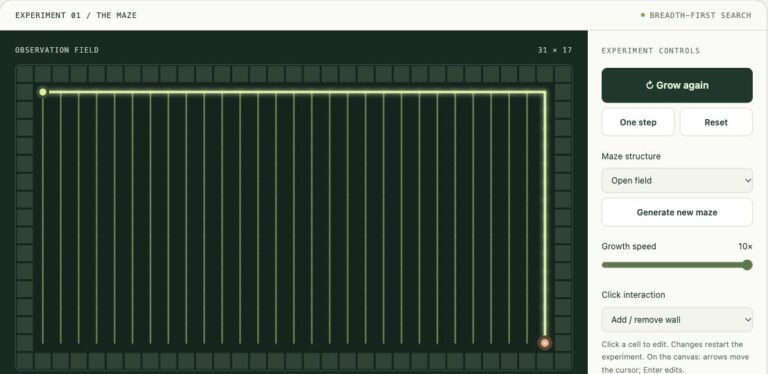
Slime Mold Maze
Pathfinding Maze: 7 Smart Slime Mold Maze Checks
Explore breadth-first search in Slime Mold Maze. Real connected, adjacent-food and blocked-origin tests explain route length, explored cells, mobile editing and its PNG observation export.
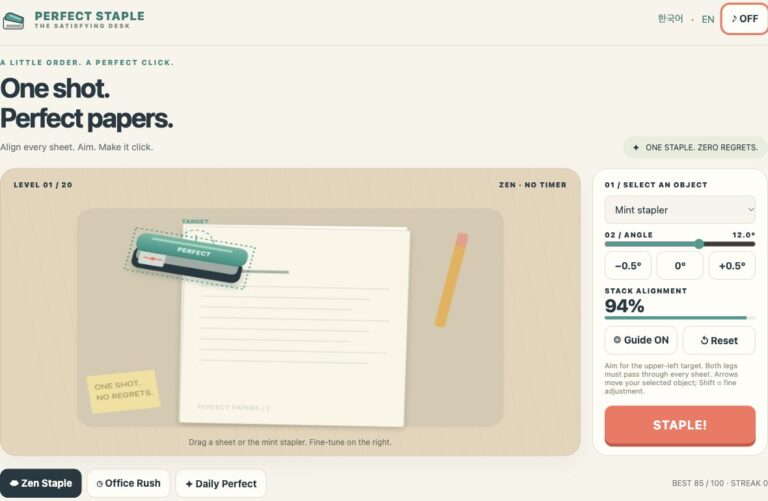
Perfect Staple
Stapler Game: 7 Essential Perfect Staple Checks
Play Perfect Staple with a clear plan: compare position, angle, penetration and fold scores. Our actual 32→42→85 trials explain the controls, daily practice, timer and local-record limits.
Brain Stroll
Brain Stroll: 7 Essential Checks for Better Play
English picture, matching, basket-memory and saying games at your own pace. Tested hints, five-item retries, daily records and replay links explained.