Tuning changes the distance between notes, even when the keyboard labels stay the same. TEMPERAMENT LAB — THE WOLF IN THE KEY lets you compare six twelve-note systems, inspect intervals in twelve keys and build a comma-budget experiment. Start with C–E, then change one variable at a time.
Checked 13 November 2026, Asia/Seoul. This guide reports visible numerical results and interaction tests. We did not independently assess the sound through speakers or headphones, and did not obtain an exported file.
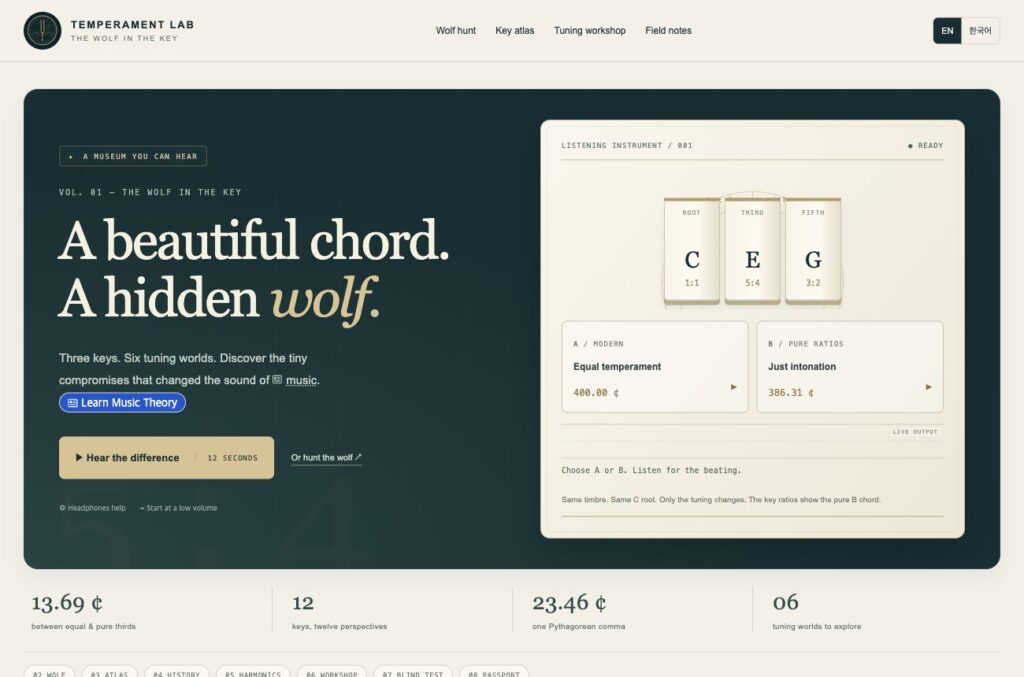
Compare six tuning systems, inspect interval maps and beat estimates, and build a clearly labeled experimental comma budget in TEMPERAMENT LAB.
- Brand
- TEMPERAMENT LAB
- Tool languages
- en, ko
- Verified date
- 2026-11-13
Explore this guide
Key takeaways
Best for: musicians, teachers and curious listeners who want to connect interval ratios with a keyboard demonstration. No instrument recording, account or uploaded audio is needed to begin.
The useful distinction: cents describe an interval ratio; the displayed Hz figure estimates the mismatch between one selected pair of partials. Equal interval sizes can produce different beat rates at different pitches.
Keep the boundaries clear: this is a teaching synthesizer. Its fixed just-intonation map is not adaptive tuning, its fingerprint is not a microphone analysis, and its workshop cannot recreate quarter-comma meantone with its restricted shares.
What this tuning lab does
A chord that works in one key can behave differently after transposition in a fixed tuning system. A normal equal-tempered keyboard hides much of that tradeoff because its semitone steps are uniform. This lab makes the interval choices visible beside playback controls, rather than asking you to infer everything from a historical description.
The six supplied worlds are 12-TET, a C-based just-intonation map, Pythagorean tuning, quarter-comma meantone, Werckmeister III and Vallotti. A seventh selector entry holds your experimental result. The history cards play the same original eight-bar study; they are digital teaching models rather than recordings of historical instruments.
Inputs include the tuning selector, chord root, reference anchor, timbre, reference pitch and twelve workshop sliders. Outputs include major-third and fifth sizes, deviations from simple ratios, a twelve-key third map, a theoretical beat envelope and a small passport. English and Korean interfaces are available through the language links.
Prepare a fair comparison
Use one browser tab and stop other playback before comparing. Begin at a low output level, then keep the volume unchanged. The page offers a global Stop control. Browser audio normally needs an intentional play action; opening the page alone is not a sound check.
Choose the same timbre for each comparison. Harmonic mode contains upper partials relevant to the displayed 5:4 comparison. A sine tone contains only its fundamental, so changing to sine changes the listening question even if the numerical interval remains the same. Write down the mode with your observations.
For the first pass, use the default 440 Hz reference and C-root locked anchor. The source defines that anchor as C4 = A4 × 2^(−9/12). A4 fixed instead shifts an entire map to put its A4 on the chosen reference. This calibration choice is separate from the interval pattern. Do not silently change it halfway through a tuning comparison.
A small observation sheet is enough: system, root, anchor, timbre, reference pitch, third in cents, fifth in cents and the selected-partial beat estimate. Record what the display says separately from any subjective impression. That separation helps distinguish a reproducible result from a preference.
7 steps through the exhibits
1. Establish the C–E comparison
At the top, use Hear the difference or the A and B cards. A is the 400-cent equal-tempered third and B is the 386.31-cent 5:4 third. The individual C4, E4 and G4 keys offer a simpler starting point. The live output waveform indicates the page’s output; it does not mean a microphone has been activated.
2. Inspect the key atlas
In the tuning selector, choose 12-TET and select C and read the metrics before playing a chord or phrase. Then select G without changing the other settings. In our test the third stayed at 400.00 cents and the fifth at 700.00 cents, while the beat estimate rose from 10.38 to 15.56 Hz. Keep both observations; they describe different properties.
3. Compare a fixed just map
Switch the tuning selector to Just intonation / C. C showed a 386.31-cent third and 701.96-cent fifth. Moving to D kept the displayed third at 386.31 cents but changed the fifth to 680.45 cents. Inspect the whole chord rather than declaring a key pure because one of its intervals matches 5:4.
4. Try the wolf hunt
Select a fifth around the circle, then choose Accuse this fifth. A premature accusation produced a request to listen first. Our test selection C–G was rejected with a visible 696.58-cent reading. That was an interface check, not a successful listening identification. New hunt rotates the model, so a memorized location is not a useful strategy.
5. Use the fingerprint as a model
Select 12-TET, 5:4 or 81:64 in the harmonic fingerprint. On 5:4, the selected partials both displayed 1308.13 Hz and their difference became 0.000 Hz. The drawing is an idealized two-partial envelope with time scaled for readability. It is neither a live FFT nor evidence that every partial in a full chord coincides.
6. Spend a comma deliberately
In the workshop, compare Equal shares with One bears it all. Give the experiment a descriptive name, apply it and inspect My experimental tuning in the atlas. Save on this device only when you want it to return. Keep a separate record of the sliders before exploring another preset.
7. Finish with an ABX diary
Play A, B and X before answering. Our attempt to use Cannot tell first was blocked with an instruction to listen to all three. After triggering each reference, Cannot tell revealed the assignment as a skipped trial and left the correct/answered counter at 0/0. Use Next randomized trial for another attempt; a skipped trial is not an incorrect answer.
Our practical test results
| Test | Observed result | Meaning |
|---|---|---|
| 12-TET, C → G | 400/700¢ in both; 10.38 → 15.56 Hz | Interval ratio stayed constant; beat estimate changed. |
| Just / C, C → D | Fifth 701.96 → 680.45¢ | The map did not retune every chord to a pure fifth. |
| Fingerprint, 5:4 | 1308.13 / 1308.13 Hz; Δ0.000 | The selected pair coincided numerically. |
| One bears it all | F–C −23.460¢; total23.46001¢; residual0 | One preset concentrated the correction and closed the circle. |
| Save and reload | Name and twelve shares returned | Local restoration worked in the same browser session. |
| Fresh copied share link | Name and shares restored; C major; 0/0 | The fragment carried the experiment; it did not preserve G-root context. |
| Korean mobile equal/apply | 400/700¢; 10.38Hz; width390px | Representative controls worked at390×844. |
The workshop name used was Editorial comma study. The concentrated preset had eleven zero shares and F–C at 100; after reload the visible name and all twelve values returned. A separate tab opened the exact copied share link and showed the same experiment, C major and an empty 0/0 diary. Because our source diary also had no answered trials, we rely on the interface’s explicit notice—not a nonzero-score experiment—for the statement that listening scores are excluded.
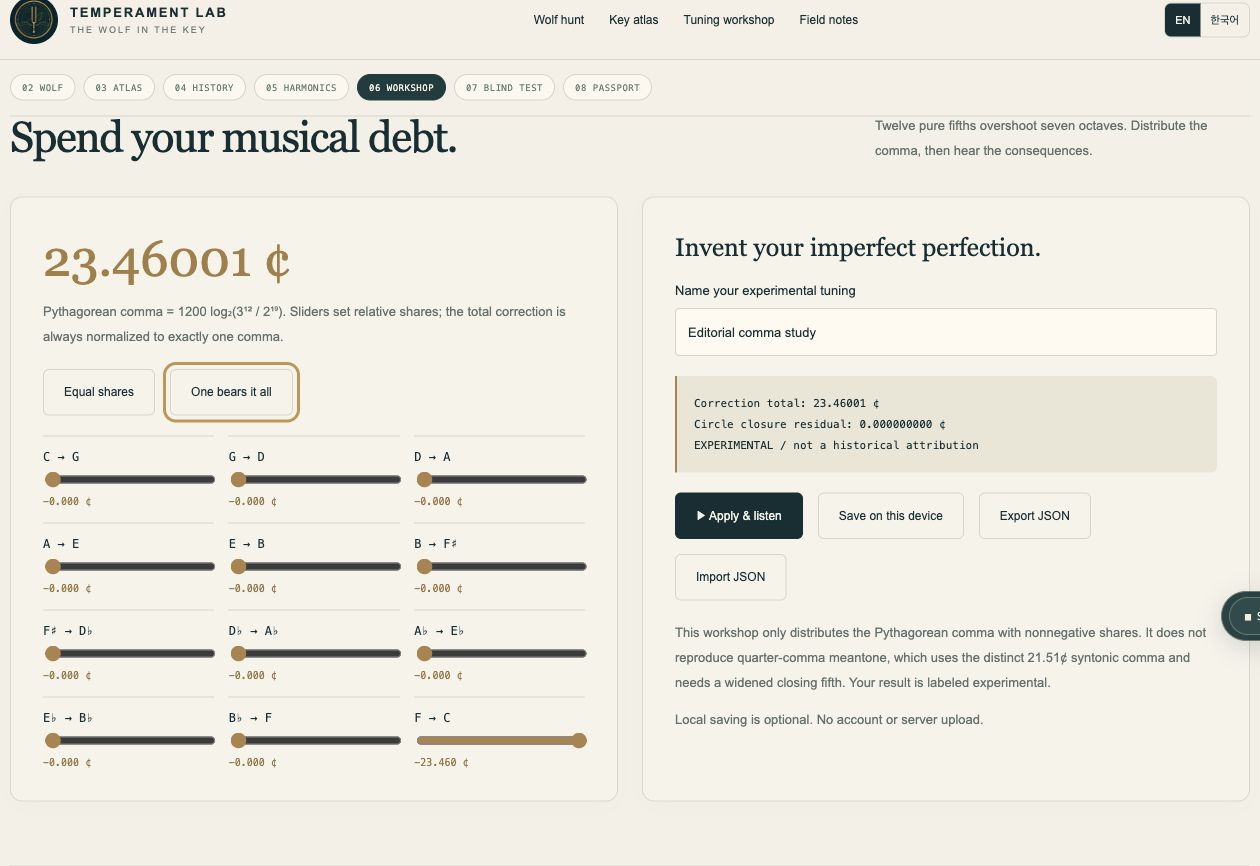
Export JSON was invoked with a download listener, but no downloadable file reached our test session. We therefore did not inspect its JSON structure, perform an import round trip or verify the passport PNG contents. A visible export button is a feature offered by the site, not proof that the resulting file was tested.
Read cents and beats correctly
A cent is a logarithmic ratio unit. One octave is 1200 cents. The calculation 1200 × log₂(5/4) gives about 386.3137 cents. The 400-cent equal-tempered third is therefore about 13.6863 cents wider. These values explain the displayed difference without requiring a claim that one system is universally superior.
The partial comparison is |5f(root) − 4f(third)|. Under the page’s default C-root calibration, the C4-based equal-tempered example gives about 10.382 Hz. Raising that root to G increases the frequencies, and thus the absolute difference, while preserving the ratio. The observed15.56 Hz is consistent with that change. A larger number is not automatically a worse chord or a diagnostic result.
Zero here has a narrow meaning: the chosen fifth partial of the root and fourth partial of its major third coincide. It does not remove all other harmonics, model loudness perception or rank complete musical passages. A useful lesson is to ask which partials the number compares before interpreting the envelope.
Two comma values solve different problems. The Pythagorean comma is about 23.46001 cents, the excess of twelve pure fifths over seven octaves. The syntonic comma is about 21.50629 cents, the gap between a Pythagorean major third and5:4. Substituting one for the other produces the wrong meantone calculation.
Build an experimental tuning
Treat the sliders as relative weights, not cents. The page normalizes the correction to one Pythagorean comma. Equal positive shares distribute about 1.955 cents of narrowing to each fifth; this is why the equal preset produces the familiar400/700-cent atlas readings. Multiplying every weight by the same factor should not change a normalized allocation mathematically; that scaling property is an explanation of the model, not a separate slider test performed here.
One bears it all places the full correction at F–C in the tested preset. Subtracting 23.46001 cents from a pure fifth of 701.95500 cents gives about 678.49499 cents for the corrected closing interval. That is a calculated consequence of the displayed budget. It is different from the737.64-cent wide wolf described in the hunt’s quarter-comma meantone model.
The workshop accepts only nonnegative shares of the Pythagorean comma. Quarter-comma meantone narrows ordinary fifths by a quarter of the syntonic comma and leaves a widened closing fifth on this twelve-note keyboard. The interface explicitly excludes reproducing that construction with these tuning sliders. Label an invented result experimental, even if it resembles part of a named recipe.
For a classroom demonstration, begin with equal shares, then concentrate the budget and ask students to predict which fifth changes before applying it. Have them compare both the third and fifth in two keys. The strongest result is an explanation of the tradeoff supported by the readings, rather than a competition to select the nicest sounding label.
Useful learning scenarios
Keyboard lesson: demonstrate why transposition is especially straightforward in 12-TET, then inspect the fixed just map in C and D. Ask the learner to locate the changed fifth rather than infer that every just chord remains pure. No claim about an acoustic piano’s stretch tuning follows from this demonstration.
Composition sketch: compare a repeated C-major phrase under the six models with the same tuning anchor and timbre. Take notes on what changes, then return to the numerical map. The page supplies a short original study; it is not a score editor or a general retuning system for your own recordings.
Independent study: alternate the fingerprint buttons and calculate the ratio-to-cent conversion on paper. Then do short ABX sessions with honest skips. Keep the conditions and number of answered trials, because a few lucky guesses cannot establish reliable discrimination.
Collaborative discussion: share a named experimental budget and ask another person to open it, read the name and check the last slider before comparing. Specify the root, anchor and timbre separately. Our fresh share opened on C despite originating from a G-root experiment, so a tuning link should not be treated as a complete session snapshot.
Limits and troubleshooting
This is a fixed twelve-note teaching environment. Enharmonic spellings share keys; it does not supply separate C-sharp and D-flat pitches. The just map is C-based, and the historical labels represent the recipes documented by this site rather than every historical variant. It also states that it is independent of temperamentlab.com.
The model does not include stretch tuning or string inharmonicity. It cannot measure your instrument, tune a microphone input or promise that the same cents figures predict an acoustic piano’s complete sound. If you need a production instrument or Scala workflow, verify its supported formats separately; a JSON export control is not evidence of Scala-file compatibility.
If playback appears inactive, use an explicit play control, inspect the page volume, check the device output and press Stop before a fresh comparison. Our tests verified control responses and numerical states; they did not independently establish audible output quality, latency or listening discrimination.
The source also displayed advertising, including an interstitial that temporarily covered the experiment. Closing the ad restored the controls. Avoid following advertising links while trying to operate the lab. This is a practical interruption to allow for in a live lesson, even though the underlying controls resumed normally.
Saving, sharing and privacy
The publisher says synthesis and calculations run in the browser and no microphone is requested. We observed no microphone prompt during the tested interactions. Save on this device is described as localStorage, and same-browser reload restored our experiment. We did not audit network traffic, so this should not be expanded into an absolute claim that the entire page makes no network requests.
Copy share link put the tuning name and shares into a URL fragment. Anyone receiving that link can read the name and experiment it contains. Use a neutral project name and keep a separate backup if the configuration matters. Browser storage may be cleared or unavailable in another profile; local saving is not a synchronized account.
Blogger and Google advertising are present, and the source’s privacy note says their cookies and policies apply. Browser-based audio processing and an ad-free or tracking-free website are different claims. File contents, import compatibility and long-term persistence remain outside the verified results in this guide.
Related tools and next steps
Use SoundFit when the next question concerns noise layers or an educational tone lab. TEMPERAMENT LAB compares note relationships; SoundFit is a separate route for exploring a listening environment. Stop one tool before playing the other to keep observations interpretable.
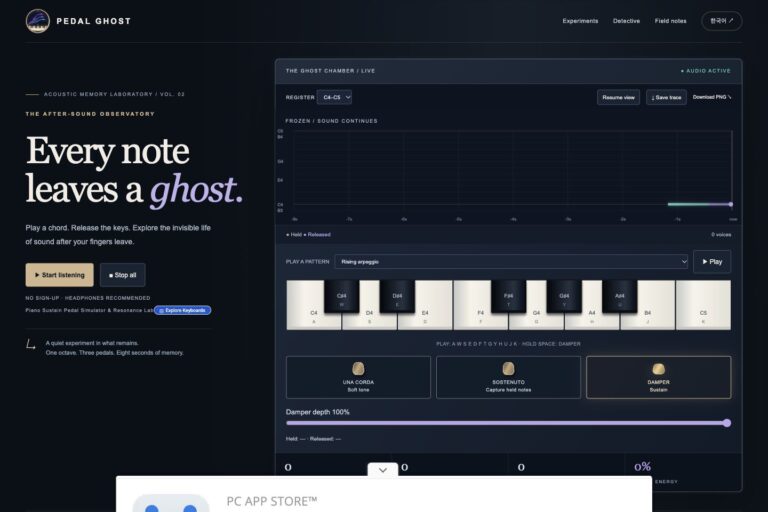
Continue with PEDAL GHOST to explore simulated sustain and release after studying interval ratios. A pedal changes how notes continue; it does not substitute for changing the tuning map. That makes it a useful follow-up lesson about another source of overlapping sound.
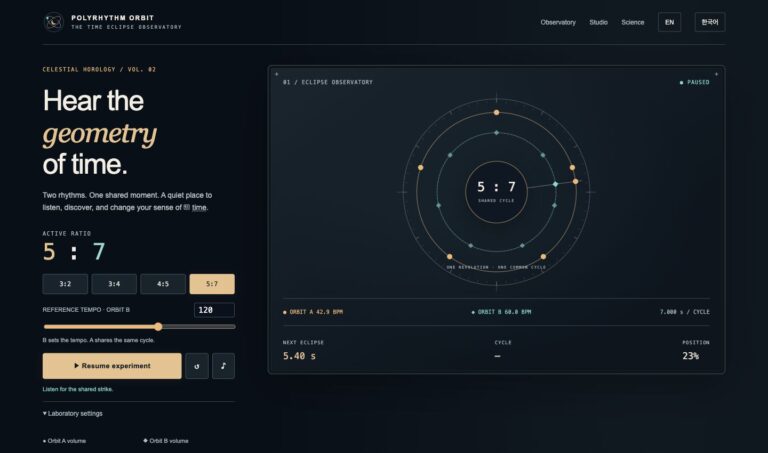
Try POLYRHYTHM ORBIT for pulse relationships. Countable rhythmic coincidences and the interference of nearby partials are different phenomena, but both benefit from specifying the quantities being compared instead of relying on an animation alone.
Frequently asked questions
Does the lab tell me the best tuning?
No single numerical ranking is supplied for every musical purpose. Use the metrics to explain a particular interval choice, then consider register, timbre, musical context and your own listening conditions. A zero selected-partial difference is not an overall quality score.
Is just intonation automatically pure in every key?
Not in this fixed C-based map. In our C-to-D comparison the fifth changed from701.96 to680.45 cents even though both displayed thirds were386.31 cents. Check each interval in the selected chord.
Why does the ABX answer button ask me to listen first?
The interface requires playback of A, B and X before accepting an answer. We verified the gate and the skipped-trial flow. The resulting0/0 counter did not represent a listening success or failure by the reviewer.
Can I send my whole listening session to a friend?
The share notice says the experimental tuning is included and the listening score is excluded. Our copied fragment contained a name and twelve shares; a fresh opening restored that experiment on C. Send the comparison conditions separately, and confirm the receiver’s displayed state.
Can I use the workshop to recreate the meantone wolf?
Not with its restricted nonnegative Pythagorean-comma shares. Use the dedicated meantone atlas or wolf hunt for that model. Do not rename the concentrated-budget preset as quarter-comma meantone.
Verification notes and sources
Verified 13 November 2026 in Chrome with English desktop and Korean390×844 viewport interactions. Three genuine source screenshots were retained. The test record distinguishes UI observations, independent arithmetic and unverified file or audio behavior. The publisher’s update notice was 6 November 2026.
Primary interface and method reference: TEMPERAMENT LAB, including its field notes and expanded FAQ. The Korean interface was also operated. Its browser-processing statement and model limits are attributed to the publisher; the test observations above are our own.
Start with C, compare a single tuning change, and keep the cents reading separate from the Hz estimate. That small discipline makes the lab useful well beyond choosing a favorite card.
A RELEVANT NEXT STEP
Tools with a useful connection
SoundFit / 소리핏
SoundFit: 7 Essential Noise Mixer Tips for Better Sessions
SoundFit mixes brown, pink and white noise with focus timers and a tone lab. Read our playback, saved-setting and mobile tests before building a background sound routine.
PEDAL GHOST
Pedal Ghost: 7 Smart Checks for Better Piano Sustain
Explore piano pedal release with modeled traces, sostenuto capture and event postcards. Checked controls and shared replay explain the graph, register, quiz and audio/export limits.
POLYRHYTHM ORBIT
Polyrhythm: 7 Smart Checks for Better Orbit Practice
Explore polyrhythm cycles, onset grids and phase in POLYRHYTHM ORBIT. Checked rates, 6:4 shared positions and fresh-link restoration explain the reference clock and session/export limits.