Brolly Panic! : The Last Gust is an umbrella survival game: read the wind, tilt a virtual canopy and decide when to brace. Our hands-on guide explains why a perfectly intact umbrella can still end in failure, with tested controls, a real result and clear limits on saving and sharing.
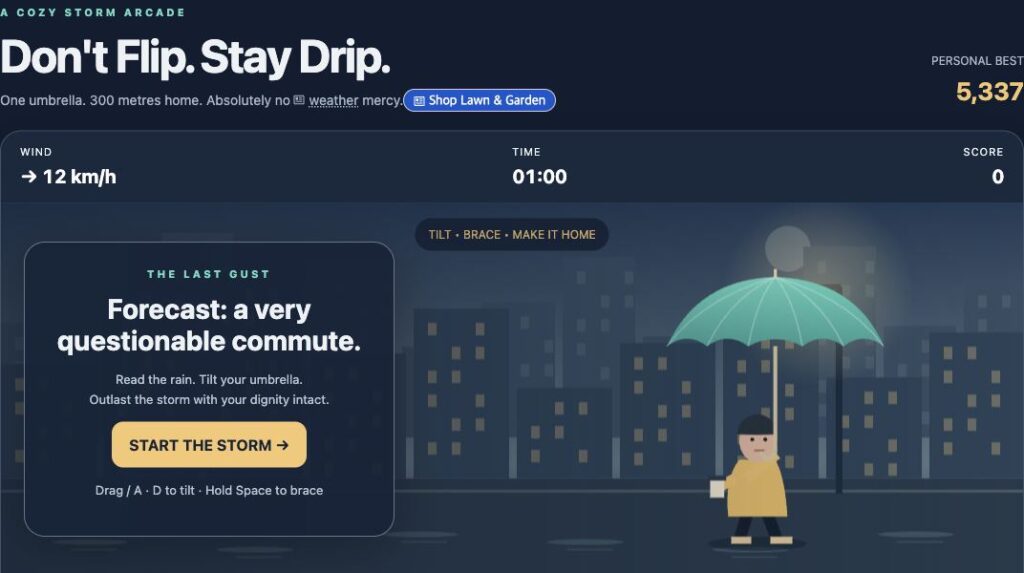
Tilt and brace in Brolly Panic. Actual keyboard and pause tests explain dryness versus canopy condition, three modes, local bests and unverified result-file saving.
- Brand
- Brolly Panic! : The Last Gust
- Tool languages
- en, ko
- Verified date
- 2026-11-10
In this guide
Umbrella survival game: key takeaways
- The official game name is Brolly Panic! : The Last Gust. English and Korean source pages were available.
- Commute Rush aims for a 60-second journey. Endless Storm targets survival time; Daily Storm describes weather shared by UTC date.
- Use A/D or arrows, or the lower drag pad, to tilt. Hold Space or the brace control for temporary protection at a dryness cost. We tested keyboard input, not every touch gesture.
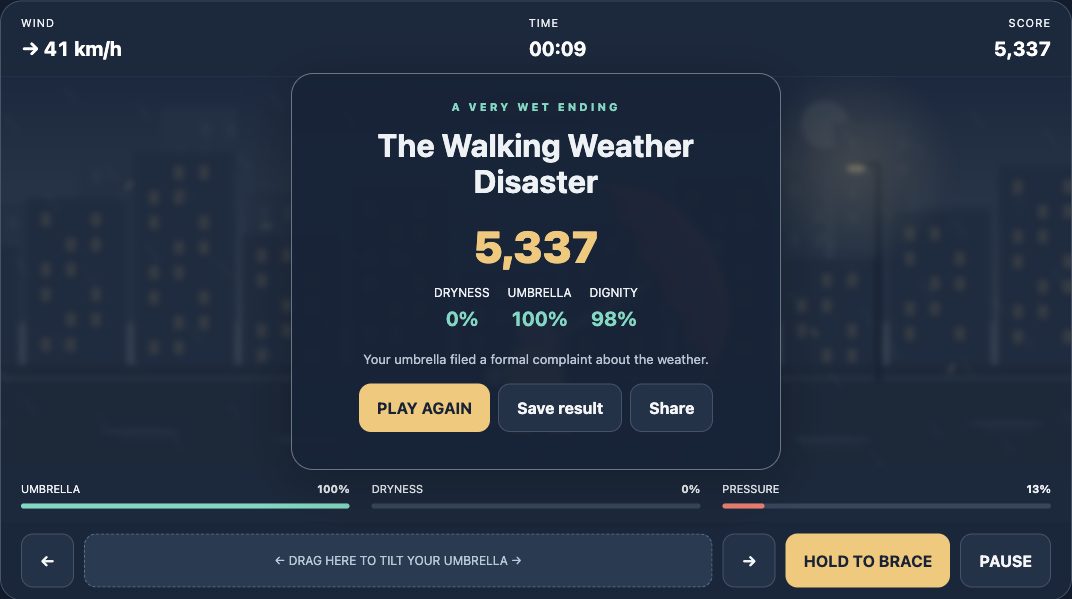
- Our default Commute Rush attempt ended at 5,337 points with dryness 0%, umbrella 100% and dignity 98%, with 00:09 still on the timer. It was a failed commute.
- The best of 5,337 survived reload and appeared on the Korean source page in the same browser. It is not an online ranking.
- Save result was attempted without a confirmed received file. Share displayed a closed-share notice; no message was sent. Screenshots here are actual captures, not exported result cards.
Checked in Chrome on 10 November 2026. This is an arcade game with fictional weather and condition meters. We did not test real umbrella strength, weather accuracy or safe outdoor behaviour.
What Brolly Panic actually does
The game turns a familiar rainy commute into a small resource-management problem. An illustrated person walks through a warm city while wind changes direction. A mint guide indicates the desired umbrella angle. The player adjusts the canopy and chooses when to trade dryness for reduced wind resistance. Three meters distinguish canopy condition, dryness and pressure; a score and timer make each attempt visible.
It suits a short keyboard arcade break or a discussion of competing goals in an interface. Protecting a canopy is not the same as keeping its owner dry, and a high-looking score does not automatically mean the journey was completed. That distinction is more useful to a first-time player than a promise that one control always wins. The result screen supplies several values, so inspect the full outcome rather than the headline number alone.
No account, location permission, photograph or weather data entry was requested in the tested flow. The “300 metres home” presentation is a fictional journey. The wind shown in km/h is a game value; it does not establish current conditions at your address. No real route planning, forecast input or product-strength calculation was observed.
Core features at a glance
- Weather cues: a direction/speed indicator, rain, leaves and a mint target angle. The guide describes a one-second gust warning.
- Inputs: A/D, arrow keys, a lower drag pad, direction buttons, Space and a brace button.
- Replay choices: Commute Rush, Endless Storm, Daily Storm and three immediately available umbrella options.
- Pause and presentation: a pause overlay with Resume, an audio toggle off by default and a Reduced effects checkbox.
- Output: score, condition meters, a humorous result title, local best, Save result and Share controls. The last two require their own successful-output check.
Choose a fair starting condition
Select language, mode and umbrella before starting. In our active and paused runs, mode buttons and the umbrella selector became disabled. A paused game therefore is not a settings lobby. If your aim is to compare canopies, decide the selection before the next attempt rather than expecting to change equipment halfway through.
Coral Classic is described as balanced; Mint Pocket catches less wind but admits more rain; Golden Golf gives more rain cover but requires more care in wind. These are source-described game trade-offs. We selected Mint and saw the canopy colour and selected label change, but did not perform matched completed trials of all three. Do not interpret the names as tested shopping advice.
Keep one baseline: mode, umbrella, date if Daily, input method and whether you use reduced effects. Sound starts off. A quiet first attempt lets you inspect the written and visual cues without relying on audio that we did not audit. Choose Reduced effects if the animation is distracting; we verified that the checkbox can be selected, not that the entire game meets every motion or accessibility need.
Seven essential checks from start to result
1. Choose the mode and equipment before pressing Start
Begin with Commute Rush if you want a clear 60-second goal. Read the mode description beneath the buttons and confirm the umbrella label. Daily Storm showed “same UTC date, same weather · 2026-11-10” during inspection. Endless Storm displayed guidance to continue while umbrella and dryness remain. Those are different objectives, so write the selected mode alongside any score.
2. Read the mint guide and three meters together
The on-page guide says matching the mint angle reduces pressure. Watch the direction of the guide and the canopy, then look at pressure and dryness separately. A low pressure value does not prove that dryness is safe. In our failed result, the canopy still had 100% condition while dryness had reached zero. The loss was easy to miss if we looked only at the umbrella bar.
3. Tilt in small corrections
Use A/D or arrow keys, or the lower control strip described by the source. We sent D in the English game and A in the narrow Korean view and observed the run respond with changing score and remaining distance. The exact key-hold duration is not an optimal tactic established by our tests. It was an input check. For practice, make a small correction, release and inspect the canopy before making another.
A common mistake is chasing the animated scenery instead of the mint guide. Another is treating a long press as a permanent setting. The aim is to respond to changing conditions, not to leave one direction held indefinitely. We did not establish the ideal angle or movement rate for every gust, and did not complete a successful manual commute to claim a winning routine.
4. Brace deliberately, then release
The guide explains that Space or Brace reduces wind resistance but costs dryness. It also describes holding for one second to recover a flipped canopy and bracing against a bus splash. We tested Space input and saw dryness decrease; we did not independently reproduce flip recovery or isolate a bus event. Treat those two details as instructions supplied by the source, not as events we completed.
Our extended-brace attempt is a cautionary example: preserving canopy condition alone was insufficient. Holding a defensive control throughout the storm is not demonstrated as a safe all-purpose strategy. Watch the dry meter and release when you want to reassess. A short threat response and a long resource drain are different uses of the same control.
5. Pause for inspection and resume consciously
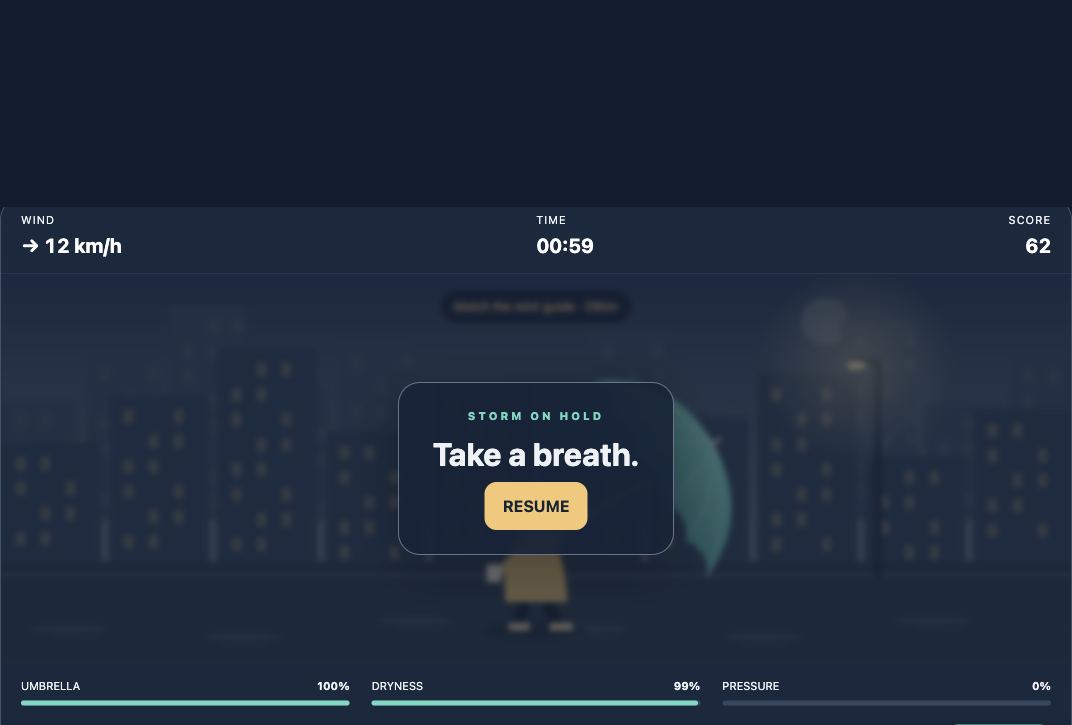
Pause produced a “Take a breath” overlay with Resume in English and “잠깐, 숨을 고르세요” in Korean. An early paused check showed 00:57, score 173, canopy 100%, dryness 96% and pressure 0%. Another Daily/Mint check showed 00:59, score 62 and dryness 99%. These were separate observations, not a controlled comparison between modes or umbrellas.
Use the overlay to read values, then select Resume when ready. The source says leaving the tab automatically pauses play. We did not validate every browser visibility transition or every focus combination; if an attempt appears stopped, first look for the pause overlay rather than pressing unrelated page controls. The pause button keeps its accessible name “Pause” even when its visible label changes to Resume.
6. Distinguish a completed commute from a score
At the end, read the outcome title, score and all three result values. Our default attempt displayed “A VERY WET ENDING” and “The Walking Weather Disaster,” with 5,337 points, dryness 0%, umbrella 100% and dignity 98%. The timer still read 00:09. Reporting that as a successful 60-second finish would be wrong. The values verify a failure screen and a local best, not a completed journey.
The FAQ says survival and accurate alignment earn points, while dryness, umbrella condition and dignity add a final bonus. We did not reverse-engineer exact weights or independently validate the scoring formula. The dignity number is part of the game’s humour, not a judgement about a real person. Keep the conditions and outcome next to the score when recording a run.
7. Verify saving or sharing as a separate step
Save result was present and activated, but no received download file was confirmed. Share returned “Share closed. You can save your result instead.” in our browser; no external message was sent and no shared link or clipboard output was verified. A button press is not proof that a file or message reached its destination. If keeping a record matters, open the actual saved file yourself or retain a clearly labelled screenshot.
What our actual attempts showed
- Initial start/pause: the game started, then showed a pause overlay and score 4 while the initial timer still displayed 01:00.
- English keyboard check: D and Space followed by Pause produced 00:57, score 173, canopy 100%, dryness 96% and pressure 0%. This was mixed input, not an isolated measurement of one key.
- Default Commute Rush result: failed at 5,337 points, dryness 0%, canopy 100%, dignity 98%, with 00:09 remaining after extended brace use.
- Selection check: Daily date 2026-11-10, Mint Pocket and Reduced effects were selected. A brief D-input run paused at score 62. No full Daily completion or matched equipment trial was made.
- Reload: the original English game returned to a new attempt with score 0 and 01:00, while Personal Best stayed 5,337. The same-browser Korean page also showed that best.
- Narrow Korean load: at 390×844, document width remained 390 and the canvas measured 364×400. Starting, A input and Pause produced score 61 and remaining distance 296 m. This used keyboard input in browser emulation.
These checks establish working interactions and visible output. They do not establish a high score benchmark, an optimal strategy, physical-phone touch behaviour or a relationship to real wind. The actual captures are evidence of the specific states described, with their date and conditions preserved.
A practical way to read the trade-off
Try an observation exercise rather than changing everything after a loss. Keep Commute Rush and Coral Classic fixed. On a new attempt, focus first on reading the mint guide and dryness together. Record what the three meters show at the first moment you decide to brace. On a later attempt, keep the same basic setup and change only that decision. This is a suggested exercise, not an experiment we completed.
For each attempt, write mode, umbrella, input method, outcome, timer at ending, score and the three result values. Add a note such as “extended brace” or “short corrections.” A best score from yesterday is not the current run, and a changed umbrella is not a controlled test of one tactic. If the weather differs between attempts, avoid assigning every result difference to your latest control change.
The lesson in our failed run is narrowly stated: that particular attempt reached zero dryness while preserving the canopy. It does not prove that bracing is always bad or that another umbrella would have won. This restraint makes the record useful: it tells you what to inspect next without inventing a universal rule from a single arcade attempt.
Modes and umbrellas: what changes
Commute Rush gives a finite target. Endless Storm changes the focus to lasting while resources remain. Daily Storm supplies a shared UTC-date weather scenario according to the guide. We opened the mode selections and the daily date label; we did not test matching weather across multiple devices or a midnight rollover. A common daily scenario also does not imply that everyone uses the same umbrella or makes the same inputs.
For a fair informal comparison with a friend, agree on source language if needed, UTC date, mode and umbrella, then include outcome and condition values. Local bests are convenient personal feedback, not a verified public leaderboard. We saw no account setup, multiplayer room or global ranking in the inspected flow. Do not promise one to someone following your score.
Local records, saving and sharing
The source FAQ says records and preferences use localStorage and gameplay is not sent to a server. Our direct evidence is narrower: the best persisted after reload and appeared on the same-browser Korean page. The active attempt did not resume at its ending state after reload. We did not inspect storage implementation, clear site data, audit network traffic or test long-term retention and cross-device sync.
Blogger and Google advertising can use their own cookies, as the source itself notes. Ads were actually visible, including inline shopping annotations, an anchor and an interstitial; we used a genuine close control rather than clicking the advertisement. A local game record therefore should not be described as proof that the entire page is offline or free of third-party processing. Read the linked Google Privacy Policy for that service’s general policy; we did not perform a policy audit.
Treat local best as replaceable browser data, and do not rely on Save or Share for an archive until you verify the specific output. The result images in this guide were captured directly from the screen. They preserve the observed outcome even though an exported file was not verified, and are labelled accordingly.
Mobile, privacy and other limitations
- Responsive scope: the Korean 390 px layout fit without horizontal overflow, and keyboard input worked. Physical-phone touch dragging, all screen readers and full accessibility conformance were not certified.
- Advertising: overlays can cover game text or controls and can change between visits. Use an actual close control when available and keep ad downloads separate from game result saving.
- Presentation: sound was off by default. The reduced-effects checkbox was operable, but audio quality and the extent of motion reduction were not measured.
- Verification limits: no successful full commute, full Endless run, flipped-canopy recovery, controlled three-umbrella comparison or date rollover was completed.
- Interpretation: game km/h, pressure, dryness and dignity are fictional feedback. This page is not an outdoor safety guide, weather forecast or umbrella purchasing test.
Related games for different control problems
For another careful pointer task, Brim Peel Challenge follows a contour around a virtual print. Its guide separates manual input from keyboard-assisted completion. It is useful when you want to practise a steady path and read a result label without the changing-weather resource trade-off. A perfect assisted peel and a successful rainy commute remain different achievements.
For indirect control and overshoot, Magnet Marble Maze moves a magnet to guide a ball. Its guide covers polarity, pulse, rewind and Maker sharing limits. Choose it when you want a spatial puzzle you can inspect, rather than a timed balance between canopy and dryness. Neither game provides calibrated physical measurements.
To move from arcade weather to an inspectable umbrella linkage, read RIBVERSE — The Folding Lab. Its five-case guide examines ribs, support links and a runner against normal ghost paths. It fits a follow-up question about how a conventional umbrella opens; it does not diagnose a physical canopy damaged in a storm.
Frequently asked questions
Is this umbrella survival game a real weather simulator?
No real forecast input or location reading was observed. Brolly Panic presents an arcade storm with illustrative values. Do not use its wind speed or umbrella condition to decide how a real canopy will perform outdoors.
Why can I fail with umbrella condition still at 100%?
Our attempt did exactly that: dryness reached 0% with umbrella 100% and 00:09 remaining. The meters describe different game resources. Watch dryness as well as canopy condition; the score alone does not prove completion.
Can I change umbrellas while paused?
The selector and mode buttons were disabled in our active and paused runs. Select equipment before the next start. We did not verify a way to switch midrun.
Does Daily Storm mean an online competition?
The guide describes a common weather scenario by UTC date and browser-local records. We saw no global leaderboard or multiplayer room. The shared scenario and your own local score are separate features.
Did saving and sharing succeed in this review?
A received result file was not verified. Share showed a closed-share message and no external message was sent. The images here are actual screenshots. Check any downloaded file or sharing destination yourself before depending on it.
Start one storm with one clear goal
Choose one mode and umbrella, start, then watch the mint guide and dryness together. Use Pause to read the trade-off and keep the final outcome next to your score. The umbrella survival game becomes easier to understand when you treat each meter as a separate clue and your first attempt as an observation, not proof of a universal winning tactic.
Verified 10 November 2026 in Chrome. Sources: the English and Korean game controls and FAQ, direct input/pause/selection tests, one failed commute result, reload and narrow-screen checks. Captures are genuine. Unverified outputs and test limits are stated above.
A RELEVANT NEXT STEP
Tools with a useful connection
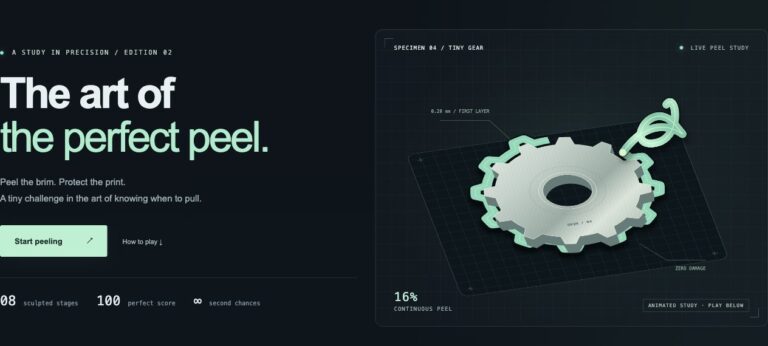
Brim Peel Challenge
Brim Removal Game: 7 Essential Peel Checks
Follow a virtual brim contour in Brim Peel Challenge. Tested manual and assisted controls, 100-point results, lab resets, local bests and export limits.
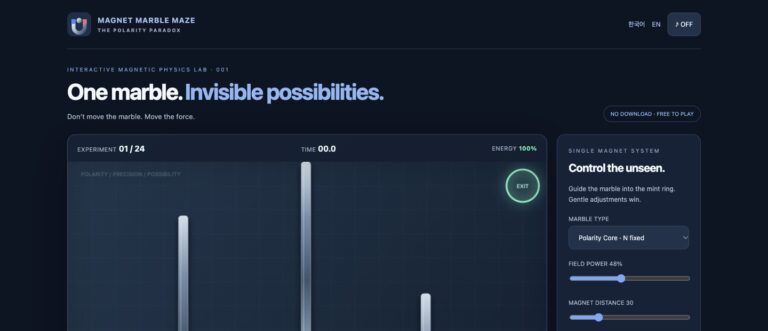
Magnet Marble Maze: The Polarity Paradox
Magnet Marble Maze: 7 Smart Checks for Better Control
Move a magnet to guide a marble through a 2D puzzle. Our guide tests polarity, pulse, rewind, Maker completion and sharing, while separating game outputs from real magnetic measurements.
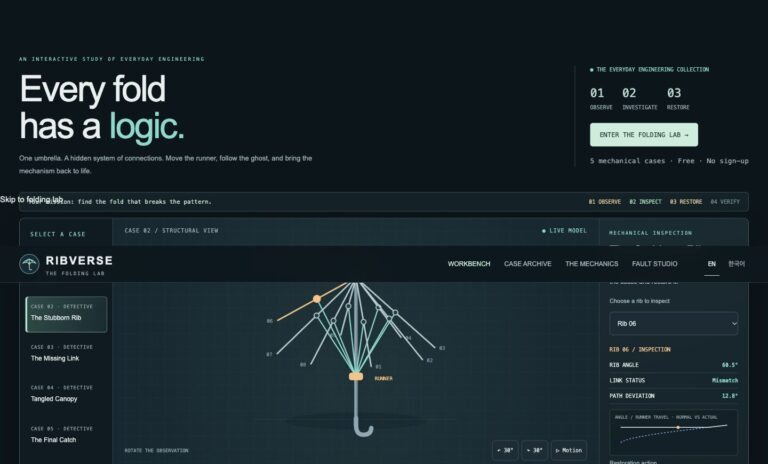
RIBVERSE — The Folding Lab
Umbrella Mechanism: 7 Essential RIBVERSE Lab Checks
Investigate a virtual umbrella linkage with RIBVERSE. Our five-case tests explain ghost paths, matching actions,0° latch faults, completion history and reproducible puzzle links.