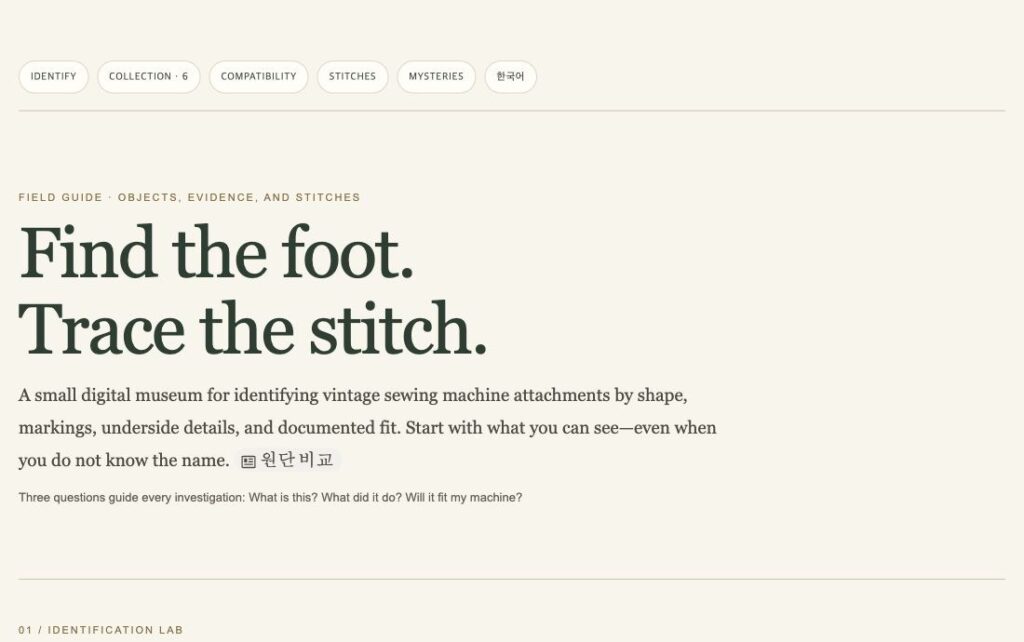
Identify useful clues for a vintage sewing foot with four expandable shape cards and six schematic exhibits. Tested guide navigation and Korean mobile use; separates likely family, documented compatibility and physical inspection.
- Brand
- Vintage Sewing Foot Finder
- Tool languages
- en, ko
- Verified date
- 2026-11-14
Sewing foot identification starts with a useful distinction: a likely family is not a confirmed part number, and neither proves that a loose attachment fits your machine. Vintage Sewing Foot Finder is a bilingual reference guide that helps you gather the clues needed for those separate questions.
Verified 14 November 2026 (KST). We opened the shape clues and specimen example, followed exhibit links and checked the Korean page at 390 × 844. We did not handle an attachment, fit a part to a machine or sew a test seam. All results below distinguish browser observations from suggested physical research.
On this page
Key takeaways
Use the guide to learn what to photograph, which mechanism to inspect and what source would support a compatibility claim. Four expandable silhouette cards lead into six illustrated attachment stories. A compatibility table separates documented, conditional and unknown evidence. The drawings are educational schematics, not photographs of authenticated specimens.
The inspected guide does not accept object photographs, run an identification algorithm or let you save a named specimen record. “Compatibility passport” is a reference section, and the expandable specimen record is an example to read. Keep your own notes and photographs elsewhere.
The most useful outcome can be a specific next question: a missing underside photograph, an unreadable stamped number or a model-specific manual page. Do not let a familiar silhouette turn into an unsupported assertion that an old part is ready to operate.
What Vintage Sewing Foot Finder does
The official name is Vintage Sewing Foot Finder. The site also uses VSFF / The Attachment Archive. Its landing page routes visitors to separate English and Korean guides. The English introduction asks what an attachment is, what it did and whether it fits a particular machine. Those questions organize the archive rather than a form that generates an answer.
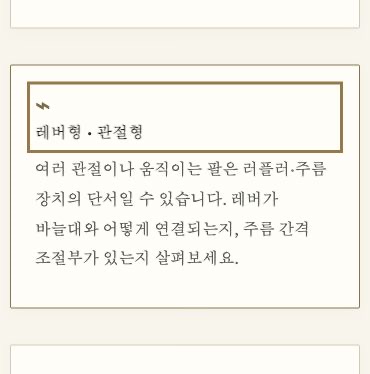
The shape section has four disclosure cards: curled/spiral, lever/jointed, slotted/grooved and flat/forked/other. Opening a card reveals an observation prompt and possible family. The specimen cabinet describes top, side, underside and markings views, with an expandable adjustable-hemmer example.
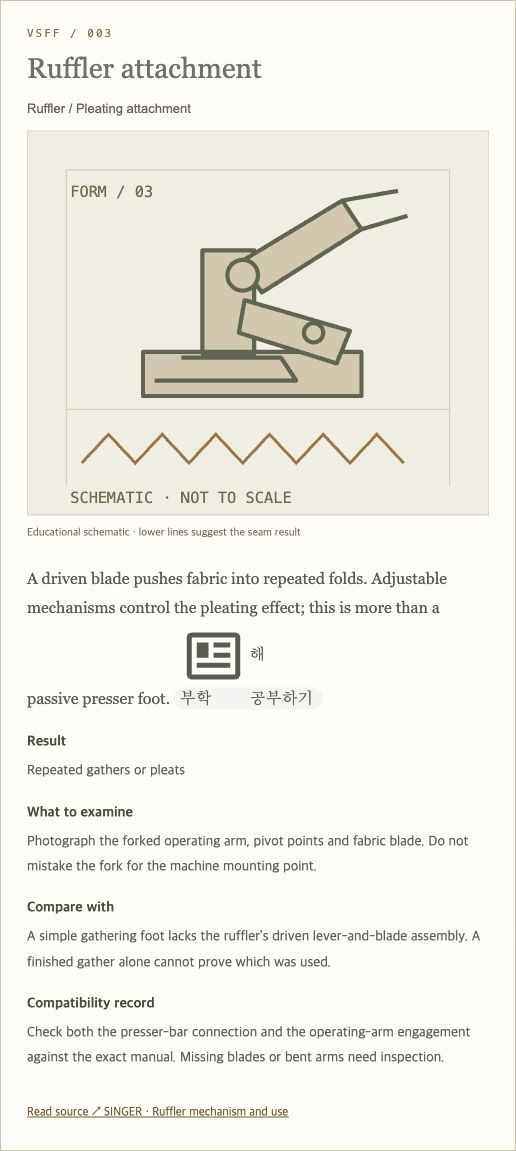
The permanent gallery covers rolled hem foot, adjustable hemmer, ruffler attachment, bias binder, tuck marker and zipper foot. Each exhibit connects a simplified mechanism drawing to the likely seam result, inspection clues and a reference. Its VSFF numbering is editorial cataloging, not a manufacturer’s part-number system.
The remaining sections discuss compatibility evidence, working backward from a stitch, an explicitly unsolved example and research sources. There is no account, submission workflow or automatic match result in the inspected article. Its role is to make a reader’s investigation more systematic.
Separate identity, function and fit
An inherited attachment box creates three different problems. You may recognize what a mechanism appears to do without knowing its maker. You may find a maker’s number without knowing whether that variant belongs to your model. You may find a manual listing without knowing whether the particular worn object is complete and usable.
Write those as separate claims. “Likely hemmer family” describes a functional interpretation. “Listed in this model’s manual” describes documentary evidence. “This individual part was inspected and fitted” describes a physical check. The guide supplies a vocabulary for the first two; reading it cannot establish the third.
This separation also improves requests for help. A clear question with the complete object, underside, visible number and machine model is easier to assess than a top-view photograph captioned “Will this work?”. It shows exactly which uncertainty remains rather than asking another person to reconstruct the entire investigation.
What we tested in the browser
| Browser action | Observed result | Boundary of the result |
|---|---|---|
| English shape clues | All four opened; lever used Enter and flat/forked used Space | Disclosure text worked; no image recognition took place. |
| English specimen example | Expanded a hemmer record template | A readable example, not an editable saved record. |
| Multiple open clues | Several cards stayed open together | Useful for comparing prompts without choosing a single winning family. |
| English navigation | Ruffler index reached #object-ruffler; Compatibility reached #fit | Links moved within the guide. |
| Korean mobile keyboard | Lever card and specimen example opened with Enter/Space | The localized disclosure interaction worked at 390px. |
| Korean navigation | Ruffler and compatibility sections reached after an advertising interruption | An interstitial can interrupt an otherwise valid link. |
| Reload | The five source disclosure cards returned closed | An open-card arrangement was not preserved in that test. |
| Input inspection | No article input, textarea or select fields | No photo-entry, machine-entry or save workflow was offered. |
At 390 × 844 the Korean document stayed 390px wide. Its compatibility table was wider inside its own container, so some content required horizontal table scrolling. This was a reading-layout observation, not a measurement of a machine or an attachment. We also encountered advertisements and a navigation interstitial; ad content was not treated as evidence about the guide.
Prepare one attachment for research
Choose one loose part and give it a temporary identifier before researching a whole box. Keep top, side, underside and marking photographs under that identifier. A movable lever or an unusually long gauge should remain visible in at least one overall photograph rather than being cropped out to make the part look familiar.
Record the machine model from the machine itself and keep it separate from the attachment’s marks. A box label, family recollection or nearby manual can be a lead, but it is not the same as a legible number on the part. Photograph the context without assigning its information to the object prematurely.
Prepare a notebook or document for observations and source links. The guide has no specimen-save control. A short record with image filenames, a tentative family and one unresolved issue is enough to start. You can add measurements and documentary support later without pretending the first guess was already confirmed.
Sewing foot research: 7 evidence checks
1. Choose the closest shape as a question
Open a silhouette card that resembles the object, then read the clue rather than treating the selection as a diagnosis. A curl suggests examining a folding path; a lever suggests inspecting driven parts. A flat or forked object may remain unknown. Multiple cards can stay open, so compare alternatives when the shape is ambiguous.
The page does not filter an uploaded image or rank candidate matches. It reveals descriptive guidance. If two families remain plausible, preserve both in your notes and list what photograph or detail would distinguish them.
2. Follow the material path
Ask what moves through the mechanism and where it emerges relative to the needle. The difference between folding the garment’s own edge and guiding a separate binding strip is more informative than the mere presence of a curved metal channel. A guide that sets a distance is not automatically a device that folds fabric.
SINGER’s rolled-hem foot description explains its scroll-shaped folding guide and advises checking model compatibility. That modern product provides functional context, not evidence that an unidentified vintage curl is that particular product or fits every machine.
3. Photograph four complementary views
Use the cabinet’s top, side, underside and markings prompts as a coverage checklist. Top describes the outline and moving parts. Side helps document mounting geometry. Underside records the opening and contact surface. Markings preserve maker names or numbers exactly as visible.
These views are complementary evidence. Four crops of the same top view do not answer four different questions. Preserve an overall image with a separate size reference if you take measurements; the website’s non-scale diagrams cannot supply dimensions for a physical object.
4. Compare mechanisms across the gallery
Open the nearest exhibit and compare a mechanism, an underside feature and an unresolved detail. With a suspected ruffler, distinguish the operating arm from the mount and check whether the blade assembly is present. A repeated gathered result alone does not identify which technique created it.
SINGER’s ruffler explanation describes an operating arm driven by needle-clamp movement. It supports looking beyond the sole of the foot to the driven mechanism. It does not document compatibility for an arbitrary vintage attachment or replace its own instructions.
5. Transcribe numbers before looking for a match
Write the visible mark literally and attach its photograph. If a character is uncertain, say so rather than completing it from an attractive listing. Keep a stamped number separate from the archive’s VSFF 001–006 labels. The latter identify exhibits within this website.
When a possible manual match appears, retain the document title, model, page and relevant wording. Record whether the match is to a name, drawing, number or explicit model listing. Those are different strengths of connection, and a resemblance to an illustration is not equivalent to a matching part number.
6. Assign documentary compatibility without overstating it
Use documented when an appropriate model-specific source supports the claim; use conditional when a meaningful mounting or variant question remains; use unknown when evidence is insufficient. Write the missing condition beside the label. A green-sounding word without the supporting source is less useful than an honest unresolved question.
The original SINGER 201K manual hosted by ISMACS has separate adjustable-hemmer, binder and tucker sections. It illustrates why the exact document matters. We consulted it as historical context, not as a universal compatibility table for the six gallery families.
7. Separate a reference match from a physical-use decision
A manual listing cannot reveal whether your object is bent, incomplete or altered. Keep documentary status and the physical condition of the individual part separate. The website discusses checking clearances with the machine off; any fitting procedure must follow the exact machine and attachment instructions, not a generic silhouette.
We performed no handwheel, clearance or powered-sewing test. If a physical detail is uncertain, make that the next inspection question rather than converting a reference match into a use recommendation. Preserve the result in your own record; the page does not issue a safety certificate or a saved compatibility passport.
Six families and the evidence still missing
| Possible family | Useful question beyond the silhouette | What remains unproven |
|---|---|---|
| Rolled hem foot | Does the fabric’s own edge follow a scroll into a folded hem? | Exact width, part number and mounting compatibility |
| Adjustable hemmer | Is there a folding guide with an adjustment mechanism, rather than only an edge-distance guide? | Complete mechanism, usable adjustment and model match |
| Ruffler attachment | Is a driven arm connected to a fabric-moving blade? | Correct engagement, completeness and clearance on the actual machine |
| Bias binder | Does a separate strip enter a folding channel around the edge? | Strip sizing and alignment for this particular attachment |
| Tuck marker | Are the spacing gauge and marking parts both present? | Whether a loose gauge is part of a complete working set |
| Zipper foot | Where can the needle pass beside the narrow or offset toe? | Mounting type, intended variant and actual fit |
This table is a research decision aid, not a second manufacturer catalog. It deliberately pairs each likely family with an unresolved claim. Different mechanisms can produce similar seams, and variants within a family can use different mounting systems. The gallery’s value is in directing your attention to the next observable detail.
A clearly hypothetical box-of-parts example
Hypothetical research scenario: imagine finding a curled metal attachment in an old box. You have a clear top photograph but no underside view, an unclear stamped character and a machine model not yet recorded. This is a teaching scenario, not a physical specimen we tested.
Start with the curled/spiral clue. A hemmer family is a candidate, but a separate-strip path might instead point toward a binder. Your next useful action is to photograph the entrance, exit and underside, then record whether the material being folded is the garment edge or an added strip. Do not enter a manufacturer number copied from the most similar photograph online.
The current record can say: “Likely folding attachment; family unresolved between the two candidates. Missing: underside, legible mark and exact machine model. Compatibility: unknown.” That is already actionable. It identifies which information to request before buying an adapter or attempting installation.
If a later manual supports a number and model, add that documentary claim with its source. Keep the earlier uncertainty and the new evidence traceable. The improvement is not a more confident adjective; it is a record someone else can check and a precise description of what still requires physical inspection.
Build a claim you can revisit
Use a small record with separate lines for object ID, observed features, candidate family, machine model, documentary source, compatibility status and next evidence. Add filenames beside important observations so the claim can be traced to the correct photograph. This is our proposed external note structure, not a set of fields inside the guide.
For each conclusion, ask what supports it and what could contradict it. A fork may be an operating connection rather than a mounting point. A screw may fit a hole while the needle path is wrong. A gauge may be present while the marking component is missing. Writing the unanswered question prevents one compatible-looking detail from standing in for the whole assembly.
Distinguish an attachment identity from the stitch used on an old garment. A rolled edge, gathers or parallel tucks can have more than one production route. The stitch section is useful for generating candidates, but the visible seam does not prove which particular attachment or machine made it.
Advanced research habits
Search the original term as well as your own description. A period manual may use tucker or tuckmarker where a seller uses a broad modern label. Preserve the historical wording beside your plain-language note. Similar terminology does not prove that a modern pintuck foot and an older marking assembly are interchangeable.
Keep documentary scope narrow. A manual for one model documents that model. A modern accessory page explains the product it describes. An exhibit links these sources to a family for learning, but that does not extend every source’s fit statement to all vintage variants. Record where the source’s claim stops.
Preserve the complete mechanism in images. An attractive close crop may remove the long bar or driven arm that separates two families. Keep overall and detail views together. Where the mark is unclear, provide an unannotated original as well as a presentation copy so another reader can inspect the character without arrows covering it.
Ask for one decisive missing item. Instead of repeating a broad identification request, ask for the underside, model plate or exact manual page that resolves a particular uncertainty. This reduces circular research and makes an unknown status useful. An unresolved part does not need a made-up identity to deserve a careful record.
Limits, privacy and mobile use
The archive is an educational reference with expandable text and static schematics. It offers no photo upload, automated recognition, measured dimensions, editable collection, downloadable report or machine-specific fit calculator in the inspected article. The unsolved three-pronged-plate case is explicitly an example, not a user submission we solved.
The English and Korean guides worked as reading interfaces. At 390px, Korean disclosures responded to Enter and Space and the page had no horizontal document overflow. The compatibility table extended within its container and needed sideways scrolling for full reading. Reload closed the disclosure cards we had opened.
Blogger advertisements and a navigation interstitial appeared during the visit. Some promotional text was inserted near source content. We did not click advertisement content or use it as an attachment reference. The guide could be read without submitting an object photograph or machine record, but we did not audit scripts, network traffic or data handling. Do not infer that the whole site is offline or free of third-party requests.
Alternatives and related tools
Choose this archive when you need a research checklist and a visual explanation of attachment families. Choose a model-specific manual when you need the documented part and procedure for a known machine. Use an external notebook for persistent records and an image viewer for your own photographs; those tasks are not supplied by the guide’s specimen example.
For preparing evidence images, three published guides offer a natural next step: FrameMint Studio for presentation context, WebP Studio for conversion or resizing copies, and PixelFit Studio for a destination’s dimensions and file-size conditions. Keep untouched originals and check that small stamped characters remain readable.
These tools prepare images; they do not authenticate an attachment or establish compatibility. We did not run a new physical-part photograph through them during this review. The links connect the research workflow to existing public guides rather than claiming additional tests.
Frequently asked questions
Can I upload a sewing foot photo for an automatic match?
No such workflow was available in the inspected guide. Shape cards reveal text clues and the gallery shows six educational families. Keep photographs externally and use the prompts to decide what evidence to gather next.
Are VSFF 001–006 original manufacturer numbers?
No. They are this guide’s exhibit labels. Copy a part number only from the actual object or a documented source that supports it, and keep its photograph or page reference with the claim.
Does the compatibility passport save my machine details?
It is a reference section, not an entry form. The expanded specimen record is also an example to read. We found no save or export control for a private machine or attachment record.
Does a listed part guarantee that an old specimen is usable?
No physical-use result follows from reading a listing. Documentary compatibility, completeness, condition and actual clearance are different questions. We did not install parts or test sewing performance in this review.
Can the same seam be produced by another method?
Yes, the guide explicitly compares alternative ways to create similar finishes. Use the seam as a lead, then examine the mechanism and supporting source. A finished gather or folded edge alone is insufficient to identify a particular tool.
Open the guide with one question
Open one shape clue, compare one relevant exhibit and write down two supporting observations plus one unresolved feature. That small record is a useful starting point even when the final identity remains unknown. A sewing foot match becomes more useful when the evidence, model scope and remaining limits are clear.
Research record: interface and screenshots verified 14 November 2026 (KST). Manufacturer and historical references provide context within their own scope. The seven checks, decision table and hypothetical example are editorial additions, not an account of physical attachment testing.
A RELEVANT NEXT STEP
Tools with a useful connection

FrameMint Studio
Screenshot Editor: 7 Smart FrameMint Studio Checks
Frame screenshots, add manual masks and build captioned stories in FrameMint Studio. Real import, order, recovery and size tests explain what to check before sharing.
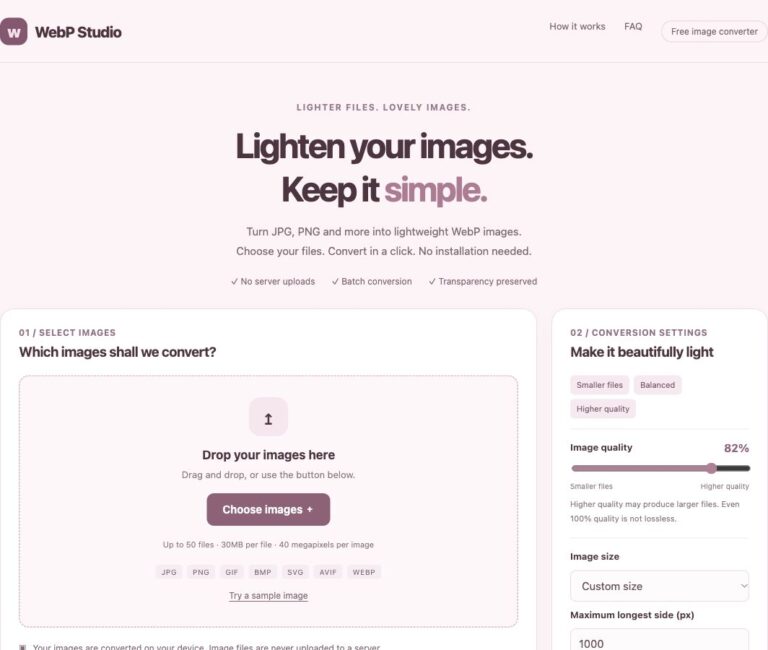
WebP Studio
WebP Studio: 7 Essential Checks for Better Batch Images
Use WebP Studio’s English interface to compare image quality, keep dimensions or resize a batch. Actual tests reveal smaller JPGs, larger outputs and a rounded zero-saving total.
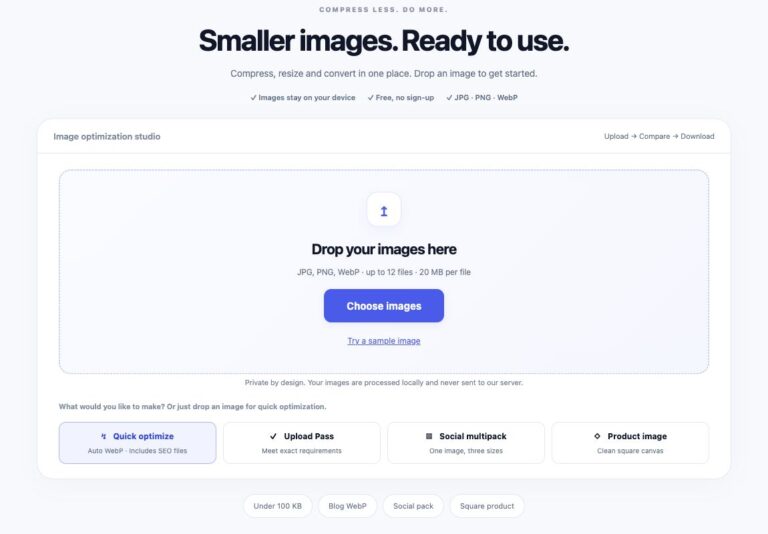
PixelFit Studio
Image Upload Optimizer: 7 Essential PixelFit Checks
Prepare exact upload dimensions and file-size conditions with PixelFit Studio. Actual sample and JPEG tests explain PASS/CHECK, crop versus contain, social totals, copied HTML and the limits of unverified file receipt.