Window Raindrop Race is a browser raindrop race in which you draw wet trails before three drops slide down a window. You alter the course rather than steer a racer. Try a short trail, inspect the result and use the replay controls to compare one change at a time.
Hands-on check: 11 November 2026. We tested the English workbench and a freshly loaded Korean 390 px viewport in Chrome, including completed races, drawing, Undo, pause and a copied course link. No scientific fluid validation or health outcome was tested. This library and the original game share a creator.
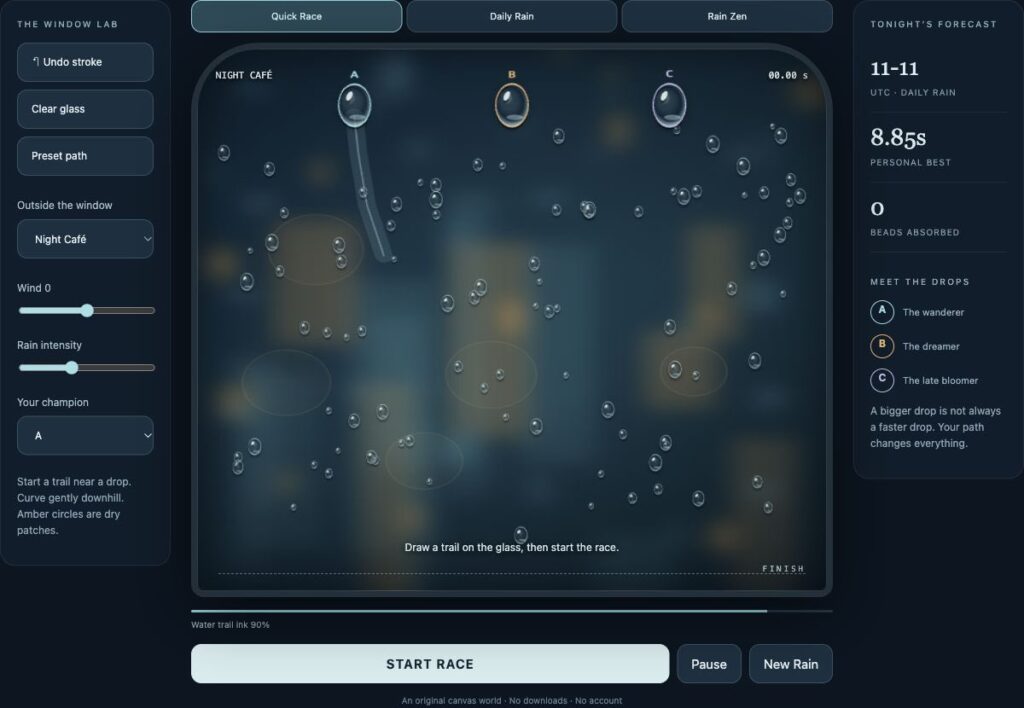
Draw wet trails in Window Raindrop Race. Actual preset, pause, replay and shared-course tests explain ink, winner statistics and why a copied course may not reproduce the same result.
- Brand
- Window Raindrop Race
- Tool languages
- en, ko
- Verified date
- 2026-11-11
In this guide
Key takeaways
The useful distinction is between editing an environment and controlling a moving object. A short wet trail near a drop is a course design input. Choosing A, B or C is a prediction or preference; it does not make that drop follow your pointer. Amber circles are dry areas, and the source describes their effect as extra drag.
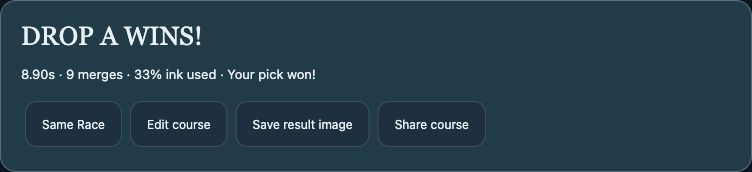
Our first preset course left 67%ink and finished with A winning in 8.90 seconds,9 merges and 33%ink used. Same Race produced the same displayed outcome after a pause/resume test. A fresh tab opened from Share course instead showed B winning in 9.05 seconds and 32%ink used. A copied design is therefore not a verified identical replay in our session.
The game is free to use in the tested flow and required no account or file upload. Local records, sound control, three modes and an image-save button are present. We verified copied-link restoration to a playable course, but did not capture the final result-image file. The physics is explicitly a stylized game model, not a calibrated water or weather calculation.
What this raindrop race changes
The official name is Window Raindrop Race. It takes the familiar experience of watching drops on a bus or café window and turns it into a small course-design game. There are three named racers, smaller beads on the glass and a finish line in competitive modes. A night café scene and a morning-rain scene provide different background choices.
Its main problem is a play-design question: how can you influence an indirect race without continuously steering a character? Drawing a water trail gives you a limited way to prepare the surface. That makes it suitable for a short browser break or a small hypothesis about a game rule. It does not solve drainage design, forecast rainfall, estimate a real drop’s speed or calculate transport through a physical pane of glass.
The source says absorbing beads increases a racer’s volume, its visible radius grows with the cube root of volume, and movement is shaped by gravity, wind, drag and wet paths. Those statements describe the game’s design. We observed bead absorption counters and completed races; we did not inspect or independently validate the numerical model. Avoid converting an attractive animation into an engineering claim.
Wet trails are described as fading during a race, while racer-made traces can affect later drops. The practical implication is that a drawing is an initial condition within a changing scene. A line does not become an immovable rail. Record a result as one observed run, especially when you change modes, reset the rain or move to a shared copy.
Read the controls and result counters
| Input or output | How to read it | Useful caution |
|---|---|---|
| Preset path | Adds a ready-made trail for a first attempt | It is an alternative to drawing, not proof of a universal winning route. |
| Wind and Rain intensity | Weather controls in editable modes | Daily Rain disabled both controls in our test. |
| Your champion | Choose A, B or C before comparing the result | A chosen racer is not manually steered. |
| Water trail ink | Remaining drawing budget | Our 67%remaining became 33%used in the result. |
| Winner merges | A statistic in the result card | The sidebar BEADS ABSORBED was a different total. |
| Personal best | A local displayed record | It is not a verified global leaderboard. |
| Same Race / Edit course | Replay or return to editing | New Rain changes the starting problem. |
Read each counter in context. In the 8.90-second result the card said 9 merges, while the sidebar showed 25 beads absorbed. Those numbers need not represent the same scope. We did not establish a formal definition for every internal counter, so this guide preserves the labels rather than adding them together or calling one a score multiplier.
Sound was off when the game opened, and the page offers a sound toggle. We left it off during the tests. A working button label alone is not evidence that generated audio played or met any loudness standard. The English and Korean interfaces are linked in the header; some canvas instructions and decorative labels remain English in the Korean view.
How to play in 7 smart checks
1. Pick a mode and keep a baseline
Open the original raindrop race and start in Quick Race. Note the background, wind, rain intensity and your champion before drawing. Keep these settings stable for a small comparison. New Rain gives another starting layout according to the source, so it is useful for fresh play but unsuitable as the only control in a one-change comparison.
2. Inspect the starting drops and dry areas
Find A, B and C near the top of the glass. Look for bead clusters and amber dry patches. Decide which small part of the environment you want to change. A trail beginning far from a racer may have little influence, as the original guidance explains. You do not need to cover the entire window to make a meaningful first attempt.
3. Draw one short downhill trail
Drag on the glass near the intended drop and curve downward. In our manual-stroke test, a short trail reduced ink from 100%to 90%. Undo removed that last stroke and restored 100%. This confirms a reversible drawing action; it does not establish a fixed number of pixels per percent. For a keyboard-oriented start, use Preset path instead of assuming the freehand canvas is fully keyboard editable.
4. Check the budget before starting
Our initial preset left 67%ink, so the result later reported 33%used. Read whether a label is showing remaining or consumed ink. If you change the trail, check the meter again. A comparison becomes hard to explain when two drawings use different budgets and you also alter wind, rain and the starting layout.
5. Start, pause and resume deliberately
Press START RACE and watch the drops. Pause changes to Resume. In the repeat test we paused at 00.30 seconds; another observation still showed 00.30, and Resume continued the run. A pause is useful for reading the scene, but elapsed game time should not be confused with the wall-clock time spent reading this guide or leaving the tab open.
6. Read the completed result as a record
The result names the winning drop and reports time, merges, ink used and whether your pick won. Write down those fields together. Our first A result was 8.90 seconds,9 merges and 33%used. A different winner is not automatically evidence that the game ignored your trail; the background conditions and copied-course representation also need to be checked.
7. Replay the same course before changing it
Use Same Race to repeat the current course, or Edit course to return to its design. In our session Same Race reproduced the first displayed outcome. Then change only one stroke if you want a comparison. Use Share course only after checking the copy in a fresh tab, because our shared version did not produce the same winner or ink statistic.
Actual tests: draw, pause and replay
| Test | Observed result | Evidence boundary |
|---|---|---|
| Preset Quick Race | A won;8.90 s;9 merges;33%ink used | One completed original course. |
| Same Race with pause/resume | 00.30 s remained paused; completed A 8.90 s/9/33% | A same-tab replay worked in this session. |
| Share course in a fresh tab | 68%ink remaining; B 9.05 s/9 merges/32%used | Playable restoration, not exact outcome reproduction. |
| Manual stroke and Undo | 100%→90%→100%remaining | Drawing and last-stroke removal worked. |
| Daily Rain selection | UTC 2026-11-11; wind/rain disabled | Mode setup inspected; no Daily completion claimed. |
| Rain Zen selection | Unlimited ink symbol; race start disabled | Noncompetitive mode state inspected. |
| Korean 390 px preset race | A 8.85 s;8 merges;33%used | A separate mobile-browser run. |
| Save result image | No final file captured | Image contents and destination remain unverified. |
We used the built-in preset and one simple original stroke. The original and repeated 8.90-second races are not a statistical benchmark. The Korean result is a separate run, so its 8.85 seconds should not be advertised as a mobile performance advantage. We did not measure frame rates, loading speed, learning gains or stress reduction.
Build a fair course comparison
A practical exercise is to ask whether extending one short route changes the outcome. Start with a course whose settings you have recorded. Run it once and keep the result. Replay before editing to see whether your baseline repeats in that environment. Return to the editor, make one bounded change and record another result. This is a suggested comparison method, not an experiment we completed across many trails.
Record enough information to avoid comparing different problems: mode, UTC date if relevant, wind, rain intensity, champion, remaining ink before start and the result fields. If the layout changes because you pressed New Rain, label it as a new course. A faster time from an easier or simply different layout does not show that a particular stroke was better.
When an edit fails to help, ask a concrete question. Did the trail begin near the racer? Did it lead downhill? Did you spend most of the ink on a long sideways detour? Was the racer passing a dry patch or missing a bead cluster? These are useful observations within the game. They are not measurements of friction, rainfall or surface chemistry in the real world.
Also distinguish prediction from optimization. Choosing B records whom you support; a course can still be interesting when A wins. If your goal is a quiet drawing break, fastest time may be irrelevant and Rain Zen may fit better. Choose the task before deciding which number counts as success.
Quick Race, Daily Rain and Rain Zen
Quick Race is the most flexible starting point for learning the controls. We changed the background to Morning Rain and increased wind from 0 to 1 with the slider’s arrow key. The displayed labels updated. That verifies the controls changed; it does not establish how much that wind value changes real or simulated velocity. We did not benchmark a full range of weather combinations.
Daily Rain displayed DAILY RAIN·2026-11-11 and disabled the wind and rain sliders. The source describes a UTC-dated shared starting layout and local best times stored per day. We inspected that setup but did not finish a daily race, compare multiple visitors or test date rollover. Read the printed date when discussing the challenge with someone in another time zone.
Rain Zen removed the competitive finish/time display in our observed state, showed an infinity ink symbol and disabled START RACE. The source presents it as watching rain and drawing without an ink limit. We did not test prolonged background operation or claim it is an audio sleep aid, a timer, a meditation treatment or a scientifically validated relaxation tool.
Sharing and saving: inspect the actual output
Share course produced a copied-link notice. We captured a URL on the original domain with a course fragment and opened that exact link in a new tab. The copy was playable and kept wind 0 and rain 50, but its ink meter showed 68%remaining rather than 67%. The fresh run ended with B at 9.05 seconds and 32%used, while the original had A at 8.90 and 33%used.
Those observations matter more than a generic copied successfully message. They show that sharing restored something usable, while exact equivalence was not demonstrated. The cause of the difference was not isolated: do not present rounding, frame timing or a specific code defect as a proven explanation. If two people compare a shared course, inspect the loaded trail, weather and budget before ranking their times.
A course link is a design input, not a recording of the winning run. A recipient still has to start a race. Do not assume it carries your local personal best, chosen champion, language, scene preference or result-image file. We verified a limited set of displayed fields, not every piece of state. Reopen the actual link after editing rather than sharing an older copy by mistake.
Save result image was available after completion, but our download attempt did not yield a file we could inspect. The screenshots in this article are direct browser captures of visible states, not outputs from that button. If you need an image for a post or a lesson, verify that the file actually exists, opens and contains the intended result before relying on it.

Limits, privacy and mobile use
The privacy notice says the game does not request a name or file upload, and settings and best records can be saved on the device. A personal-best value remained visible in the same browser, including the Korean page. We did not audit storage keys, network requests, retention or cross-device recovery. Device-local records are not evidence of account-based synchronization or a global leaderboard.
Blogger and Google AdSense may process cookies and device information for platform and advertising services. We saw advertising inserts and overlays during research. A game requiring no login can still load third-party services. Read the original notice and Google Privacy Policy; the game also links to Google ad controls. We did not click advertisements.
A freshly loaded 390 px Korean viewport completed a preset race without horizontal page overflow. The layout hides the desktop side panels in that narrow view, while the preset and race controls remained usable in our test. This is responsive Chrome testing, not a survey of real phones, touch drawing or assistive technology. We did not verify freehand touch precision or full nonvisual access to the canvas.
The result time is game feedback, not a laboratory measurement. Sound playback, long sessions, offline availability, all browser families, persistent storage after clearing data and final image exports remain unverified. The repeated and shared results also limit any claim of universal deterministic replay. Keep those limits visible when explaining the game to another person.
Related games with a different control problem
If you want continuous indirect control rather than a prepared wet trail, try the published Magnet Marble Maze guide. You move a magnet and observe a marble’s response. Its simplified magnetic rules are different from this rain game, and it does not import these courses.
For a slower placement-and-observation activity, Perfect Pebble Stack focuses on stone position, rotation and settling. It is a separate artistic physics game, not a water simulator. These links offer another control problem for a short browser session; neither is a connected replay or export destination.
Frequently asked questions
Do I need an account or an installation?
Neither was required in our browser tests. The source describes the game as free. Ads can still appear, and we did not verify offline use. The presence of an advertising download button does not mean the game requires that download.
Why did my chosen drop lose?
Your champion is a pick, not direct steering. The course and changing scene determine the observed outcome. Inspect where your trail starts and whether it connects downward, then repeat a controlled course before claiming a change helped.
Does Same Race mean New Rain?
No. The source says Same Race keeps seed, weather and paths, while New Rain creates a new starting layout in Quick Race. Our same-tab repeat reproduced 8.90 seconds, but a fresh shared copy did not exactly match. Keep the two observations separate.
Why are merges and beads absorbed different?
They were displayed in different places: the result card said 9 merges and the sidebar 25 beads absorbed. We did not establish that they count the same set of events. Preserve the labels instead of combining the values or presenting the sidebar total as the winner’s merges.
Can I use the copied link as proof of a record?
It restores a course to play, not a verified recording of the result. Our fresh copy changed the winner and ink statistic. A screenshot documents a displayed outcome, but it does not prove a globally ranked or independently certified record.
Is Rain Zen a scientific simulator or a sleep tool?
The page calls the physics stylized. Zen provides noncompetitive rain play with unlimited ink. We did not measure scientific accuracy, sleep, stress or any medical outcome, and we left sound off.
Draw one short trail and inspect the result
Open Quick Race, draw a small downhill stroke or use the preset, and read the ink meter before starting. Keep the winner, time and labeled counters together. Replay once, then change one part of the course. When sharing, inspect the fresh copy as a new playable design rather than assuming an identical result.
A RELEVANT NEXT STEP
Tools with a useful connection
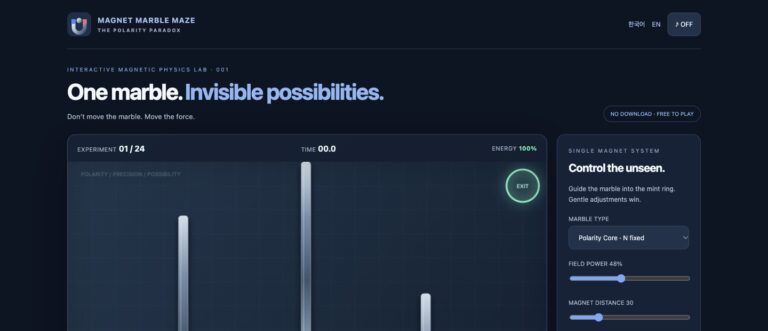
Magnet Marble Maze: The Polarity Paradox
Magnet Marble Maze: 7 Smart Checks for Better Control
Move a magnet to guide a marble through a 2D puzzle. Our guide tests polarity, pulse, rewind, Maker completion and sharing, while separating game outputs from real magnetic measurements.
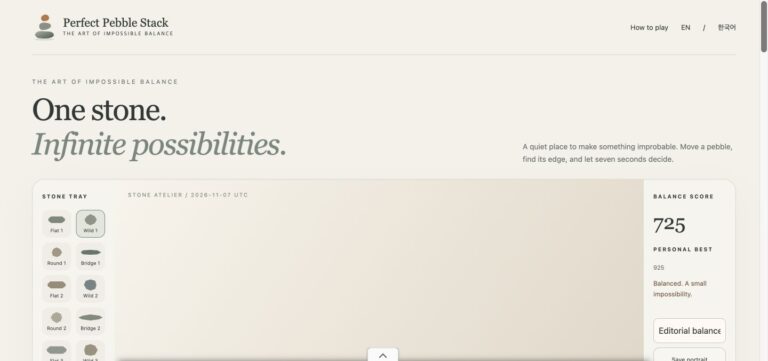
Perfect Pebble Stack
Perfect Pebble Stack: 7 Smart Balance Checks
Build a digital stone sculpture with preview placement, 1° rotation and three modes. Our hands-on guide explains settling, Undo, local portrait storage and the limits of this artistic physics game.
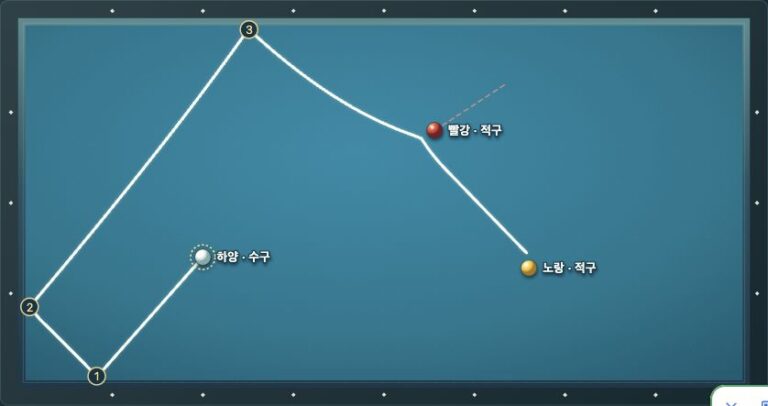
쓰리쿠션 길 안내소
3 Cushion Simulator: 7 Smart Practice Checks
Compare experimental three-cushion routes, save a position and calculate points per inning with 쓰리쿠션 길 안내소. Korean interface; actual table accuracy is unverified.