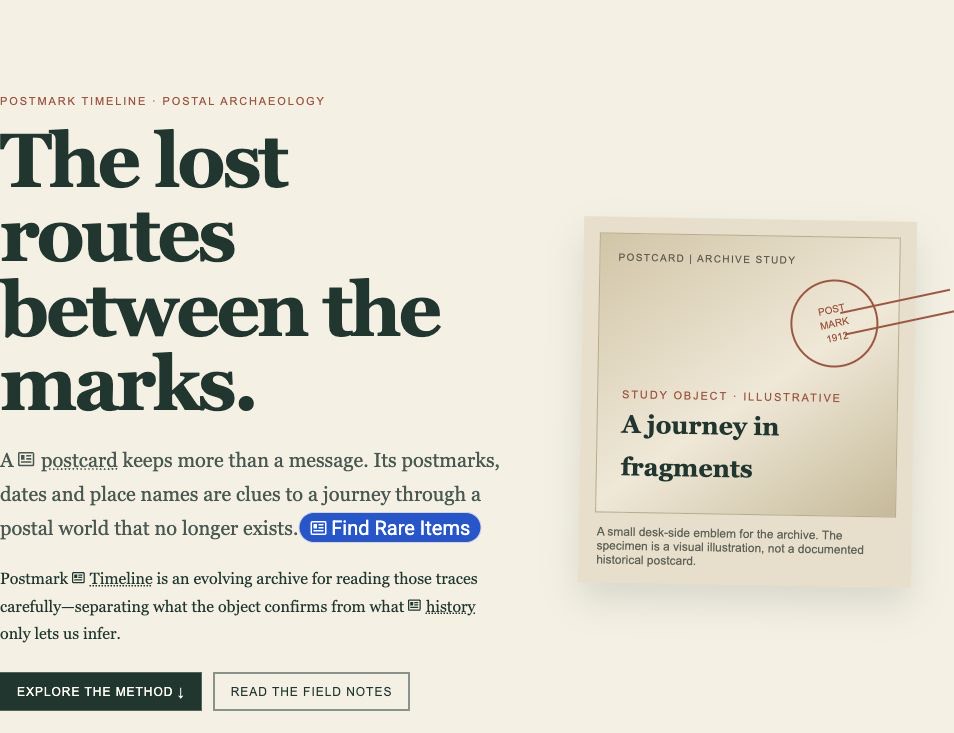
Read postcard postmarks with Postmark Timeline. Tested English and Korean controls, an evidence worksheet and a clear distinction between confirmed marks, inferred routes and missing dates.
- Brand
- Postmark Timeline
- Tool languages
- en, ko
- Verified date
- 2026-11-14
Postmark Timeline is a postmark-reading and postal-history learning archive for separating confirmed evidence, supported inference and an unknown journey. Its illustrated timeline shows how to keep gaps visible when reconstructing an old postcard’s route. The current page is an explanatory framework, not a photo-upload service, automatic date reader, historical route calculator or editable collection database.
Hands-on verification: 14 November 2026, Chrome. We followed an evidence link, expanded the three English field-note answers, tested a FAQ with Enter and Space, and checked the Korean page at a fresh 390px width and after reload. The screenshots are actual website captures. The “1912” emblem and April sequence are explicitly illustrative; we did not examine an original historical postcard or verify a real postal journey.
On this page
Key takeaways before tracing a postmark
Use the archive to improve a research note, not to obtain a finished itinerary. Its central distinction is between a mark you can document on the object, a proposed connection supported by period sources, and an interval that remains unknown. A line between two places does not establish which train or ship carried a particular card. The guide encourages keeping the source and the uncertainty beside the proposed route.
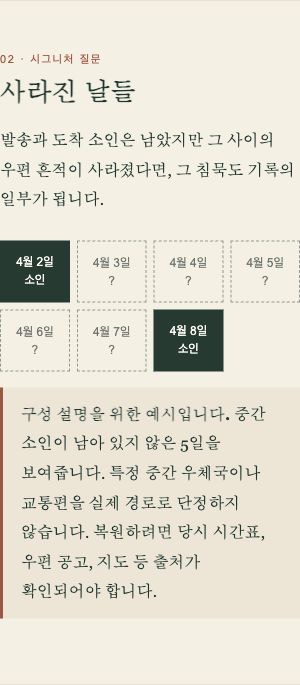
The Missing Days display contains April 2 and April 8 endpoints with question marks on April 3–7. Those are five intermediate date labels, not evidence of a five-day delay. The source labels the sequence a demonstration. No intermediate office or transport service is established. Keep your working transcription and citations elsewhere: the page we inspected offers no personal record editor, import, save or export workflow.
What Postmark Timeline actually provides
An old postcard can contain several kinds of dates and place names. A visible stamp may refer to dispatch, transit, arrival, sorting, delivery or another postal operation; the source’s FAQ warns against assuming that every dated handstamp is the posting date. Postmark Timeline organizes this interpretive problem into evidence, missing intervals, a reconstruction method and an archive-cabinet framework. English and Korean versions are linked.
The archive cabinet currently describes possible record formats: origin to the next known mark, a return or undeliverable item, and an unresolved postmark. These are explanatory cards. We did not find a searchable catalog of documented journeys behind them or a control for submitting a personal case. The page says individual studies can be added once their images, transcriptions and sources are documented, so future intentions should not be described as completed features.
This is useful when preparing a family-history question, organizing a small postal-history collection or explaining why an attractive route map is still provisional. Its value is a disciplined distinction between reading and interpretation. If you need image recognition, a modern parcel tracking number lookup or a transport timetable calculation, this is not the current tool for that task.
Prepare an object record outside the website
Open a separate document or spreadsheet before using the guide. Give the item a neutral working identifier and retain full views of both sides. Assign a separate mark identifier to each visible postal marking and connect it to an image location. If you only want to learn the method, you can read the page without owning or uploading a postcard. Our tested reading and FAQ controls required neither account registration nor payment.
Preserve an unedited original image and name any crops or enhanced presentation copies as derivatives. A small crop may make lettering easier to discuss but can hide its relationship to the stamp, address or another marking. Write down which side and region each crop represents. Do not silently replace uncertain characters with a familiar place name because it fits the story you expected.
Keep four working fields distinct: literal reading, interpreted date or place, evidence supporting that interpretation, and unresolved questions. Add a revision date when a reading changes. This is our suggested record structure outside the website, not an exported Postmark Timeline form. The source introduces the principle; you supply and retain the actual evidence for your own item.
How to use the archive: 7 essential checks
1. Open the guide and identify the example as an example
Use the English button above. Read the caption beside the archive emblem before interpreting the “1912” text as an object date. It is a visual illustration, not a documented postcard. The April timeline is also labeled illustrative. Starting with this distinction prevents a screenshot of the guide from later becoming a supposed historical exhibit in your own notes.
2. Follow the evidence section and separate the marks
Select Explore the method or Evidence. In our English test the page moved to #en-evidence. Read the three evidence categories, then inventory each mark on your own item separately in your external record. A writer’s message date, an address and a postal marking are different pieces of information. Do not merge them into one date simply because they appear on the same object.
3. Transcribe before assigning a postal role
Copy only the characters you can read and retain a question mark for uncertainty. Record where the mark appears. Then ask what operation it may represent, using the whole object and suitable references. The field-note answer lists several possible postal operations. The website does not detect a mark type from a photograph or determine which interpretation applies to your item.
4. Preserve date uncertainty before ordering events
Store the literal date separately from any normalized date. Note missing characters, an unclear year or an unresolved date convention rather than filling them from a presumed journey. Ordering events requires comparable readings. If that condition is not met, a provisional sequence may be all that is justified. Do not calculate exact travel hours from date labels that contain no verified times.
5. Resolve a place name with a source and a period
Keep the name as written beside a proposed modern identification. Record spelling, language and relevant administrative context. A modern map result can suggest a candidate, but the historical office and its period still need checking. When two candidates remain possible, retain both and the reason for uncertainty. Postmark Timeline explains this task; it does not geocode or resolve the name automatically.
6. Add proposed connections only with explicit support
Use period timetables, postal notices, maps or other relevant sources to assess a possible connection. Keep the citation beside the proposed leg. A service’s existence can make a route plausible without proving that this postcard used it. If no evidence supports an intermediate stop, leave the interval unknown. The Missing Days display is designed to illustrate precisely that restraint.
7. Review the claim, citation and next question together
Before sharing, check whether every sentence is an observation, an inference or an unresolved question. Ask what evidence would change your current interpretation and name the missing source or view. Save your record externally. The guide has no personal observation editor or report-export control, and our Korean reload returned all three disclosure panels to their closed state.
Actual navigation, FAQ and mobile test results
| Action | Observed result | Meaning |
|---|---|---|
| English evidence CTA | Address fragment #en-evidence | In-page navigation responded |
| Three English field-note questions clicked | All explanatory answers displayed | Static FAQ content accessible |
| English example FAQ, Enter then Space | Answer opened, then closed | Keyboard disclosure path responded |
| Korean fresh 390px page | Document width measured 394px | Small horizontal excess in source layout |
| Korean date FAQ, Enter then Space | Answer opened, then closed | Localized keyboard control responded |
| Open Korean example FAQ, reload | All three panels closed | Open-panel state did not persist in our test |
These are interface observations. We did not upload, transcribe or authenticate a historical postcard, and we did not test a route against an actual period timetable. No personal data was entered into a research form because no such form was offered. The source site contains Blogger search inputs, but those are not an OCR or archive-record input feature.
Five missing dates do not prove five days of delay
The displayed sequence runs from APR 02 to APR 08. APR 03, 04, 05, 06 and 07 are shown with question marks. Count them as five dates between the two endpoints. In simple calendar-label arithmetic, the endpoints are six date increments apart. Neither number establishes a real card’s travel time or delay: the display is a constructed example and gives no verified event times, item-specific route or historical source for a journey.
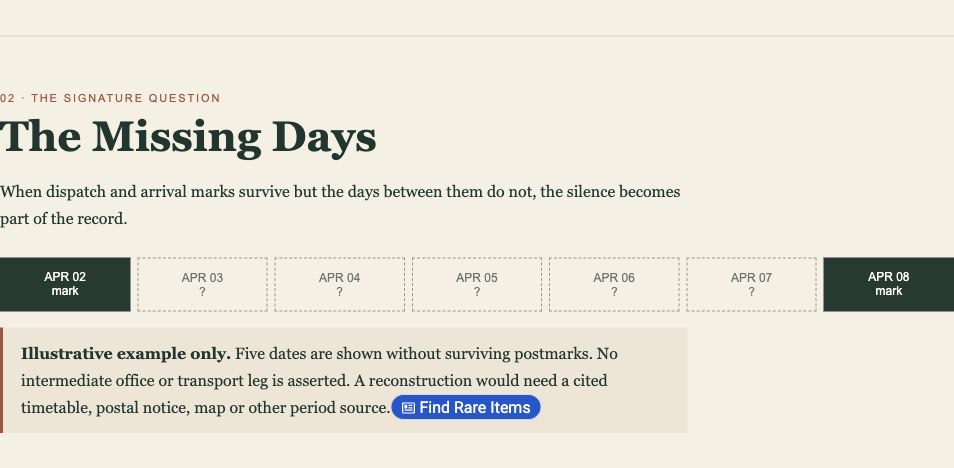
There are three different questions here. How many date labels lack a shown mark? Five in this illustration. What date interval separates the labels? Six increments in the simple sequence. Was mail delayed, where did it wait and what carried it? The diagram supplies no evidence to answer those historical questions. A convincing visual sequence should not collapse these distinctions.
Reader planning example, not an experiment we performed: imagine an item with two legible marks but no surviving intermediate mark. Create two observed-event rows and one unresolved-interval row in your notebook. Do not create five invented office visits to fill five calendar dates. If you later find a relevant timetable, add it as support for a proposed connection while preserving the original two observations.
The same distinction matters for negative statements. “No intermediate mark is visible in the images examined” describes the record you have. “The card did not pass through another office” asserts a journey you have not established. A missing mark may limit knowledge; it is not automatically evidence that a postal event never happened. Keep the scope of the observation in the sentence.
A practical evidence and route worksheet
Use the following worksheet as a reader-created aid. It is not a native input form or downloaded report from the website. A row can represent one observed mark or one explicitly proposed segment, provided its type is clear. Link a claim to the specific image or source that supports it rather than attaching a general bibliography to a confident-looking map.
| Field | Record separately | Why it matters |
|---|---|---|
| Item / mark ID | Original file, side, image region | Returns the reader to the evidence |
| Literal text | Visible characters and uncertainty | Preserves the reading before interpretation |
| Interpreted event | Date, place and possible postal role | Keeps interpretation distinct from the mark |
| Status | Confirmed record, inferred link or unknown | Prevents a proposed leg becoming a fact |
| Supporting source | Repository or publication; exact item/page | Makes a claim retrievable and checkable |
| Revision / next step | What changed; remaining question | Retains a useful correction history |
For an unclear date, the literal field can remain incomplete while the interpreted field is blank. For a proposed link, identify the source’s scope: which offices, service, direction and period does it actually describe? Avoid numerical confidence percentages unless you have a meaningful method for them. A short explanation of the uncertainty is usually clearer than a precise-looking number with no basis. The website supplies no confidence calculator.
Resolve historical names without erasing the original
A familiar modern city name can hide a historical ambiguity. Keep the original script and spelling, a separate transliteration if useful, and a modern candidate with a citation. Distinguish the place, the postal office and the administrative unit rather than assuming they are interchangeable. This is a documentation recommendation, not an identification of any real location shown by the archive.
When a reference proposes a match, ask whether it covers the relevant period and the exact spelling or office designation. Record why it supports that candidate and what it leaves unresolved. If another reading is possible, preserve it as an alternative. Updating a place identification should not erase the transcription that prompted the research. A future reader needs to see both the evidence and your reasoning.
Modern routing tools answer contemporary network questions. A shortest line or current road route is not a historical postal itinerary. Use a map to communicate a sourced interpretation, with the distinction between known and proposed segments explained in words as well as appearance. If a connection has no support, leaving it blank is more informative than decorating it with an assumed journey.
Attach a retrievable source to each inference
A useful citation lets someone retrieve the record you used. The National Archives of Australia’s citation guidance asks for the holding institution, series number and item/control identifier when citing its records. Its guidance also explains identifying a particular document within an item. Follow the relevant repository’s own requirements; do not assume one archive’s numbering system applies everywhere.
For your working note, retain the source title or description, repository or publisher, item identifier or page, stable link where available and the date you consulted it. Also write one sentence stating what it supports. A timetable can support a service’s availability; a mark image can support a transcription. Those are different claims. A citation’s presence alone does not make every sentence next to it true.
Keep the item-level description as well as the image crop. A search-result thumbnail or a detached screenshot can lose the collection context and identifiers needed to find the original. If a source is unavailable, record that fact instead of claiming you inspected it. If access improves later, add the new reading with a revision note. This article’s worksheet is a suggested practice, not a claim that the archive website stores citations for you.
Advanced review and common mistakes
Review the sequence in both directions. Starting from the earliest-looking date may encourage a single story; starting with the last legible mark can reveal that you have not established which role an earlier date played. This is a reasoning exercise, not a method for forcing the marks into a preferred chronology. Keep a record of conflicting interpretations until evidence resolves them.
Use precise uncertainty labels. Unreadable, cropped out, not photographed and not present in the inspected views describe different limitations. A question mark should not silently become a city, date or stop when you make a presentation copy. Check the caption and the prose as carefully as the graphic. A line style alone is easy to overlook, so state explicitly when a connection is inferred.
Keep image editing separate from evidence preservation. Enlarging a crop may help a reader discuss a letter, but it does not establish a missing character. Do not retouch an unclear mark into the reading you expect. If a new image or source changes your interpretation, retain the earlier note and explain the correction. Unsolved postmarks are part of the source’s framework, so leaving a reading unresolved is a legitimate outcome.
Current limits, privacy and mobile behavior
The current page explains an archive framework and possible case formats. We found no upload, OCR, map editor, route simulation, editable case submission, search of verified postcard journeys, personal save or export workflow. We did not verify a historical route, a transport duration, a postcard date or an original artifact. The emblem and timeline should remain labeled illustrative wherever their screenshots are reused.
English and Korean content is available. At a fresh 390×844 Chrome viewport, the Korean source document measured 394px wide, a small four-pixel horizontal excess. Its date cells wrapped into additional rows and the FAQ responded, but advertising could cover content and an interstitial interrupted navigation. This is a source-site usability limitation, not a claim that the guide works perfectly on every phone. Our article previews are checked separately.
Reading the guide does not require submitting a postcard image. That does not establish that the whole Blogger site is offline or free of third-party requests. We observed advertising and did not audit network traffic or implementation code. Promotional links such as shipping or record-search ads are separate from the archive’s actual controls. Keep personal collection notes outside the page because it offers no record-entry workflow.
Related tools for a documented collection workflow
For a captioned presentation of a screen or a marked image copy, read our published FrameMint Studio screenshot editor guide. Manual annotations can identify a mark and an unresolved reading, while the original remains separate. For readers also examining the stamp itself, our PerfPrint Lab review explains why a reference display is not a specimen measurement. Neither tool reconstructs the postcard’s postal journey or supplies its missing historical evidence.
Postmark Timeline FAQ
Can I upload a postcard and generate its route?
No such workflow was present in the current page. It explains a method and archive structure, with illustrative material and expandable answers. Keep your images, transcription and proposed route in a separate research record.
Does every date stamp show dispatch?
No. The source’s field-note answer lists other postal operations, including transit, arrival, sorting and delivery. Determine the role from the marking and context rather than treating every circular mark as the same event. This review does not classify a mark on any reader’s item.
Are the April dates and 1912 illustration real evidence?
No. The source labels both as illustrative. The April sequence explains missing evidence; it is not a verified case. Do not combine the emblem’s year and the timeline’s dates into an invented historical journey.
Will the page save my observations or open FAQs?
There is no personal observation editor. In our Korean reload test the three FAQ panels returned to closed. Preserve your own notes and source files externally; an open browser panel is not an archival record.
Can a timetable prove a particular train carried the card?
A source may support a possible connection, but service availability alone does not prove item-specific carriage. State exactly what the source establishes and keep the link inferred when direct evidence is absent. The archive’s own principle warns against treating a route line as proof of a train or ship.
Start with one mark and one unresolved question
Choose one visible mark, transcribe it conservatively and list what it does and does not establish. Use the framework to separate a documented event from a proposed connection and an unknown interval. The useful outcome is a research note another person can follow and correct, even when the journey remains incomplete.
Sources checked 14 November 2026 (KST): Postmark Timeline root page, English archive guide and Korean archive guide. NAA citation guidance is linked beside the relevant claim. The seven-step workflow, calendar-label explanation and worksheet are independent editorial additions; no real postal journey was experimentally verified.
A RELEVANT NEXT STEP
Tools with a useful connection

FrameMint Studio
Screenshot Editor: 7 Smart FrameMint Studio Checks
Frame screenshots, add manual masks and build captioned stories in FrameMint Studio. Real import, order, recovery and size tests explain what to check before sharing.
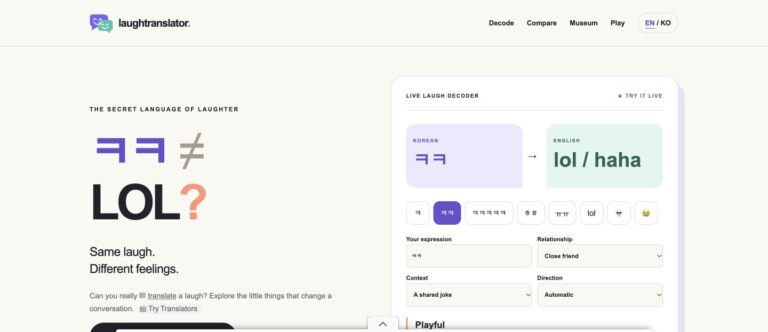
Laugh Translator
Laugh Translator: 7 Essential Checks for Better Replies
Compare Korean and English laugh cues with Laugh Translator. Explore 72 specimens, context notes and fictional reply practice, with hands-on tests and clear limits on translation and emotion interpretation.

나설명서64
Personal User Manual: 7 나설명서64 Sharing Checks
Create a revisable personal user manual in the Korean 나설명서64 interface. Actual synthetic tests explain edited sentences, selected-copy output, type codes, gallery regeneration, local saves and conversation templates. Not a scored assessment.