Laugh Translator compares Korean and English laugh expressions so you can explore how a short reply might sound. Start with ㅋㅋ, lol or an emoji, then change the relationship and situation. Its strongest use is practising clearer replies before a language exchange, international group chat or casual conversation with a colleague.
Hands-on review: November 7, 2026. We tested the decoder, direction selector, length slider, fixed-message comparison, museum search and filters, two theater scenes and a bilingual field-note card in Chrome. We also tested the Korean interface at 390 pixels. The library and original tool share a creator; this is a documented editorial review, not an independent third-party endorsement.
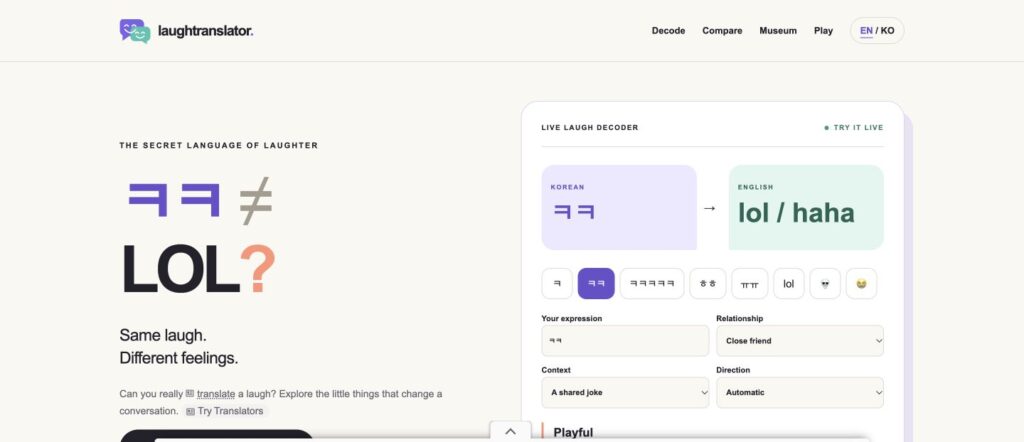
Compare Korean and English laugh cues with Laugh Translator. Explore 72 specimens, context notes and fictional reply practice, with hands-on tests and clear limits on translation and emotion interpretation.
- Brand
- Laugh Translator
- Tool languages
- en, ko
- Verified date
- 2026-11-07
On this page
Key takeaways
- The output is an illustrative comparison of short expressions. It does not translate full sentences, read emotions or establish someone’s intention.
- Changing the relationship or context can change the caution underneath an expression without changing its suggested equivalent. Read both.
- The museum contains 72 specimens, with 24 initially displayed. Its search covers expressions, meanings and examples, so a query can return more than an exact match.
- Ten fictional theater scenes and 24 bilingual field notes support practice. We selected answers in two scenes; we did not complete all ten.
- Use invented examples. The source describes browser-based input processing, while also disclosing Blogger/Google and advertising data processing.
What Laugh Translator actually does
The name suggests translation, but the useful unit here is a small conversational signal: a typed laugh, crying characters or an emoji reaction. The live decoder pairs a recognised expression with a possible counterpart, a descriptive label, an explanation and a relationship/context note. You do not upload a conversation, select a messaging account or ask a model to rewrite a paragraph.
For an English speaker encountering ㅋㅋ, the tool offers a starting comparison with lol / haha. For a Korean speaker seeing lol, the direction reverses and suggests ㅋㅋ / ㅎㅎ. These alternatives are deliberately loose. A laugh can acknowledge a joke, keep an exchange friendly or accompany embarrassment; the displayed pair does not prove the same social effect in every setting.
That makes this a useful small learning lab for language partners, teachers planning discussion exercises and people curious about chat conventions. It is less suitable when you need an accurate sentence translation, a formal business reply or an explanation of a particular person’s private message. Those tasks require information and judgement that the decoder does not have.
The problem: a short laugh leaves out the relationship
Imagine receiving “lol” after reporting a mistake at work. Is the person sharing your embarrassment, trying to soften the moment or making fun of you? The text alone may not settle that. Looking up the abbreviation expands the letters, but it does not supply the conversation history. Treat the tool as a prompt to notice what is missing rather than a verdict about the sender.
A practical response is to separate understanding the symbol from deciding what to say next. First learn a possible use of the expression. Then identify whether the other person needs acknowledgement, practical help or a playful response. Finally write enough ordinary words to make your own intention understandable. The reader should not have to decode a laugh to discover whether you are offering help.
Features: decoder, museum and conversation practice
| Area | What you control | What you read |
|---|---|---|
| Live decoder | Expression; three relationships; three contexts; automatic or manual direction | Suggested counterpart, label, explanation and caution |
| Fixed-message comparison | ㅋㅋ, ㅎㅎ, lol or 💀 | The same reply with a different ending and a possible interpretation |
| Laugh DNA and length | Slider from 1 to 12 copies of ㅋ | Changing expression and visual wave; a metaphor rather than a score |
| Museum | Search, language/reaction filter, more cards, expandable details | 72 specimens with comparisons, examples and context notes |
| Theater and field notes | Answer choices and Next; expandable teaching cards | Ten fictional scenes and 24 bilingual examples |
The length slider is particularly easy to overread. In our test, moving to one ㅋ produced heh / lol with a dry-chuckle label. Moving to twelve produced lmao / hahaha with a big-reaction label. The associated explanation flags the informality of lmao. This is a demonstration of the tool’s categories, not a calibrated scale of how amused a real person feels.
Before you start: language and a safe practice example
Open the original English page or choose KO in its header for the Korean interface. We verified the Korean page at the source’s Korean address. The layouts and central comparison were available in both languages; some theater answer choices remain in English on the Korean page. No account or payment was required during our visit.
Prepare a short invented expression rather than a pasted chat log. The expression field has a 60-character input limit, but that limit does not imply 60-character sentence translation. Begin with one of the eight presets if you are unfamiliar with the script. Decide which relationship and situation you want to examine before changing anything, so you can tell which control caused the difference.
How to use Laugh Translator: 7 useful steps
1. Decode one expression
Choose ㅋㅋ or type lol into Your expression. In Automatic direction, our ㅋㅋ test showed lol / haha, while lol showed ㅋㅋ / ㅎㅎ. Read the description under the result instead of copying only the large output. The label describes a possible usage category; it is not an assessment of the sender.
2. Change the relationship, then the context
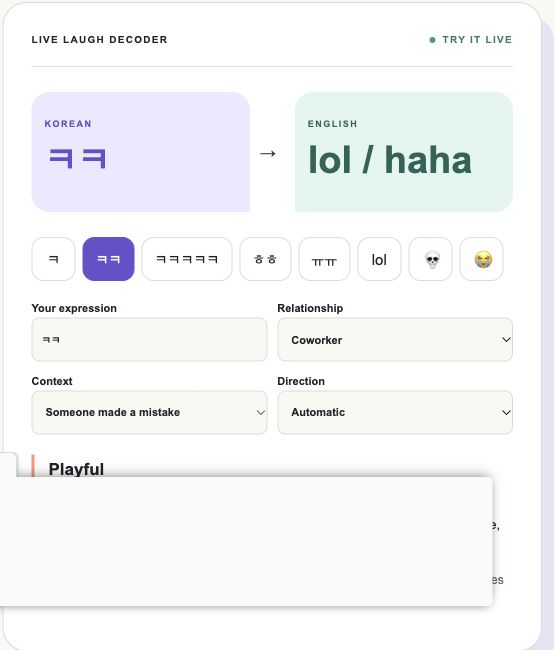
Keep the expression fixed. Compare Close friend with Coworker, then choose Someone made a mistake. Our ㅋㅋ result stayed lol / haha and Playful, while the guidance changed to recommend clear words at work and acknowledging the problem before joking. This is useful evidence that the tool is adding context guidance rather than performing a fresh emotional diagnosis.
3. Check the comparison direction
Leave Automatic on unless you want to examine one direction explicitly. When we selected 한국어 → English while 💀 was still entered, the result asked us to choose a Korean token. The explanatory label remained associated with the emoji. Correct the input/direction mismatch before using the result; a familiar-looking description does not mean that a valid translation was produced.
4. Hold the sentence still and change its ending
Use Compare to switch only the laugh on the fixed tomorrow-meeting exchange. Selecting 💀 changed the reply ending and displayed an explanation about exaggerated disbelief or laughter, with familiarity helping avoid confusion. Keeping the rest of the sentence constant makes the exercise easier to discuss. It still cannot tell you how your own colleague would react.
5. Use the length slider as a category experiment
Move the Laugh Length Machine between its ends and watch the decoder as well as the wave. We used keyboard Home and End to reach 1 and 12. Record the displayed label and proposed counterpart if you are teaching a class. Do not turn the length into a sincerity ranking or assume twelve characters always means more genuine amusement than two.
6. Search the museum and open a card
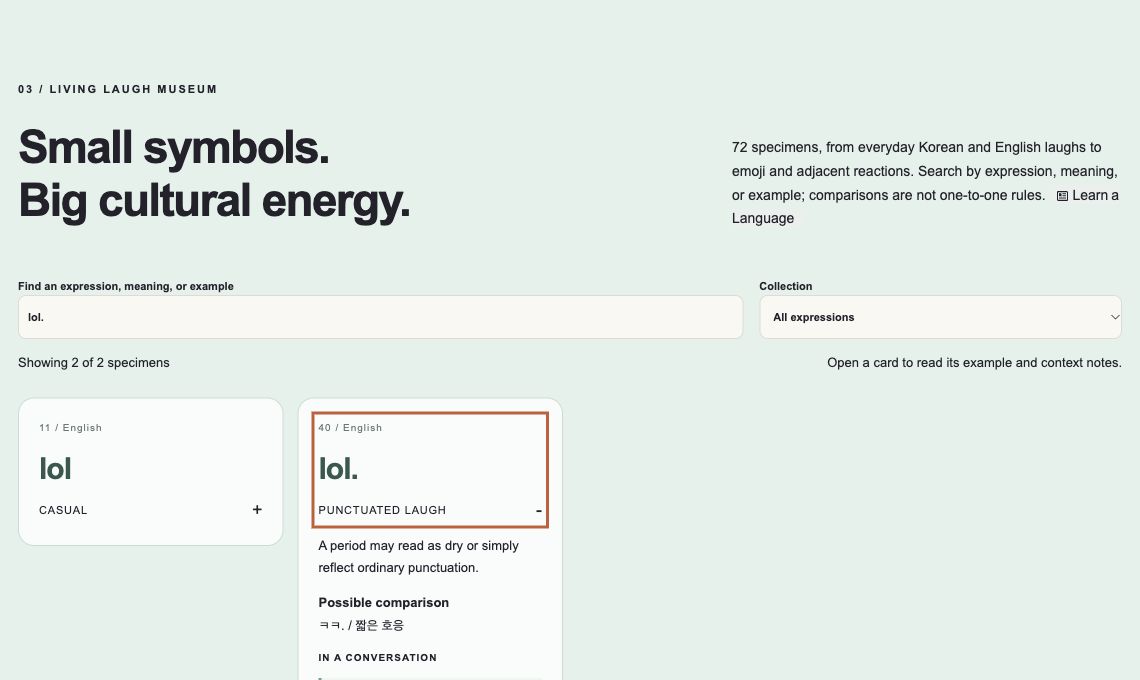
Start with All expressions, enter a term, then open a specimen to read its example and context note. Our lol. query returned two cards, including lol and lol.; it was not an exact-match-only search. Switching the collection to Korean while leaving that query in place returned zero. Clear the search or change the filter when something seems to be missing.
7. Practise a reply, then explain your reasoning
In Play, read the fictional situation before choosing. Our first scene concerned coffee spilled on a keyboard. Selecting the caring question produced feedback describing it as a considerate possibility; Next advanced to scene two. We then selected hahaha 😂 for the ridiculous-cat-video scene and read feedback about shared humour. Use the explanation to discuss choices, without treating the exercise as a personality test.
Hands-on results and the limits of this test
| Test | Observed result | Practical meaning |
|---|---|---|
| ㅋㅋ + friend/joke | lol / haha; Playful | A baseline comparison, not a literal emotional reading |
| ㅋㅋ + coworker/mistake | Same counterpart; caution about clarity and acknowledgement | Read the guidance, not just the large text |
| lol + automatic | ㅋㅋ / ㅎㅎ; Casual | The English-to-Korean comparison worked |
| 💀 + automatic | 죽겠다ㅋㅋ; I’m dead | One online usage, not every meaning of the skull |
| hello there | Not in the collection yet; dash for counterpart | No full-sentence translation was supplied |
| 💀 + forced Korean input | Choose a Korean token | Direction must match the expression |
| Museum more/search/filter | 24/72 → 48/72; lol. → 2 results; Korean filter → 0 | Loading more, search and filtering responded |
| Theater scenes 1 and 2 | Answer feedback appeared; Next advanced the scene | A sampled practice path, not a completed ten-scene run |
These are observed interface outputs from a small test set. We did not verify every specimen mapping, every relationship/context combination, the final result after all ten scenes, long-term persistence or all browser/device combinations. We did not run a network or storage audit. The distinction matters: working controls and sensible sample explanations do not validate a universal model of cultural interpretation.
A practical exercise: turn a cue into a clearer reply
The following is our editorial exercise, not another tool-generated result. Suppose a fictional coworker writes, “I sent the wrong attachment.” A bare lol might be intended to reduce tension, but the recipient still needs to know whether you understood the problem. Use the decoder to inspect the small cue, then write the useful part of the reply yourself.
| Situation | A clearer practice reply | Why discuss this choice? |
|---|---|---|
| Coworker reports a wrong attachment | “Thanks for flagging it. Can you send the corrected version?” | Acknowledges the issue and makes the next action explicit |
| Friend shares a deliberately silly photo | “That pose 😂 How did you manage that?” | Connects the reaction to the shared joke rather than leaving only a symbol |
| New language partner uses an unfamiliar emoji | “I’m not used to that emoji—did you mean it was funny?” | Asks for meaning instead of assuming shared conventions |
For a language-exchange session, each person can invent a sentence and offer two endings. Keep the relationship constant during the first comparison, then change it during the second. Discuss what extra words would make the intention easier to understand. The useful output of this exercise is a reasoned reply, not a list of supposedly correct substitutions.
Advanced tips for a more useful laugh comparison
- Change one variable at a time. If you edit expression, relationship and context together, you lose the ability to explain which difference mattered.
- Distinguish evidence from interpretation in your notes: “the tool displayed Playful” is an observation; “my friend was playful” is an inference the test cannot establish.
- Check the full museum example. Search can match meaning or example text, which explains why an unexpected card may appear.
- Treat a zero-result search as a filter question first. Our Korean collection excluded the remaining lol. results until the filter or query changed.
- Use the work field notes for discussion, then adapt the wording to the actual workplace. A teaching example does not know titles, hierarchy or local chat norms.
- Add words before adding more symbols when clarity matters. A short acknowledgement and a concrete question usually give the recipient more information to work with.
- Explain uncertainty aloud when teaching. A label is a useful conversation starter only if participants can disagree with it using their own context.
Avoid converting the tool into a stereotype chart. The source itself distinguishes editorial Korean/emoji comparisons from the research listed in its bibliography. If you discuss emoji characters, the official Unicode Emoji List is useful for names and keywords. Those character names do not establish the intention behind a particular message.
Limitations, privacy and mobile use
Scope: this is a rule-based cultural learning experiment. It compares recognised short expressions; it does not handle a complete message as a professional translator would. The wave is a visual metaphor, and the quiz is playful reflection. Neither supplies validated emotional, psychological or social-skill measurements. We would not use either to assess a person.
Privacy: the source’s disclosure says inputs are processed in the browser and are not sent to an AI or translation server. It also warns against entering private conversations and explains that Blogger/Google and existing AdSense advertising may process technical data, cookies or identifiers. We read that notice but did not independently audit network requests or storage. Browser processing should not be read as a promise that the entire page makes no external connections.
Mobile: in a fresh 390 × 844 Chrome viewport, the Korean page fitted the document width at 390 pixels. We entered lol, selected coworker/mistake and read the Korean guidance. The decoder sits below the hero, so scrolling is necessary. This was viewport testing, not a physical-phone or exhaustive assistive-technology test. Advertising overlays appeared during desktop research and could cover content; collapse or close controls may be needed.
Practical boundary: do not use an illustrative mapping to accuse someone of sarcasm, romantic interest or hostility. If the conversation matters, ask what the sender meant. If you need formal wording, translate the complete message using an appropriate language workflow and have a fluent person review the context.
Related tools and other ways to solve the problem
Continue with Conversation Collision, our conversation timing game guide, when you want to explore turn-taking after practising typed replies. Laugh Translator focuses on short written cues; Conversation Collision explores choices when two speakers start together. They are separate learning exercises, with no automatic transfer of your input or results.
| Need | Better starting point |
|---|---|
| Understand a short familiar chat cue | Laugh Translator’s decoder and museum, followed by the surrounding conversation |
| Translate an entire message accurately | A full-sentence translation workflow and contextual review |
| Resolve an actual misunderstanding | A direct clarification question to the other person |
| Practise overlapping speech choices | The published Conversation Collision guide and its original game |
For another learning activity, browse the published Games, Learning & Experiments collection. Select by the task you want to practise rather than assuming every playful score measures a real-world skill. The most useful sequence here is cue exploration, a clearer draft reply and, if necessary, a human clarification.
Laugh Translator FAQ
Is ㅋㅋ simply the Korean version of LOL?
The decoder offers lol / haha as a possible comparison for ㅋㅋ. That is a starting point for learning, not a guaranteed replacement in every sentence. Relationship, surrounding text and the person’s usual habits still matter. Read the context note before borrowing the expression.
Does lol. prove that someone is being sarcastic?
No. The museum’s punctuation card describes both a possible dry reading and ordinary punctuation. Our search found that card, but finding a card is not evidence about a real sender. Ask for clarification when the distinction affects your reply.
Why does the translation stay the same after I change context?
In our coworker/mistake test, the ㅋㅋ counterpart remained lol / haha while the guidance changed. These controls can provide relationship and situation cautions instead of changing the expression pair. The small explanatory text is part of the result.
Can I paste a whole conversation into the tool?
That is outside its stated scope. The field is limited to 60 characters and our ordinary phrase test returned an unsupported-expression message. Use a short invented cue; do not paste private conversations. A longer input allowance would still not turn this into a full translator.
Is the tool free and available in Korean?
The source describes it as a free experiment, and our session required no account or payment. English and Korean pages were available. Advertising was also present, and some Korean-page answer choices were English. Availability and the interface can change after our verification date.
Try one laugh, then write a clearer reply
Start with ㅋㅋ, keep it fixed and compare friend/joke with coworker/mistake. Notice which part of the result changes. Open one museum card, then rewrite a fictional reply with the acknowledgement or question that the recipient actually needs. That small routine gives the tool a practical purpose without asking it to read anyone’s mind.
A RELEVANT NEXT STEP
Tools with a useful connection
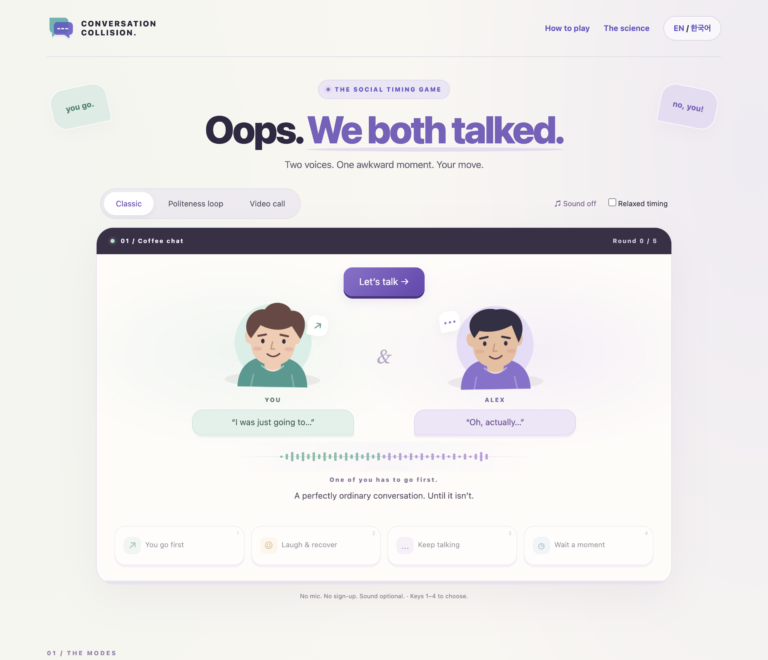
Conversation Collision
Conversation Collision: A Conversation Timing Game in 5 Steps
Explore overlapping speech through a five-round conversation timing game. Compare four responses, three modes and our matched English/Korean tests without treating scores as a personality assessment.
나설명서64
Personal User Manual: 7 나설명서64 Sharing Checks
Create a revisable personal user manual in the Korean 나설명서64 interface. Actual synthetic tests explain edited sentences, selected-copy output, type codes, gallery regeneration, local saves and conversation templates. Not a scored assessment.
COIN EDGE DETECTIVE
Coin Edge Detective: 7 Essential Checks for Better Field Notes
Use COIN EDGE DETECTIVE to describe a coin edge before drawing conclusions. Tested panels and mobile navigation, a seven-step workflow and an independent evidence worksheet.