ZeroBeep Club is a timing game about stopping a simulated microwave before the countdown reaches zero. Click, tap or press Space to start and stop. The closer you stop before zero, the higher the score; letting it reach zero wakes the cartoon cat and ends the round.
Hands-on check: 12 November 2026. We tested the actual English and Korean interfaces with automated browser inputs. These results verify game behaviour, not human reaction speed. This library and the featured tool share a creator; this is an editorial guide rather than an independent third-party endorsement.
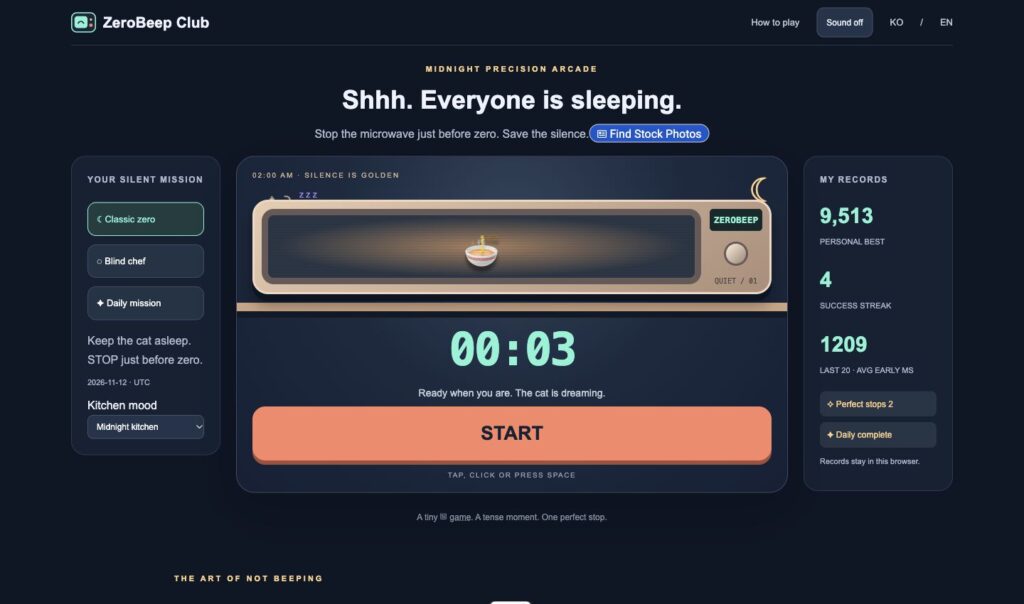
Stop a simulated microwave before zero. Tested Classic, Blind chef and daily rounds explain success versus score, UTC conditions, local records and mobile controls.
- Brand
- ZeroBeep Club
- Tool languages
- en, ko
- Verified date
- 2026-11-12
In this guide
Key takeaways
Success and score are different signals. A very early stop can save the silence and still score zero. Our Classic round stopped 2,707 ms early, received a success message and showed 0 points. Missing zero entirely produced BEEP and reset the current success streak.
Blind chef hides the final second, while the daily mission uses the UTC date to set its conditions. On 12 November 2026 UTC, the daily challenge lasted three seconds with the final second hidden. That is a dated observation, not a promise about tomorrow’s mission.
Personal records belong to the browser, not a verified global ranking. Existing records were already present when we began. We did not earn the displayed personal best of 9,513 or the two existing perfect stops during this review, and we do not present them as our test achievements.
What ZeroBeep Club actually does
The central timing interaction is deliberately small: begin a countdown, wait, then stop just before its deadline. There is no text prompt to write, photograph to upload or questionnaire to complete. The microwave, snack and sleeping cat turn an otherwise abstract interval into a playful visual scene.
Its timing-game use is a brief timing-game break or a small personal timing challenge. You can compare how you respond to a visible countdown and to a hidden final second. It is less useful if you need a working kitchen timer, a calibrated reaction measurement or an account-based competition: none of those is the task this game performs.
The timing result replaces the countdown with a score and a message giving the displayed early-stop margin. A records panel shows personal best, current success streak, recent-20 average early milliseconds, perfect stops and daily completion. The interface also offers a sound switch, two kitchen moods, Share result and Save image.
English is available at /p/en.html and Korean at /p/ko.html. The root address opened in English during our check. Both dedicated pages worked. Opening a different language page retained the local record values in our browser, while the current mode, sound and mood returned to their default settings in a fresh view.
Choose a timing mode
| Mode | Visible rule | Useful first question |
|---|---|---|
| Classic zero | Three-second countdown | Can I stop before zero without rushing? |
| Blind chef | Final second hidden | Can I estimate the ending without the last numeric cue? |
| Daily mission | UTC-date-based duration and blind rule | Am I comparing the same date and conditions? |
Start with Classic zero if you have never played. It exposes the deadline and makes the difference between stopping early and missing the deadline easy to understand. Blind chef adds uncertainty: we directly observed ??:?? in the final second, then stopped successfully.
The publisher says the daily duration is three, four or five seconds and that the date also determines whether the final second is hidden. We verified only the mission displayed on 12 November 2026, not an advance schedule of future missions. The daily completion mark is saved locally; there is no global leaderboard according to the site.
Kitchen mood offers Midnight kitchen and Space station. Choosing Space station changed the visible snack illustration to a planet in our test. We did not establish that a mood changes the scoring or duration, so treat it as a visual option rather than a difficulty setting.
7 steps to a useful first session
1. Open the intended language page
Use the English launch button above or select KO for Korean. Confirm the heading and controls before starting. Both pages are on the same origin, but a language link is still a page navigation; do not use it as a mid-round toggle and expect the current timing attempt to continue.
2. Check sound and your input method
The interface initially showed Sound off. In Korean we changed the label from sound off to sound on and back again. This verifies the switch state, not actual speaker output. For a quiet session, check the visible off state before beginning. Use the same input method when comparing timing attempts.
3. Select Classic zero first
Check the selected timing mode and ready message. Classic starts at three seconds. On a narrow screen the mode controls appear below the game, so scroll to select the mode, then return to the START control. A three-second interval leaves little room for scrolling once the round is running.
4. Start once, then watch for STOP
Press START. The main action changes to STOP! while the countdown runs. You can use the primary button or the advertised Space input. We verified Space starting and stopping a Korean round; the extremely early result was a control check, not a good score.
5. Stop before the deadline
Aim initially for a clear early timing success. Once you understand the result, try reducing the remaining margin. Do not interpret a zero-point success as a malfunction: the formula has a zero floor for very early stops. Reaching zero is a different outcome, accompanied by the awakened-cat message.
6. Read the message before replaying
Compare the timing score with the remaining milliseconds and current streak. A successful but low-scoring stop tells a different story from a missed timing deadline. Note the mode as well: a Blind chef attempt removes a visual cue that Classic supplies. Avoid combining unlike rounds into one claim about improvement.
7. Check the daily date and save only verified output
If you try the daily mission, read its UTC date and conditions first. After a result, you may use the sharing or image controls, but check what actually reaches your clipboard or download folder through your own browser. In our environment the copy-success message appeared, yet the copied link contents and image file were not available for independent inspection.
Our actual timing test results
| Direct test | Observed result | What it establishes |
|---|---|---|
| Classic, no stop | BEEP; cat awake; current streak reset to 0 | Deadline expiry follows the failure path. |
| Classic, immediate stop | 2,707 ms early; success;0 points | Success need not be a positive score. |
| Blind chef | ??:?? observed;600 ms early;3,996 points | Final-second hiding and successful stopping worked. |
| Daily, first result | 250 ms early;7,505 points;Daily complete | The dated mission recorded local completion. |
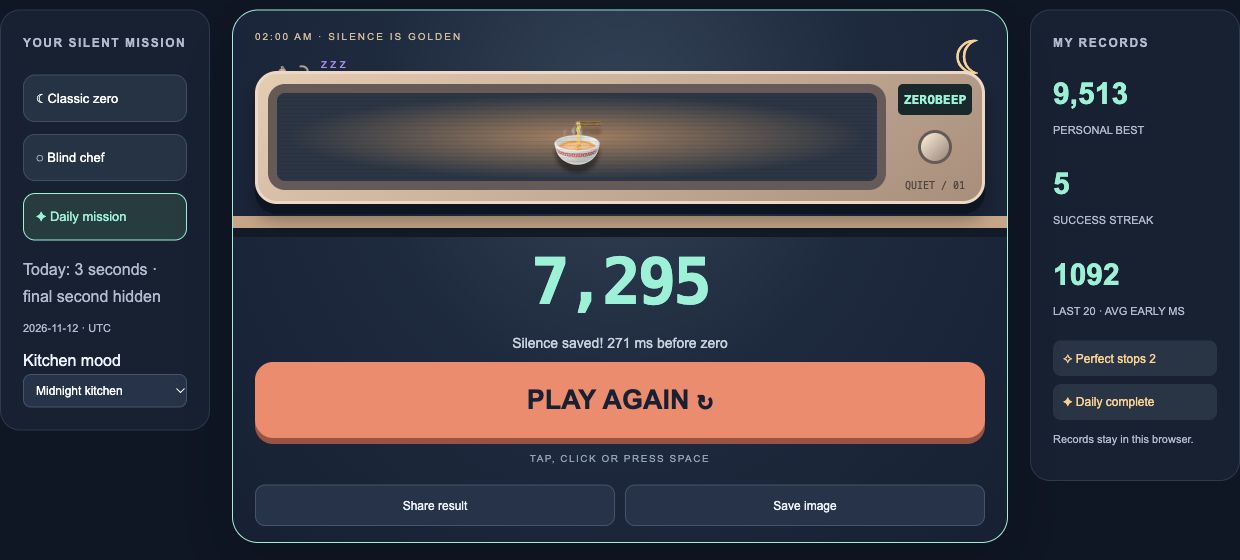
| Daily, pictured result | 271 ms early;7,295 points | A second individual result;not a benchmark average. |
| Korean Space input | 2,975 ms early;success;0 points | Keyboard start and stop worked. |
| 390 px Korean click input | 2,717 ms early;success;0 points | Primary control worked in responsive emulation. |
We used browser automation to exercise the controls. Its execution delays are not representative of a person’s sensory response, mouse skill or physical phone. The table records observed messages and scores, not a controlled timing experiment comparing devices. No perfect-stop achievement was newly verified in these trials.
There were existing local records at the start, including a best of 9,513, one current success and two perfect stops. Later totals therefore mix earlier activity with our checks. Our table uses individual result messages, which can be attributed to the actions we actually performed, instead of claiming that the whole records panel was produced by this session.
Read success, score and milliseconds separately
The published scoring rule is max(0, 10,000 minus remaining milliseconds multiplied by 10). A stop at or after zero is a failed round worth zero. Displayed time is rounded, while judging uses the underlying unrounded value. That last distinction matters when checking an apparent mismatch.
For example, multiplying our displayed 271 ms by 10 would suggest 7,290 points, but the actual result was 7,295. That is consistent with judging an unrounded margin and displaying a rounded integer; it is not evidence that the score was calculated from the printed integer. We did not inspect the underlying timer value or claim a specific hidden fraction.
A margin of 1,000 ms or more makes the pre-zero formula zero or negative, so its floor yields 0 points. The player may still have met the game’s silence condition. Our 2,707 ms early success demonstrates the distinction in the actual interface. Read both fields rather than using the score alone as a pass/fail signal.
The site describes a perfect stop as under 100 ms before zero. Its Korean instructions use wording equivalent to within 100 ms, while the English explanation says under 100 ms. We did not test the exact boundary. If a displayed 100 ms result matters to you, remember that the unrounded measurement may sit on either side of that printed number.
The recent-20 metric is labelled average early milliseconds. We did not reconstruct its sample inclusion rules or calculation from stored data. It is therefore unsuitable for treating every number in the panel as a fresh, independently checked average. In particular, a browser with earlier activity is not a clean timing baseline.
A practical timing routine
Use a short sequence with one variable at a time. First establish a reliable pre-zero stop in Classic, then try smaller margins using the same screen and input. Next try Blind chef and observe how removing the last numeric cue changes your approach. Keep notes on the mode rather than pooling all attempts.
A useful timing note has four fields: mode, daily date if applicable, displayed margin and outcome. Add the score when it helps, but do not discard a failed attempt merely because it looks worse than a successful one. Selecting only your best round makes an informal timing comparison less informative.
For a friendly challenge, agree on the mode, date and input conditions before comparing a result. A desktop mouse and a phone touch interface are not calibrated equivalents. The publisher itself warns that refresh rate and input latency vary. Treat close scores as part of the game rather than proof that one player has faster reactions.
The goal is a brief enjoyable challenge, not a claim that repeated play has measured or improved a cognitive ability. We did not evaluate training effects, attention benefits or transfer to other tasks. A small game can be entertaining without needing those extra claims.
Controls, sound and mobile use
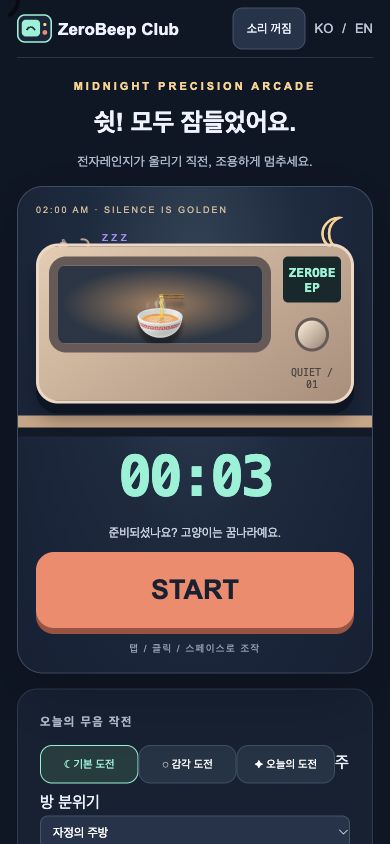
At 390 pixels, the page’s document width also measured 390 pixels. START was visible within the first 628 vertical pixels in the fresh view, and a start/stop click sequence returned a valid early-stop result. The main game moved above the mode and record panels. There was no page-wide horizontal overflow in this check.
On desktop the mode panel, microwave and records sit alongside each other. On mobile, make the settings choice before a round and return to the main timing action. If an advertisement obscures the control, close the advertisement with its own close control before playing; do not confuse an injected shopping link with a game button.
We verified the sound label toggle and the visible Space control, but not every keyboard focus route, screen-reader announcement, vibration behaviour or audio device. We also did not test on a physical handset. These are practical limits to the responsive check, not reasons to reinterpret the measured game scores as hardware benchmarks.
Limitations and common mistakes
The most common mistake is waiting for a displayed zero. The rule requires a stop before the deadline, and the final visible update may be too late. The second mistake is assuming that every early stop deserves points; the scoring floor makes very early success worth zero.
Do not switch modes, navigate language pages or open another task during a short round and then compare it as if nothing changed. The publisher says switching tabs cancels an active round; we did not directly validate that cancellation path. Stay on the game page and use a fresh timing attempt after an interruption.
Advertising appeared during our inspection, including injected links and a panel that could obscure the page. We did not use the advertisements as part of the game. A waiting interval interrupted by an overlay is not a clean timing comparison. Resolve the obstruction before starting again.
ZeroBeep Club is a simulation, not a control interface for a real microwave. It should not be used to time cooking or to make claims about appliance behaviour. Likewise, its local score is not a certified reaction test, a public rank or evidence of another player’s verified identity.
Local records, sharing and image saving
The publisher says the game stores records in localStorage, does not collect a name or email for the game, and sends no scores to a server. Our same-browser English/Korean reloads retained the record values and daily completion. We did not audit network traffic, storage eviction, another browser profile or cross-device transfer.
Blogger and advertising providers may handle cookies and usage data separately. Browser-local game records therefore do not imply that the entire hosting page has no third-party processing. Clearing site data removes the locally retained records according to the site; we did not clear existing user records to test that removal.
Share result produced the visible message “Challenge link copied.” The clipboard text was not available to our tool, so we could not inspect the link or verify a recipient’s experience. We did not post a result externally. Save image was activated, but our download wait returned no file, leaving image format, dimensions and contents unverified.
If you want a keepsake, distinguish an actual received export from a screenshot of the current page. The images in this article are real interface screenshots, not inspected Save image exports. Confirm the received artifact yourself before relying on it as a shareable result card.
Related games for a different challenge
The Uncatchable Fly — Mind vs Wings combines choosing a predicted landing with a timed strike. It is a useful next game if you want a decision about where to act as well as when. Its accuracy and reaction displays should be read within that game’s rules.
Group Photo Chaos replaces a timing deadline with the shared ready moment of an animated crowd. Choose it when you want to watch several changing visual cues before pressing a shutter. It does not require a real camera or photograph upload.
Conversation Collision moves from millisecond stopping to choosing a response when speakers overlap. Its playful partner reactions offer a different kind of timing decision. These are separate published games, with no automatic transfer of ZeroBeep records verified.
Frequently asked questions
Why did I succeed with zero points?
You may have stopped too early for a positive score. The published formula has a zero floor, while success depends on stopping before zero. We directly observed a 2,707 ms early successful stop worth 0 points.
Why does the score not match the displayed milliseconds exactly?
The site says displayed values are rounded and judging uses the unrounded measurement. Our pictured 7,295-point result displayed 271 ms early. Do not reconstruct an exact hidden timer value from a rounded readout.
Is the daily challenge based on my local midnight?
The displayed date and publisher explanation use UTC. Our 12 November 2026 mission was three seconds with the final second hidden. Check the date on the page when comparing with someone in another timezone.
Are scores comparable across devices?
Only as informal game results. Input latency and refresh rate can differ. This review used automated browser inputs and responsive emulation, so it provides no scientific device or reaction-speed comparison.
Did image saving and challenge sharing pass end-to-end?
No. A copied-link confirmation appeared, but the link contents were unavailable. Image saving did not return a file to our tool. Those controls are present; their final artifacts remain unverified.
Try a short round
Begin with Classic zero, keep sound in the state you want and make one deliberate stop before zero. Read the margin as well as the score. When that is familiar, try the hidden final second or the dated daily mission and keep the comparison playful.
Verified 12 November 2026. Direct results, publisher descriptions and unverified sharing/export behaviour are distinguished throughout this guide.
A RELEVANT NEXT STEP
Tools with a useful connection

The Uncatchable Fly — Mind vs Wings
Fly Catching Game: 7 Essential Checks for Better Play
Predict a fly’s landing, wait out a bluff and make one timed strike. Tested Mind Duel and Korean Daily Fly reports explain accuracy, catches, reaction displays, mobile controls and sharing limits.

Group Photo Chaos
Group Photo Game: 5 Fun Ways to Master the Timing
Catch the shared ready moment in an animated group portrait. A tested guide to timing, shutter delay, replay and reading the score.
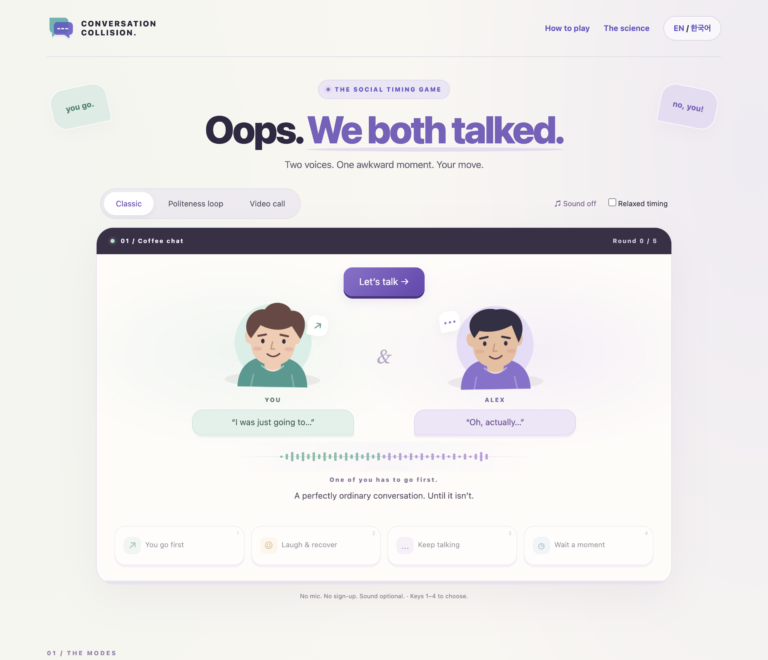
Conversation Collision
Conversation Collision: A Conversation Timing Game in 5 Steps
Explore overlapping speech through a five-round conversation timing game. Compare four responses, three modes and our matched English/Korean tests without treating scores as a personality assessment.