DUNGEON TORCH SHADOWS is a rule-neutral 2D dungeon lighting lab. Move a torch, inspect an obstacle’s shadow and compare a short route with a route that gives light a movement cost. Use it to design a spatial question before applying your tabletop game’s rules.
Checked 13 November 2026 in Chrome. We tested torch movement and undo, a door, point analysis, pillar placement, both route modes, scene saving/restoration, a fresh shared link and Korean settings at 390 px. All results are from the browser model. We did not measure real light, run an RPG stealth check or inspect exported PNG/JSON files.
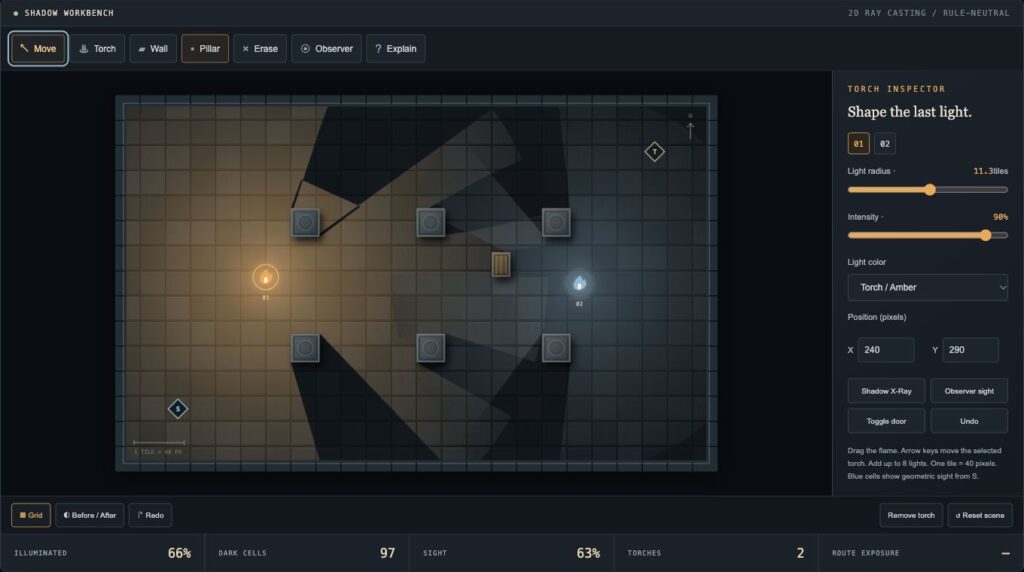
Compare dungeon light, observer sight and shadow routes. Actual tests explain Explain points,60/66-cell paths, scene restoration, mobile controls and rule-neutral limits.
- Brand
- DUNGEON TORCH SHADOWS
- Tool languages
- en, ko
- Verified date
- 2026-11-13
On this page
Key takeaways for dungeon lighting
Illumination, geometric sight and detection answer different questions. The tool models the first two and provides a relative route score; it does not decide whether a creature notices a character. A dark point can remain in an observer’s unobstructed sight, and another torch can illuminate a point blocked from the selected torch.
Our one-torch puzzle produced a 60-cell shortest route at 13% exposure and 87/100. The illumination-weighted route reported 66 cells,7% and 93/100; repeating it gave the same result. The six additional reported cells traded against a lower displayed mean illumination. Neither result is a measured detection probability or a rules-system success rate.
Scene saving and full-link restoration worked. After reloading and restoring, route exposure showed a dash until routing was run again. Keep the scene recipe and the route observation as separate records. The source defines one tile as 40 source pixels, while route search uses a 20-pixel grid.
What DUNGEON TORCH SHADOWS does
The official name is DUNGEON TORCH SHADOWS, presented as The Last Light / Dungeon Lighting Studio, version 2.0. It is a browser Canvas workbench for torch placement, opaque obstacles, observer sight and an S-to-T route exercise. It is free to explore without an account according to the visible interface.
The dungeon problem it makes tangible is a disagreement between the map’s appearance and its geometry. A warm-looking room may contain a blocked light path. A route can be short yet pass through brighter cells. A global percentage can barely change while the point your encounter depends on changes considerably. The lab lets you ask those questions explicitly.
Move, Torch, Wall, Pillar, Erase, Observer and Explain are available in the toolbar. The inspector exposes selected-torch radius, intensity, color and X/Y source coordinates. Shadow X-Ray, Observer sight, door toggle, grid, before/after and edit-history controls support inspection. We directly verified movement, door behavior, Explain and one pillar placement; we did not test every drawing mode or every light-count configuration.
The library offers The Forgotten Crypt, Hall of Pillars, The Narrow Passage and The Cursed Altar. Treat each as a different starting geometry. Our reported baseline below is the reset two-torch setup, not a claim that the first library button was the active preset. The scene names alone are not evidence of which map was tested.
Prepare a repeatable dungeon experiment
Start with one question: “Is this point blocked from torch 1?” or “What does a darker route cost in this scene?” Record the selected light, its position, radius and intensity; the door state; observer S; target T; and relevant obstacles. Keep those fixed until a baseline has been captured.
| Record | Reason | Do not substitute |
|---|---|---|
| Torch position and settings | Define the light being inspected | The color or position of a different torch |
| Door and obstacle geometry | Determine blocking and walkability | A decorative screenshot alone |
| S and T | Define sight origin and route endpoints | An assumed RPG character’s abilities |
| Map statistics | Summarize sampled floor cells | An exact point’s illumination |
| Route mode and reported cells | Identify the route objective and result | A game movement allowance in feet |
Decide your tabletop scale outside the tool. One source tile is 40 pixels, but the app does not automatically convert that to your system’s movement or vision rules. Source coordinates also differ from browser-screen pixels: the 960×600 canvas can be displayed at a smaller size on a phone. Use the numeric inspector when you need a reproducible torch position.
Before making an edit, save a screenshot or write down the current values. Adding a new torch, moving the observer and opening a door at once changes several causes. A visually pleasing result can be difficult to explain if you lose the reference scene.
Light, darkness and sight are different metrics
The source says whole-map statistics sample walkable 40-pixel cells. A sampled cell is counted as illuminated above 15% relative light, while dark cells are counted below 8%. These are different thresholds, and one result is a percentage while the other is a count. You cannot turn 66% illuminated into a 97-cell dark result by subtracting from 100.
Cells between the stated thresholds need not belong to either category. The displayed whole percentages are rounded summaries. In our reset scene, moving the selected torch from X 240 to 250 left illuminated at 66% and sight at 63%, but dark cells changed from 97 to 95. A stable rounded percentage did not mean the edit had no effect.
Sight is the fraction of sampled cells with a clear geometric segment from S, independently of lighting. Explain instead inspects a clicked point: its distance from the selected light, whether that light path is blocked, and the combined relative illumination. These views complement one another rather than sharing a single denominator.
Route exposure uses the route’s 20-pixel cells. It is not the same sampling grid as the whole-map panel. Compare route results within one documented scene and mode, and do not infer a route’s exposure from the global illuminated percentage.
7 checks for a useful dungeon lighting plan
1. Establish the dungeon baseline
Open the lab and record the current geometry before editing. Our reset setup had two lights; torch 1 was X 240/Y 290, radius 450 pixels and intensity 90%. The interface displayed 11.3 tiles for that radius,66% illuminated,97 dark cells and 63% sight. Preserve a copy of your own work before resetting.
2. Select one torch and test a small move
Select torch 1 and focus the map. In our desktop test ArrowRight changed X 240 to 250. Dark cells became 95, while the two rounded percentages stayed the same. Undo returned X 240 and 97 dark cells. This is a useful demonstration of local sensitivity without a large scene redesign.
3. Inspect one exact light-path question
Choose Explain and click a point in the map. Our click around source coordinate 400,100 reported 6.2 tiles away, blocked by a wall or pillar, with 0% combined illumination. Around 200,300 the tool reported 1.0 tile, a clear path and 82%. Those are model observations for those positions and light settings.
4. Change one blocking condition
Toggle the door and record its visible state. Opening it in the reset scene changed dark cells from 97 to 96 while illuminated remained 66% and sight 63%. We also added one pillar through the canvas: the copied scene contained an additional 40×40 rectangle, and Undo returned the visible baseline. Do not assume a door must produce a dramatic whole-map percentage change.
5. Start the one-torch puzzle deliberately
Start one-torch puzzle creates a controlled challenge state. In our test it used a single light at X 480/Y 300 with radius 440 pixels and intensity 90%. Record the new baseline rather than continuing to quote the two-torch values. The challenge is reusable practice, not a newly generated daily level.
6. Run both route modes before choosing
Shortest route reported 60 cells,13% exposure and 87/100. Test shadow route reported 66 cells,7% and 93/100. Repeat a mode before making another edit if you want to check reproducibility. We repeated the weighted route and obtained the same displayed result.
7. Save the scene and its observation separately
Use Save in browser or Copy scene link, then verify restoration. Record the route mode, count, exposure and score in a note or screenshot. After restoring in a freshly loaded page, run the route calculation again. A saved scene is a reproducible input, not proof that an old route has been preserved or remains the right comparison.
Our actual dungeon test results
| Direct test | Observed result | Scope |
|---|---|---|
| Reset two-torch scene | 66% lit 97 dark 63% sight | A model baseline, not real visibility |
| ArrowRight on torch 1 | X 240→250; dark 97→95 | Small coordinate change registered |
| Undo movement | X 240; dark 97 | The move was reversible |
| Open door at baseline | Dark 96 lit 66% sight 63% | Rounded global metrics can conceal local change |
| Explain near 400,100 | 6.2 tiles; blocked; 0% | Selected path and combined light at one point |
| Explain near 200,300 | 1.0 tile; clear; 82% | A second local model observation |
| Shortest puzzle route | 60 cells; 13%; 87/100 | Unweighted route result |
| Shadow-weighted puzzle route | 66 cells; 7%; 93/100; repeat matched | A lower displayed exposure for this scene |
| Reload/restore or fresh link | LightX 480 restored; rerouting reproduced 66/7/93 | Geometry restored; route recomputed |
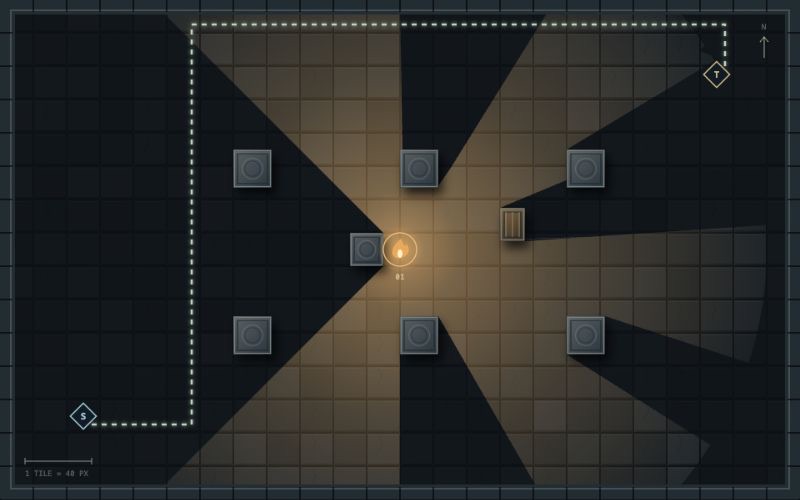
The point-analysis distances are straight-line distances from the selected torch, expressed in the source’s tile scale. They are not a character’s walkable route around obstacles. Keep distance, path blockage and combined illumination in separate columns when explaining a dungeon decision.
We tried Export JSON, but no retrievable download was exposed within an eight-second observation window. The file contents, re-import and PNG output remain unverified. This does not establish a universal export failure. The source advertises a 960×600 map export; our article images are browser captures, not evidence that its PNG export succeeded.
Shortest route versus illumination-weighted route
The source makes its route cost explicit: each step costs 1 +8×illumination, with illumination represented on a 0–1 scale. A dark cell contributes 1; a fully illuminated cell contributes 9 under that formula. The route therefore balances travel length with light, instead of minimizing mean illumination at any possible length.
That distinction matters. A lower-exposure route can be longer, and the weighted-cost optimum is not automatically a proof of the absolute minimum average exposure among every conceivable detour. Our 66-cell route was a better displayed exposure comparison than the 60-cell route, but we did not exhaustively enumerate all routes or independently audit the routing implementation.
Routing uses a 20-pixel grid and four-direction movement. The displayed cell count should be retained as reported; do not casually relabel it turns, feet or exact walking distance. The score formula is 100×(1−mean route illumination). With rounded outputs of 13% and 7%, the displayed 87 and 93 are consistent with that description, but the underlying mean may have more precision.
After changing torch position or geometry, explicitly rerun routing before recording the next result. In one editing test a 7% route badge remained visible while the map illumination changed. We do not infer from that badge alone which route or calculation state is current. A new calculation and its status message provide a clearer comparison record.
A game master’s dungeon comparison worksheet
Suppose an encounter offers a direct passage and a darker detour. Use the one-torch example as a worksheet, not as a ready-made stealth ruling. The useful design decision is whether the spatial alternative is understandable and whether the route trade-off suits the scene you want to run.
| Decision field | Example from our test | Separate tabletop decision |
|---|---|---|
| Scene input | One light at 480,300; radius 440; intensity 90% | What a torch represents in your game |
| Direct alternative | 60 reported cells; 13%; score 87 | Movement time and allowed actions |
| Darker alternative | 66 reported cells; 7%; score 93 | Whether darkness matters under your rules |
| Occlusion question | Use Explain at a named location | Creature senses and concealment rules |
| Evidence | Save scene plus route-mode note | How much to reveal to players |
A practical host note could say: “The weighted route adds six reported cells and lowers displayed exposure by six percentage points in this model.” That is precise enough to discuss the map without claiming a 6% reduction in detection or a 93% chance of success. Percentages, percentage points and game outcomes are different quantities.
For a classroom exercise, ask one person to predict the effect of moving a light before the change is made, and another to record the local and global outputs. The goal is to explain why a rounded summary can stay stable while a particular point or dark-cell count changes. This is a proposed activity, not a session we conducted.
Explain a point before changing the dungeon
Explain is particularly useful when the screen looks ambiguous. Select the relevant torch first, then choose Explain and click a point. A blocked selected-light path does not, by itself, prove total darkness: the source reports combined illumination, so a second light may still contribute.
If the question concerns an observer, inspect Observer sight separately. Shadow X-Ray is a geometry aid; a visibility overlay is not another illumination source. Turning an overlay off does not remove its underlying geometric constraint. Record which inspection mode was active in a screenshot so readers understand the colored cells.
The inspector’s source coordinates help reproduce light positions, while point clicks depend on the displayed canvas size. On a scaled map, do not confuse a browser click at a particular screen pixel with that same numeric coordinate in the 960×600 scene. Use the source grid and labels to communicate a location consistently.
Save, share and recalculate a dungeon scene
Save in browser and Restore scene worked for our single-light challenge. After saving at X 480, we moved the light to 490 and restored it to 480. After reloading and restoring, the light and geometry returned while route exposure displayed a dash. Running Test shadow route again produced 66 cells,7% and 93/100.
Copy scene link generated a URL using #scene=…. Its visible copied payload contained lights, obstacle rectangles, door state, observer S and target T. We opened that actual link in a fresh tab and checked X 480 before recalculating the weighted route. The route result is therefore a new calculation from restored input, not an exported replay.
A screenshot shows what you saw. A scene link carries input data. A JSON file is intended to carry geometry, but its artifact and import remain unverified here. Keep a baseline image, the full link and a short result note together. Do not assume a “copied” message or a file button proves that every other record exists.
Korean mobile controls and common mistakes
At 390 px, the Korean map loaded without horizontal overflow. The torch inspector was collapsed behind “횃불 설정 및 분석”. Opening it exposed radius, intensity, color and coordinate inputs. We changed Xfrom 240 to 260 and selected Rune / Violet in Korean. This was a narrow Chrome viewport test, not a claim about every physical handset or touch gesture.
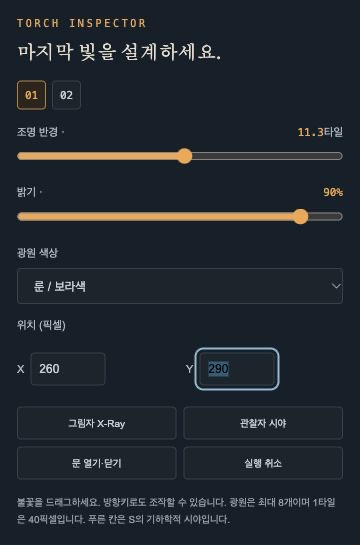
The mobile toolbar is horizontally scrollable according to the on-screen prompt. If a control seems absent, inspect the toolbar and collapsed inspector before assuming the feature is missing. Explicit numeric inputs are useful when touch dragging would be imprecise. Keyboard movement was directly tested on the desktop canvas.
Common mistakes include changing the challenge state without recording it, analyzing the wrong selected torch, equating dark-cell counts with dark percentages, treating geometric sight as detection and reading an old route badge after editing. Keep a small before/after note and rerun the calculation that answers your current question.
Dungeon model limits and privacy
This dungeon simulator is 2 Dwith full-height opaque obstacles. Soft penumbra and height-dependent 3 Dshadows are outside the source’s stated scope. Its warm falloff is an artistic relative-light model, not calibrated lux or a real lighting-engine validation. Eight lights is the interface’s stated cap; our numerical tests used one or two, not all eight configurations.
There is no verified RPG rules engine, enemy behavior, sound detection, darkvision model or stealth success verdict in these tests. Apply your chosen system’s rules separately. A high relative shadow score is a planning result, not permission to treat a character as undetectable.
The source describes browser local storage and does not ask for account or personal-data input. Shared fragments contain scene data and anyone with the full link can inspect it. Blogger and Google advertising were visible and sometimes obstructed controls; we used close/collapse controls to continue. No independent network audit or offline-operation test was performed.
Related tools for the next design task
For a separate search-method lesson, the Slime Mold Maze pathfinding guide explains breadth-first search, explored cells and final route length. It is useful for understanding why the area searched differs from the chosen route. Its unweighted grid exercise does not validate this dungeon’s illumination-weighted costs.
To prepare a readable player handout or design note, see the FrameMint Studio screenshot editor guide. Label S/T, the selected light and the route mode. Preserve an original capture and distinguish your added annotations from the lab’s actual output.
If the adventure also needs a separate outdoor approach scene, the Field Recording Diorama guide describes synthetic wind, rain and bird layers for an imaginary platform or forest. It is an optional atmosphere-design task, with no verified dungeon-map integration or real field recording. Its guide also separates scene settings from unverified audible/export results.
Frequently asked questions
Does 93/100 mean a 93% chance of remaining hidden?
No. It is a relative shadow score based on mean route illumination. Creature detection and RPG stealth rules are outside this tool’s demonstrated scope.
Why can the illuminated percentage stay the same after moving a torch?
The map statistic is sampled and rounded. Our 10-pixel move left 66% illuminated unchanged while dark cells changed 97 to 95. Explain a specific point if that is what matters to your encounter.
Is the shadow route guaranteed to have the lowest possible average light?
The stated cost includes both step length and illumination. It is a weighted route objective, not an exhaustive proof about average exposure at every possible detour length. In our documented puzzle it lowered the displayed exposure from 13% to 7%.
Does a shared dungeon link preserve my route?
We verified scene inputs from a fresh generated link and reproduced the route by running it again. After reload/restore, route exposure initially showed a dash. Keep the route observation separately and recalculate.
Can I use the dungeon lab in Korean?
Yes. The official Korean lab includes translated tools and inspector settings. We tested X 260 and violet light at 390 pxafter opening the settings panel.
What remains unverified?
Exported PNG/JSON contents, JSON re-import, every editing gesture, all eight-light configurations and real-world lighting/RPG outcomes were not validated. Start with one reproducible light-path question and record the result you actually see.
A RELEVANT NEXT STEP
Tools with a useful connection
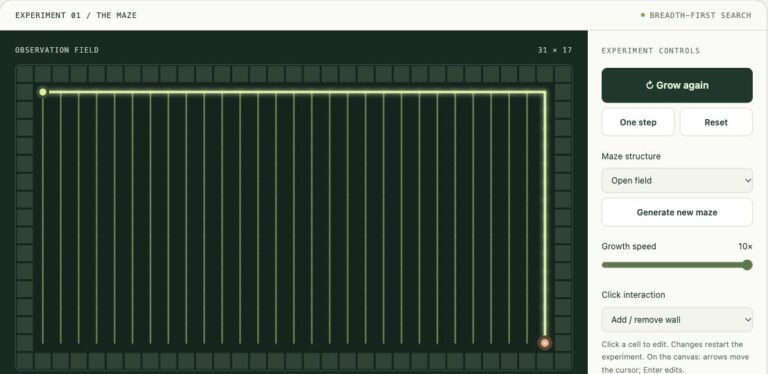
Slime Mold Maze
Pathfinding Maze: 7 Smart Slime Mold Maze Checks
Explore breadth-first search in Slime Mold Maze. Real connected, adjacent-food and blocked-origin tests explain route length, explored cells, mobile editing and its PNG observation export.
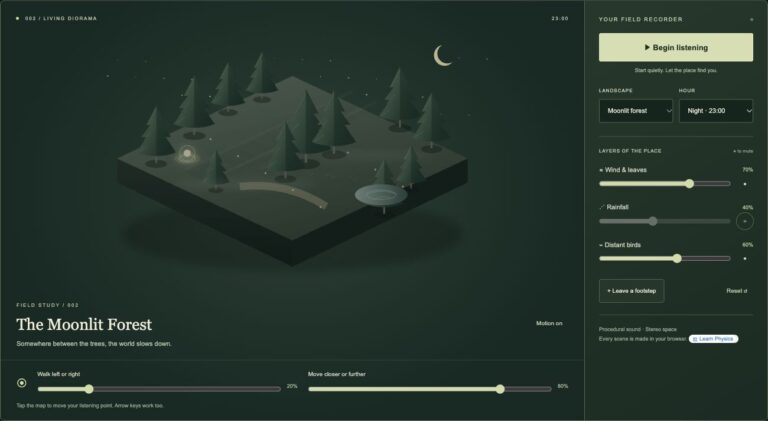
Field Recording Diorama
Field Recording Diorama: 7 Smart Soundscape Checks
Build an imaginary soundscape in Field Recording Diorama. Tested layer mutes, listener controls, Save/Restore and a fresh shared link explain what the scene recipe preserves and why a postcard is not recorded audio.

FrameMint Studio
Screenshot Editor: 7 Smart FrameMint Studio Checks
Frame screenshots, add manual masks and build captioned stories in FrameMint Studio. Real import, order, recovery and size tests explain what to check before sharing.