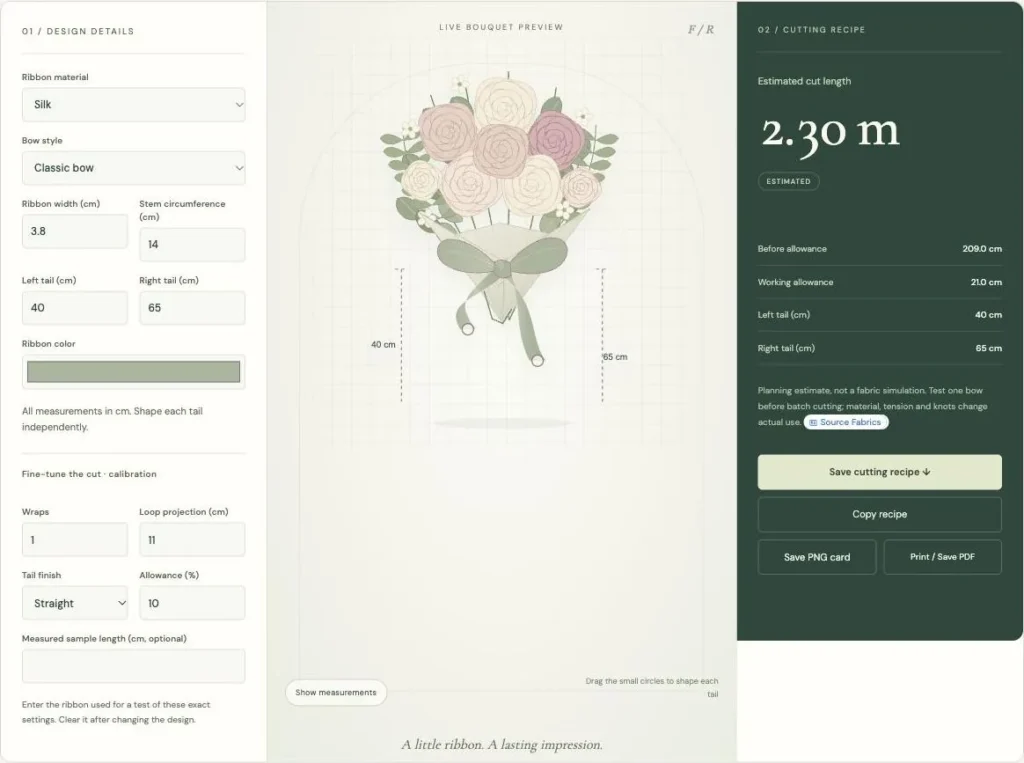
Estimate continuous bouquet ribbon cuts, compare asymmetric tails and count whole pieces per roll. Actual tests cover sample calibration, Wedding silk, sharing and downloaded SVG/PNG recipes.
- Brand
- Florist Ribbon Tail
- Tool languages
- English, 한국어
- Verified date
- 2026-11-18
Florist Ribbon Tail is a bouquet ribbon calculator for estimating one continuous cut, previewing independent tails and counting whole pieces per roll. It helps answer a practical florist question: how much ribbon should I cut for this design, and how many rolls will a batch require? Use the drawing to discuss proportions and the recipe to test an actual bow before committing the whole order.
Verified 18 November 2026, KST. We operated the English and Korean calculators, checked working allowance and calibration, changed tails and finishes, applied Wedding silk, tested a short roll, reopened a settings link and inspected downloaded SVG and PNG cards. Korean controls were tested at 390×844. Images are actual interface captures or an actual downloaded card. No physical bow, printout or PDF was tested.
On this page
Key takeaways
The first default result was 1.49 m per bouquet. Fifty cuts used 74.50 m, but a 10 m roll supplied only six whole cuts, so the planner required nine rolls and showed 15.50 m left across them. Dividing 74.50 by 10 and rounding to eight would leave insufficient continuous pieces. Total purchased length and usable whole-piece capacity answer different questions.
Calibration replaces the before-allowance amount with a measured sample length, then adds the working allowance. Our 150 cm sample with 10% allowance became 165 cm. Changing a tail subsequently cleared the calibration field and returned the result to Estimated. Keep that behavior visible in a production note: the displayed Calibrated label is not a permanent certification of every later design.
What this ribbon calculator does
The official tool name is Florist Ribbon Tail, with The Botanical Cutting Studio branding. The root website introduces it; the working English calculator is a separate linked page, alongside a Korean version. No account was required for the tested workflow. The studio combines a botanical bouquet illustration, design inputs, a live cutting recipe, material notes and roll-aware batch arithmetic.
Material choices are Satin, Silk, Grosgrain, Organza and Velvet. Bow styles are Simple knot, Classic bow, Four-loop bow and Spiral wrap. Primary inputs include ribbon width, circumference at the tie, left tail, right tail and color. Fine-tune the cut exposes wraps, loop projection, straight/diagonal/dovetail finish, allowance percentage and optional measured sample length. Spiral mode exposes height and overlap and disables ordinary wraps and loop projection.
The drawing provides a proportion reference rather than a photograph of your flowers or a fabric simulation. Measurements can be shown, and the source provides small circles for shaping each tail. Numeric inputs offer a clearer way to specify a repeatable recipe. The library has Everyday bouquet, Wedding silk, Minimal knot and Statement bow presets; each is a starting design, not a measured specification for a particular supplier’s ribbon.
Measure before choosing a recipe
Measure circumference where the ribbon will actually be tied, not around the flower heads. Measure each finished tail from the knot. Decide whether the desired design uses one wrap, multiple wraps or a covered spiral section. A circumference and a diameter are not interchangeable inputs: entering the width of the stem bundle in a circumference field would describe a different amount of ribbon.
Confirm units before typing. Design dimensions are centimetres; roll length is metres. The price field accepts your chosen currency without identifying a vendor, converting exchange rates or adding delivery and tax. Record the unit beside any handwritten stock list. A nominal roll length is also not necessarily the usable length after damaged ends, defects or pieces already removed.
Use the actual ribbon for a sample. The material names are styling categories with planning assumptions, not measured fabric properties. Satin describes a weave while silk describes a fiber, so a real ribbon may be both. Treat the dropdown as the app’s model choice rather than proof of fiber composition. Thickness, tying tension and the finished knot affect real consumption.
7 essential ribbon planning checks
1. Choose the design before entering the order
Select a material and bow style, then read every dimension. Wedding silk changed the first design to Silk, Classic bow, 3.8 cm width, 14 cm circumference, 11 cm loop projection and 40/65 cm tails. It also reset our previously entered roll price to zero. Apply a preset before finalizing batch inputs, or recheck the whole order afterwards.
2. Enter independent finished tails
Set left and right deliberately rather than splitting an assumed total in half. Starting from 25/35 cm, changing the left to 45 cm kept the right at 35 and changed the estimate from 1.49 to 1.71 m. The asymmetry is an editable design choice; it does not mean the two complete cut pieces are separate lengths.
3. Open the fine-tuning panel
Read wraps, loop projection, tail finish and working allowance. The first default was one wrap, 9 cm projection, straight ends and 10% allowance. Width affects more than appearance because knot and finish allowances use it. A preview with a similar color can still have a different calculated cut if these underlying dimensions differ.
4. Test a sample before calibrating
Make and measure a sample using the exact selected design if you are preparing real work. Our 150 cm input was a synthetic numerical test, not ribbon we physically used. It changed the base to 150.0 cm and the total to 1.65 m at 10%. If your sample already includes spare working length, decide how to account for that before applying another allowance.
5. Calculate whole cuts per roll
Enter usable roll length, bouquet quantity and price per roll. Check cuts per full roll before the total ribbon figure. Wedding silk at 2.30 m produced four cuts per 10 m roll; fifty bouquets needed thirteen rolls. If a cut exceeds the roll, the planner cannot solve the job by adding more rolls of that same insufficient length.
6. Save a recipe that can be checked
Copy recipe produces text; Save cutting recipe downloads an SVG card; Save PNG card produces a raster card. We received and inspected both files. The card showed material, bow, dimensions, allowance and roll totals. It is a reference card rather than a full-size ribbon template or a vector pattern to send to a cutting machine.
7. Reopen the settings link before handing off
Copy settings link and open the copied URL in a fresh tab. Our Wedding silk link restored 2.30 m, 40/65 cm tails and its design settings. Keep a checked recipe card or text alongside the link when it matters. Settings are editable, so a later revision should have a new version label rather than silently reusing an old exported result.
Actual calculator test results
| Test | Actual result |
|---|---|
| First default: Satin, Classic, width 2.5, circumference 14, wraps 1, loop 9, tails 25/35 cm, straight, 10% | Before allowance 135.0 cm; displayed working allowance 14.0 cm; cut 1.49 m. |
| Measured sample 150 cm at unchanged default design | Calibrated; base 150.0 cm, allowance 15.0 cm, total 1.65 m. |
| Left tail 45, right 35 after calibration | Calibration cleared; Estimated; base 155.0 cm, cut 1.71 m. |
| Same 45/35 design with Dovetail finish | Base 160.0 cm and cut 1.76 m; the 2.5 cm width added 5 cm of finish allowance before the working margin. |
| Wedding silk preset | Silk, Classic, width 3.8 cm, loop 11 cm, tails 40/65 cm; base 209.0 cm and cut 2.30 m. |
| Wedding design, 10 m rolls, 50 bouquets, price 12,000 | 4 cuts/roll; 13 rolls; 115.00 m used; 15.00 m left; purchase cost 156,000. |
| Wedding design with 2 m rolls | 0 cuts; rolls, leftover and cost shown as dashes; explicit cut-exceeds-roll warning. |
| Spiral wrap selected after Wedding silk | Height 10 cm, overlap 30%; ordinary wraps/loop disabled; base 180.7 cm, total 1.99 m. |
| Korean 390 px, left-tail ArrowUp | 40 to 41 cm, right remained 65; base 210.1 cm, total 2.32 m; document width 390 px. |
These are observed browser outputs, not physical yield measurements. The default base can be checked from the documented assumptions: 14×1 for wrapping, 4×9 for two loops, 25+35 for tails, and 10×2.5 for the knot total 135 cm. Multiplying by 1.10 gives 148.5 cm; the displayed cut is 149 cm. Plan from the shown cutting value rather than carrying hidden fractions into a separate roll calculation.
Why total metres understate roll purchases
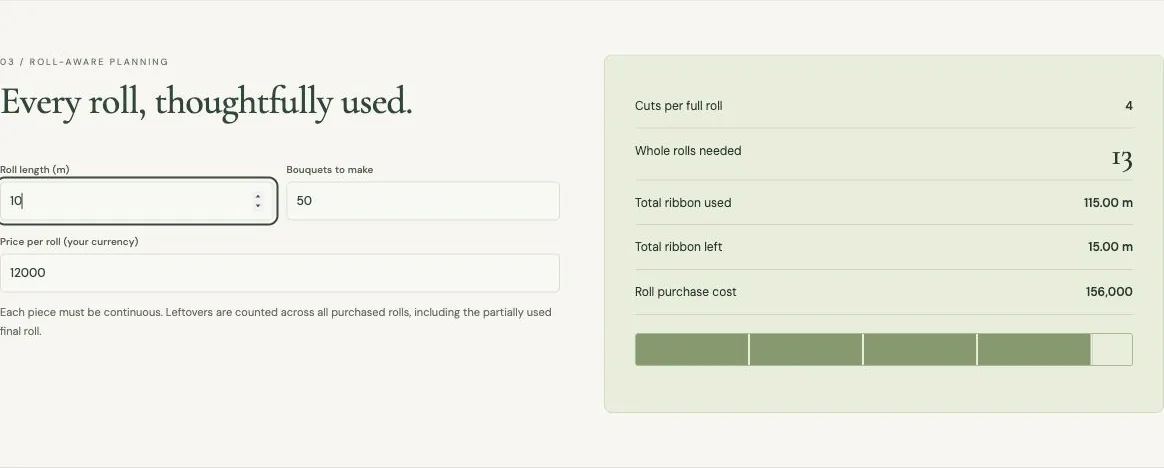
For equal continuous cuts, whole-piece capacity is floor(roll length ÷ cut length), and rolls needed is ceiling(quantity ÷ that capacity). With 2.30 m cuts, floor(10 ÷ 2.30) is four. Ceiling(50 ÷ 4) is thirteen. The app then shows 50×2.30 = 115 m used and 13×10−115 = 15 m left. Purchase cost is 13×12,000 = 156,000 in the chosen unit.
The 15 m total is not a single 15 m ribbon segment. Twelve fully used rolls can supply four cuts each and leave 0.8 m per roll; the final roll supplies two cuts and leaves 5.4 m. The pieces total 12×0.8+5.4 = 15 m. This is an explanatory allocation consistent with the observed totals, not a separate cutting schedule exported by the tool.
A very small change can cross a roll-capacity boundary. As a hypothetical illustration, a 10 m roll fits five 2.00 m pieces but only four 2.01 m pieces. That arithmetic is not an additional app test. It explains why design changes, rounding and actual sample consumption matter to purchasing. Recompute after finalizing the design instead of assuming that a few centimetres per bouquet cannot affect an entire roll.
The short-roll test exposes another boundary: two shorter leftovers cannot satisfy one continuous 2.30 m cut. A 2 m roll yielded zero pieces and no purchasable solution in the output. Check stock length rather than treating the warning as a missing cost calculation. The interface is planning identical pieces from one roll length, not optimizing a mixed inventory of partially used rolls and several different designs.
Calibrate a sample without double counting
Calibration uses the measured sample as the before-allowance amount. Our exact 150 cm numerical sample with 10% became 165 cm. That is helpful when the model underestimates your actual knot or tension, but it also creates a bookkeeping question: does your measured figure already contain the spare length you intend to leave? Define what you measured before treating the total as a production instruction.
Changing the design cleared the sample entry in our tests. After entering a 160 cm sample for the 45/35 cm dovetail design, changing the right tail to 36 cm emptied the field and returned the badge to Estimated. The page also tells users to clear a sample after changing the design. Check both field and badge after any revision; a past successful sample does not validate a new width, material or knot.
For a useful workshop record, save the material identity, width, design dimensions, how tightly it was tied, measured consumption and allowance policy. Repeat the sample when the relevant physical conditions change. The calculator cannot inspect your ribbon roll, find a manufacturing defect or confirm that two people tie the bow with the same tension. Its calibration is a documented input, not an independent measurement device.
Compare tails, materials and bow styles
The preview is useful for discussing tail balance, color and width before opening a roll. It cannot demonstrate how a particular silk falls in wind, how velvet compresses inside a knot or how a bow looks on a real bouquet. We inspected the numerical controls and drawing; the small-circle dragging gesture was not independently tested. Keep the known tail numbers with any visual comparison.
Spiral wrap answers a different geometry question. The source uses pitch = width×(1−overlap), then a helical length per turn based on circumference and pitch. Height and overlap replace the ordinary loop controls. Our Wedding-derived spiral result was 1.99 m, not the Classic bow’s 2.30 m. This comparison reflects a different construction, not evidence that a spiral gives an equivalent visual finish with a guaranteed saving.
Straight, diagonal and dovetail ends also change the recipe. The source adds one ribbon width across both ends for diagonal and two widths for dovetail. Our 2.5 cm dovetail test raised the base by 5 cm. Those are the model’s planning assumptions, not a claim that every scissor angle consumes exactly that amount. Finish one sample consistently before using the whole-cut count as a production target.
Save a usable recipe and reopen its link
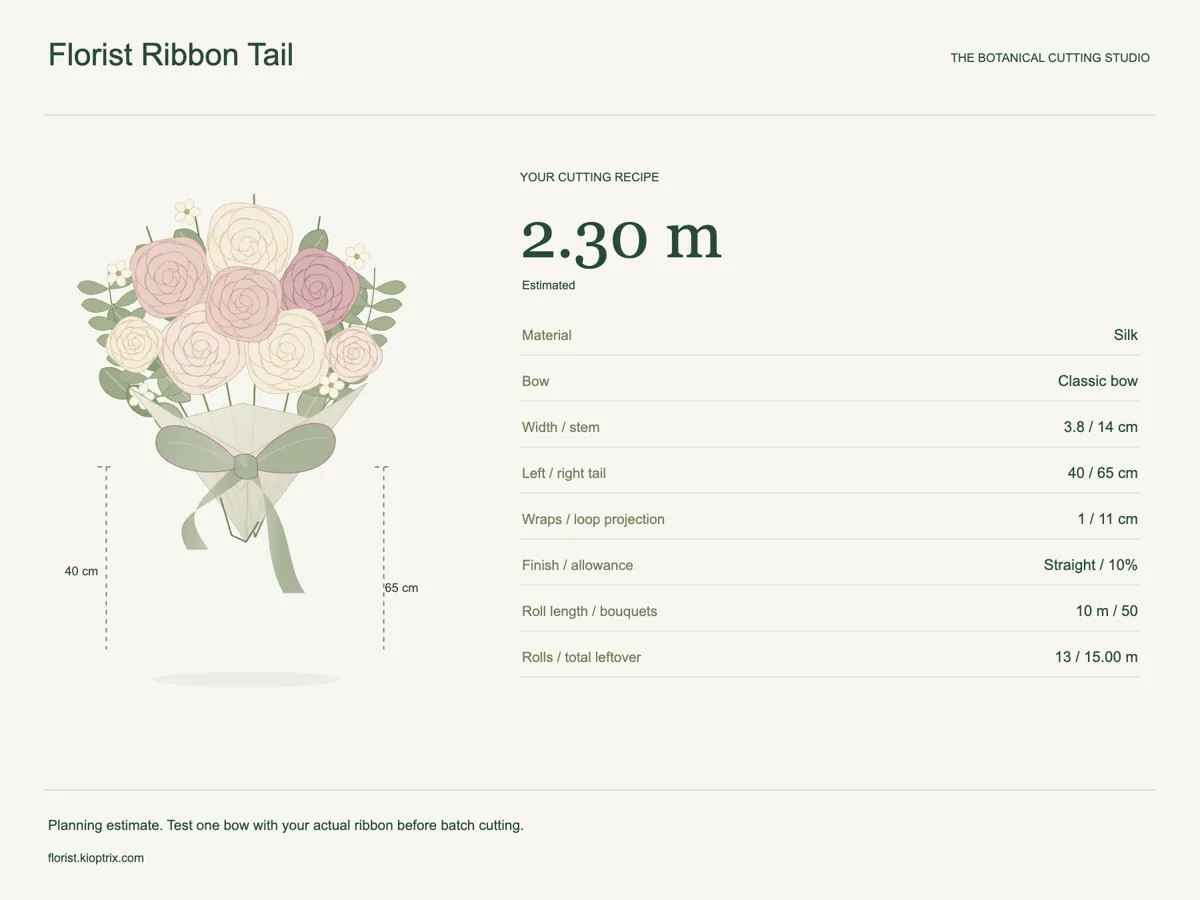
The downloaded card included the 2.30 m estimate, Silk, Classic bow, 3.8/14 cm width and circumference, 40/65 cm tails, 1/11 cm wraps and projection, Straight/10%, 10 m/50 bouquets and 13 rolls/15 m left. The inspected SVG contained matching recipe text and the botanical drawing. We did not inspect a completed printed page or saved PDF; the interface provides that separate control.
Copy recipe included the main design and roll totals in text. Our copied text did not include the roll purchase price or total purchase cost, so do not assume every displayed financial field travels with that output. The shared URL contains recipe settings, including the cost field in the observed link format, but the fresh-link test used the preset’s zero price. We verified the design restoration rather than a nonzero-price round trip.
English and Korean pages read the same observed browser settings: the Korean page opened with our Wedding silk values and entered price. This is useful continuity, but it means switching languages is not a clean independent experiment. Settings links should be read before being shared because they expose the included configuration to recipients. No account-based cloud library or cross-device synchronization was verified.
Mobile operation and keyboard input
The Korean source loaded at 390×844 without page-level horizontal overflow. Keyboard ArrowUp changed the left tail from 40 to 41 cm, the right remained 65 and the cut updated to 2.32 m. A compact bottom estimate and a return-to-studio link were visible. This was a browser viewport test, not a real-phone touch or complete accessibility audit.
Use the named number fields when an exact adjustment is more important than a gesture. If you switch a preset or bow style, inspect the expanded fine-tuning panel and batch inputs afterwards. Some controls become disabled in spiral mode. A disabled loop input still showing its old number is not an active instruction to add classic loops to a spiral recipe.
Limits, privacy and common mistakes
Results are planning estimates, not fabric physics, floral care guidance or supplier specifications. Material factors and knot allowances are assumptions, so test real ribbon before batch cutting. The source advises avoiding flame sealing because materials can scorch or melt; this review did not test finishing techniques. The illustrated bouquet does not accept your own flower photograph in the inspected workflow.
The source says settings remain in the browser and discloses Google advertising cookies according to consent choices. We observed settings persisting between the language pages, but did not audit network traffic, cookies, retention, offline operation or overall security. A local-processing statement does not make the entire Blogger page free of external services. We also encountered an interstitial advertisement while entering from the landing page.
Related tools for the flower workflow
The published StemCut Studio flower stem calculator helps plan retained stem length, vase proportions and whole-stem assignments before arranging flowers. Then Florist Ribbon Tail can document the finishing ribbon. These are separate calculations: a vase’s finished height is not automatically the circumference of a bouquet tie, and no automatic transfer between the tools was tested.
For team work, keep the stem plan and ribbon recipe as separate labeled references for the same arrangement. Confirm the actual tie location after preparing the bouquet, then enter its circumference in the ribbon studio. This manual sequence makes the measurement dependency clear without inventing a file integration or turning an illustrative flower drawing into a real measurement.
Frequently asked questions
How much ribbon should I cut for a wedding bouquet?
There is no single verified length for every bouquet. The tested Wedding silk preset was 2.30 m, based on its particular dimensions and assumptions. Start from the real tie circumference, desired tails and a sample of your material rather than treating that preset as a universal recommendation.
Why are nine 10 m rolls needed for only 74.50 m used?
Each roll supplies six continuous 1.49 m pieces. Eight rolls supply only 48 pieces, short of fifty. The remaining ribbon is distributed across rolls and cannot be joined to make the required continuous cuts in this model.
Does a 150 cm calibration input mean a 150 cm final cut?
Not at the tested 10% working allowance. The app used 150 cm before allowance and returned 165 cm. Decide whether your measured sample already includes spare length, and read the resulting base and allowance separately.
Can I use the exported card as a full-size pattern?
The received PNG is a recipe illustration, and the SVG declares graphic dimensions rather than a measured physical ribbon outline. Use the written cutting values and test the actual ribbon. We did not validate physical print scale.
Does the app optimize different ribbon designs together?
The inspected batch interface uses one current recipe, one roll length and one quantity. We did not find or verify a mixed-design cutting-stock optimizer. Multiple recipes and partial rolls require a separate inventory plan.
Are local settings a permanent backup?
No permanent or cross-device guarantee was tested. Export and inspect a reference, save a checked settings link and keep the actual sample notes. Review which data each output contains rather than assuming every field is included.
Plan one ribbon before the full batch
Choose one design, measure its tie circumference and read both finished tails. Test and calibrate a real sample, confirm the working allowance, then calculate whole cuts per roll. Save a checked recipe and distinguish the illustration from a physical pattern. A small rehearsal can reveal a purchasing or measurement mistake before it is repeated across fifty bouquets.
A RELEVANT NEXT STEP
Tools with a useful connection
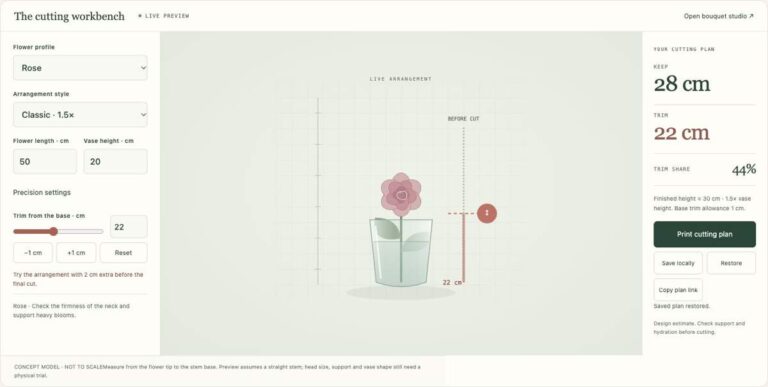
StemCut Studio
Flower Stem Calculator: 7 Essential StemCut Checks
Estimate retained flower length, trim and finished height, compare vases and assign whole stems to arrangement slots. Includes real geometry and batch-priority tests.
KNOTTRACE — The Reverse Knot Atelier
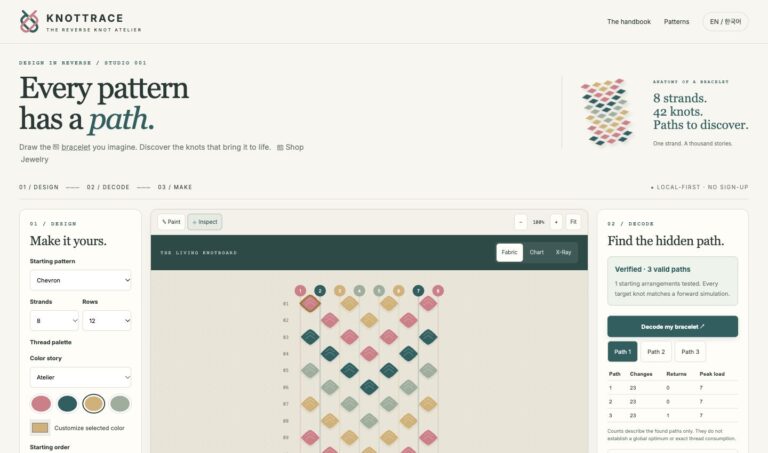
Friendship Bracelet Decoder: 7 Essential KNOTTRACE Checks
Turn a painted normal bracelet pattern into checked knot paths. Our 8-strand, 12-row tests cover 42 knots, 3 paths, strand tracing, F-to-FB changes, row marks and calibrated thread estimates.
Tassel Atelier
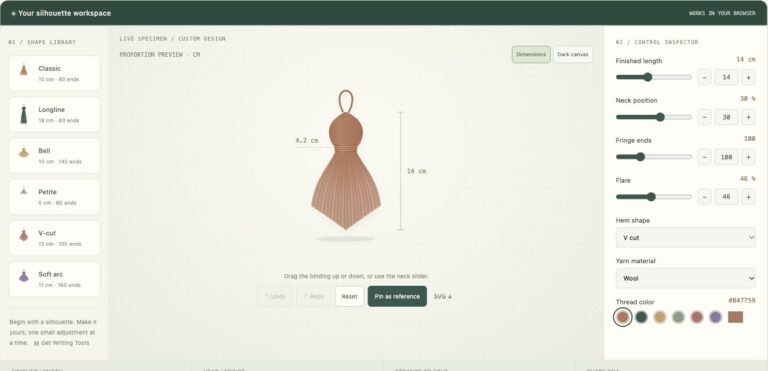
Tassel Designer: 7 Essential Steps for Better Patterns
Compare tassel proportions and plan a batch with Tassel Atelier. Real A/B, yarn arithmetic, link restoration and mobile tests explain what to trust and what needs a handmade sample.