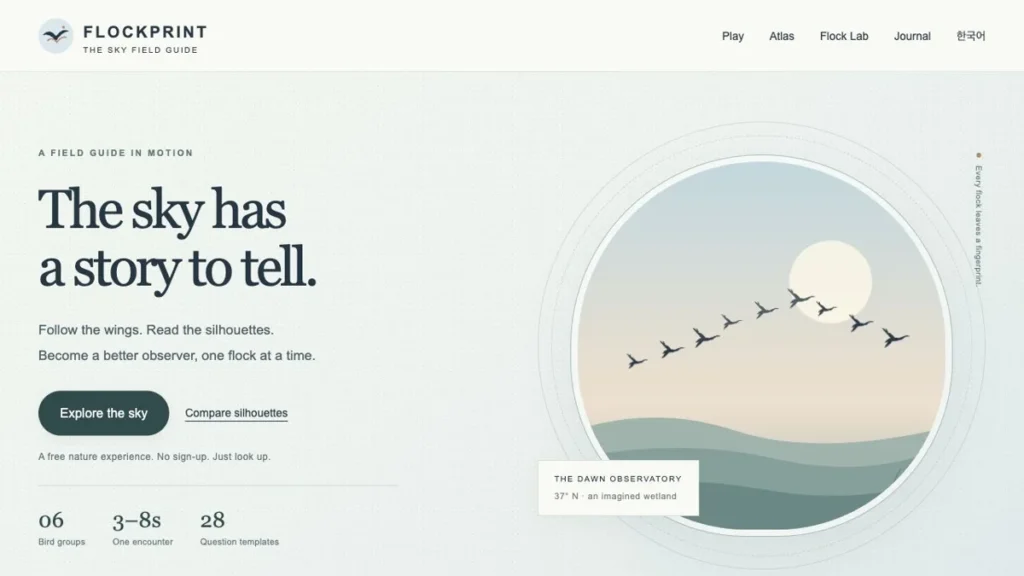
Practice bird silhouettes with FLOCKPRINT. See tested scores, evidence mistakes, review rules, text help and local journal limits before your first round.
- Brand
- FLOCKPRINT
- Tool languages
- English, 한국어
- Verified date
- 2026-11-20
FLOCKPRINT helps you practice bird silhouettes by choosing both an answer and the evidence behind it. Watch a short illustrated encounter, compare posture, select a clue and state your confidence. The Sky Field Guide then explains the result and queues mistakes for review. This is a learning game for six representative groups, not automatic species recognition, a live migration map or an assessment of professional birding ability.
Verified 20 November 2026, KST. We tested an illustrated crane/heron comparison, evidence-error scoring, review resolution, original-difficulty restoration, text assistance, journal reload and English/Korean sharing. We downloaded a real JSON journal, changed comparison selections and Flock Lab controls, and completed the Korean game at 390×844. Tests used a separate browser that began with an empty journal; an existing journal in the administration browser was exported and left unchanged. We did not observe wild birds or test all 28 question templates.
On this page
Bird silhouettes: key takeaways
A correct answer can still be a weak explanation. For “Which bird holds its neck retracted?”, our Bird B answer with Trailing legs and Strong evidence scored 50/100 and added one review question. Bird B was correct, but neck posture was the distinguishing clue. Both pictured groups can have long trailing legs.
In review, Bird B plus Neck posture and Tentative confidence scored 80/100 and removed the pending question. A later unassisted Strong evidence answer with that correct clue scored 100. On the Korean page, opening the text alternative still allowed 100, with help disclosed. These are game rules: the percentage is not scientific certainty or proof of independent identification.
What FLOCKPRINT teaches
The official name is FLOCKPRINT, with The Sky Field Guide and The Sky Detective labels. The English root links to a Korean page. The main experience combines Sky Encounter questions, a two-bird comparison desk, a silhouette atlas, a generic Flock Lab and a local Sky Journal. We needed no account or payment for the tested workflow.
The six group labels are Geese, Cranes, Ducks, Swans, Shorebirds and Herons. They are broad learning categories, not six individual species. The source describes original representative drawings informed by identification guides, and explicitly says they are not expert-validated species models. A bird shape on this page should therefore be read as a clue exercise rather than a specimen with guaranteed anatomy.
A practical use is preparing a student or new observer to say what they actually saw. “It was in a V” is different from “I could see an extended neck and legs behind the tail.” The game makes the explanation a separate input, so a familiar name alone is insufficient. It also offers uncertainty answers where the available detail does not support a stronger conclusion.
Compare posture before naming a bird
| Learning group | Useful question to ask |
|---|---|
| Cranes / Herons | Is the neck extended or usually retracted? Long trailing legs alone may occur in both. |
| Geese / Swans | How do neck length and body proportions compare? Do not identify from a V alone. |
| Ducks | Is the illustrated body compact with a relatively short neck? Distance can conceal those features in real life. |
| Shorebirds | Are you noticing flock movement or an individual structural feature? Group turns do not identify a species. |
| Any pair | Are the needed features actually visible? The same-sized drawing frames are not true relative-size measurements. |
We changed the comparison desk to Swans and Geese and saw their explanatory text update, then returned it to Cranes and Herons. Selecting Examine Herons highlighted that atlas card and its neck clue. The drawings share a display frame; measuring their screen widths cannot establish which real species is larger. Compare the stated posture and proportions rather than treating the atlas as a calibrated size chart.
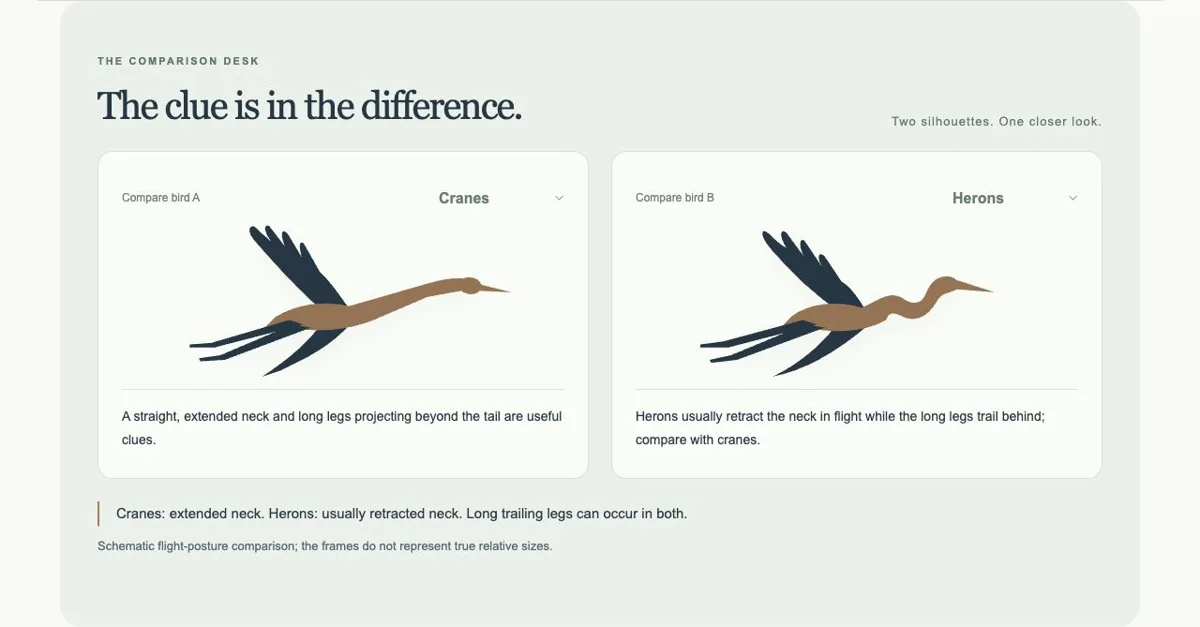
The linked primary guides add useful nuance. Cornell Lab’s Great Blue Heron identification page describes neck-in flight while acknowledging occasional outstretched posture. Its Sandhill Crane guide describes flight with extended neck and trailing feet. These are species examples from North American guides, not a guarantee that a distant bird at a Korean wetland belongs to either species.
7 essential silhouette learning checks
1. Choose a learning condition, not a target score
Explorer is labeled 8 seconds, Observer 5 and Detective 3. The source says difficulty also changes scale, contrast, viewing direction and available hints. We used Observer and Detective; we did not measure all timing and drawing variations. Start where you can describe features, then increase the challenge.
2. Read the question before observing
New observation or Daily mystery first prepares a question. In our 20 November daily example it asked which of A and B held its neck retracted. Only then did Ready · observe 5 seconds begin the observation. Knowing whether the task concerns posture, a group or uncertainty helps you look for relevant information instead of memorizing a name.
3. Use the observation controls deliberately
Still mode provides a nonmoving viewing option, but the observation stage still needs to be completed. Pause and Replay once controls are available, and a text alternative appears after observing. We directly tested Still mode and the text help. Do not describe a helped answer as an independent speed-identification result.
4. Select the answer by its current label
Our daily scene showed A with an extended neck and B with a retracted neck. The order of answer choices changed between attempts, while the labels remained available. Choose Bird B by its meaning rather than clicking the same row position. A different question or future daily challenge may use a different scene.
5. Choose evidence that distinguishes this pair
Supporting evidence includes neck posture, trailing legs, body proportions, bill shape, wing shape, formation only and insufficient detail. The relevant clue depends on the question. Long legs were visible in our pair, but they did not distinguish the retracted neck. Visibility and diagnostic usefulness are different tests.
6. Calibrate confidence to the information
Confidence offers Tentative, Reasonable and Strong evidence. Record what you could see rather than selecting the strongest option merely to chase points. The same correct answer and clue scored differently with Tentative versus Strong in our specific neck-posture example; that does not establish a universal best confidence choice for uncertain questions.
7. Read the explanation and review the right issue
Reveal & explain separates answer, evidence, confidence and observation points. If the answer is correct but the evidence is unsuitable, review the clue rather than memorizing the answer again. Then use the journal to distinguish a resolved review queue from the historical attempts that remain recorded.
Actual answer, evidence and confidence tests
These were controlled game examples, not tests of natural birds. The daily comparison was the same retracted-neck question. We selected Bird B in each case and changed the supporting clue or confidence. Still mode was enabled; the observation stage was completed. The final Korean example used the text alternative and was visibly marked assisted.
| Test condition | Score components: answer / evidence / confidence / observation | Result |
|---|---|---|
| Observer · Trailing legs · Strong evidence | 40 + 0 + 0 + 10 = 50 | Answer correct; evidence error; review queue 1. |
| Saved Observer review · Neck posture · Tentative | 40 + 30 + 0 + 10 = 80 | Answer and evidence correct; queue cleared. |
| Detective · Neck posture · Strong evidence | 40 + 30 + 20 + 10 = 100 | Correct clue and confidence for this question. |
| Korean Detective · same correct inputs · text help | 40 + 30 + 20 + 10 = 100 | Help use disclosed; no point deduction. |
The first result is the most instructive. Trailing legs was not imaginary: both schematic birds showed long legs. It was simply the wrong basis for answering which neck was retracted. An evidence error can therefore be an error of relevance rather than failure to notice anything. That distinction is more useful to a learner than treating every non-perfect score as a wrong bird name.
The score weights displayed in the FAQ are answer 40, relevant evidence 30, calibrated confidence 20 and completed observation 10. Our examples matched those components. We did not independently audit the scoring logic for every template or difficulty. Keep the question and assistance flag with the number; 100 on a helped comparison is not equivalent to independently identifying an unfamiliar wild bird.
An 80-point review can resolve a mistake
After the 50-point evidence error, we changed the global difficulty to Detective, then started Review mistakes (1). Review loaded the original Observer five-second setting and the saved crane/heron scene. This is important: choosing a harder global setting did not silently turn the saved mistake into a different difficulty in the tested review.
Bird B with Neck posture resolved that item even though Tentative confidence left the total at 80. The queue went from one to zero. Confidence shortfall alone did not keep this otherwise correct answer/evidence pair waiting. A learner should therefore aim to repair the reasoning the queue tracks rather than assume every review needs a perfect score.
After ending review, the previously chosen Detective three-second condition returned for the next daily attempt. The earlier 50-point row was not erased: after three completed tests, reloading showed three observations and a rounded average of 77/100. Queue completion and historical performance answer different questions. A cleared queue can coexist with earlier errors in the journal.
A perfect score can still include text help
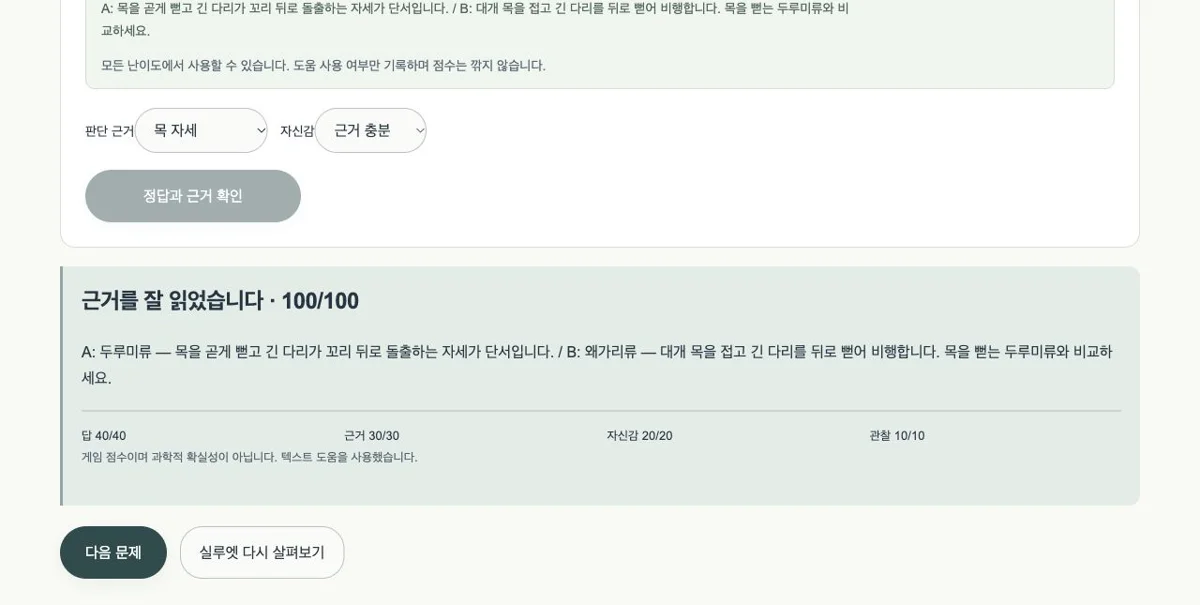
In the Korean Detective example we opened Text alternative / observation hint after observing. It described the extended neck in A and the usually retracted neck in B. The help text explicitly said it was available at all difficulties and recorded assistance without subtracting points. We then chose the correct answer, neck clue and Strong evidence.
The result was 100/100 with an explicit statement that text help had been used. This is a useful accessibility and learning feature, not a hidden failure. For a classroom comparison, however, keep independent visual attempts and helped practice recognizable in the notes. The score alone cannot tell you which route produced the answer.
A good follow-up is to close the explanation, describe the neck difference in your own words and later attempt another question without the text. That is a suggested study method, not an additional experiment we claim to have completed. Repeating a known daily answer can reinforce a feature, but it cannot measure transfer to unseen birds.
Local journal, language sharing and export
The journal describes a latest-30-observation analysis with mistakes held until resolved. We verified persistence of our first three completed Chrome tests after reload: three entries, average 77/100 and no pending review. Following the language link to Korean showed the same three entries and average. This directly checked English/Korean sharing in that browser, not synchronization between browsers or devices.
The two journal panels distinguish groups to revisit from clues to look at again. Their labels explain missed useful clues and misused selected clues; one question may have multiple useful features. Historical errors are broader than the pending queue. Read those headings before deciding that a zero pending count means every earlier attempt was correct.
Download journal produced a real JSON file whose root was a list of journal entries. Observed fields included date, group, score, difficulty level, assistance, question, answer/evidence correctness, selected inputs, confidence, review and context. The interface also warns that some older entries were reconstructed from scores and missing selections are not known choices. A field name does not establish complete historical data for every row.
We preserved an existing journal before testing in a different browser. The article’s result examples come from our new game attempts. We did not use Clear local journal. No import or complete portable recovery of a pending queue was verified, so a downloaded JSON list should not be advertised as a demonstrated one-click restoration system. Browser-data deletion, another device and offline behavior remain outside the tested recovery path.
Flock patterns are a separate illustrative model
Flock Lab is separate from the answer game. Its formation menu offers V formation, Diagonal line and Murmuration; Wind ranges from 0 to 100 and Spacing from 20 to 100. We selected Murmuration, moved wind to 100 and spacing to 20, and saw the note describing 60 agents responding to cohesion, alignment and separation. We restored V formation, wind 25 and spacing 60 afterward.
These are general illustrative controls. The source does not assign physical wind units or a species-specific aerodynamic meaning to those slider values. A V in this laboratory is not a goose label, and a dense cloud does not identify a shorebird species. Use the lab to discuss how a group pattern can change while asking for individual structural evidence remains necessary.
Sky and season settings add Dawn/Day/Dusk/Night and seasonal learning courses. The imagined wetland at 37° N is scenery, not a detected user location. Spring, autumn and winter themes give context for learning; they are not local arrival forecasts. We inspected these controls and descriptions, but did not exhaustively validate every season/template combination.
Korean and mobile operation
At a fresh Korean 390×844 viewport, we selected Still mode and Detective three seconds, opened the daily question, completed the observation and answered with the text alternative. The result displayed answer 40, evidence 30, confidence 20 and observation 10. Document width was 390 px, with no horizontal overflow in that tested view.
The localized controls include 오늘의 도전, 준비 완료 · 관찰 3초, 판단 근거, 자신감 and 정답과 근거 확인. Use the current labels: answer positions can shuffle. Keyboard Space selected the radio answer in our test, and Enter activated buttons. We checked responsive-browser behavior, not a physical phone touch study or every assistive technology. Advertising can occupy screen space; use the named controls and available keyboard path carefully.
Limits, privacy and real observation
Do not upload a photograph or expect recorded-call analysis: the inspected experience uses its own illustrations and answer controls. The source says the game requests no location, microphone or account and uses no recorded bird calls. It did not request those permissions during our tests. We did not perform a network or security audit.
Local journal storage is different from the entire webpage’s privacy behavior. The site is hosted on Blogger and displays Google advertising, which can process technical data and cookies under its own policies. Do not turn “the learning journal stays in this browser” into a promise that no request leaves the webpage. No cross-device recovery or cloud account was demonstrated.
For real observation, combine shape with actual size, plumage, calls, range, date, habitat and viewing conditions. A distant silhouette may remain unidentified, and that is a useful record rather than a reason to force a species name. Keep away from nests and roosts and avoid disturbing feeding or resting birds. The game does not verify local access rules or current wildlife presence.
Related tools and a practical learning route
The published Moth Around Light guide offers another wing-related learning activity: compare a simplified light-orientation model and distinguish its outputs from real-insect evidence. FLOCKPRINT practices selecting a visible clue; Moth Around Light practices reading a model assumption. Neither replaces field identification, and no automatic transfer between their records was verified.
| Learning route | What to preserve |
|---|---|
| Comparison desk → daily question | Which feature you compared and why it distinguishes the current pair. |
| Result → review → journal | Answer error versus evidence error, assistance and the original difficulty. |
| Game → actual field notes | Only what you could see, plus date, habitat and unresolved uncertainty. |
| FLOCKPRINT → Moth Around Light | The distinction between an illustration, a model output and observed biological evidence. |
For a short group lesson, have one learner name the feature, one choose the answer and another challenge whether that feature separates both birds. Begin with the crane/heron comparison, then ask why long legs alone failed. Write a new observation sentence before discussing the points. This turns the game from a guessing contest into practice making a claim that someone else can inspect.
Frequently asked questions
Does FLOCKPRINT identify an uploaded bird photo?
No photo-identification workflow was present in the tested experience. It uses representative learning silhouettes and answer/evidence choices.
Why did a correct Bird B answer get only 50?
In our retracted-neck example, trailing legs was not the distinguishing clue. The result awarded 40 answer points and 10 observation points, with zero evidence/confidence points.
Why did 80 points clear the review queue?
Both the answer and neck evidence were correct. Tentative confidence reduced the total but did not keep that item pending.
Does text help lower the score?
The help says it does not. Our Korean helped attempt scored 100 and explicitly disclosed assistance.
Are the drawings a relative-size guide?
No. The source says the frames are schematic and not true relative scales or expert-validated species models.
Is the JSON export a full restore feature?
We downloaded and inspected journal rows, but did not verify import or complete pending-queue recovery.
Start with the clue you can explain
Compare the two neck postures, read the question, then choose the feature that actually separates the birds. Keep the answer, evidence and help status together. The most useful outcome is an observation you can explain, including when the available silhouette is not enough.
A RELEVANT NEXT STEP
Tools with a useful connection
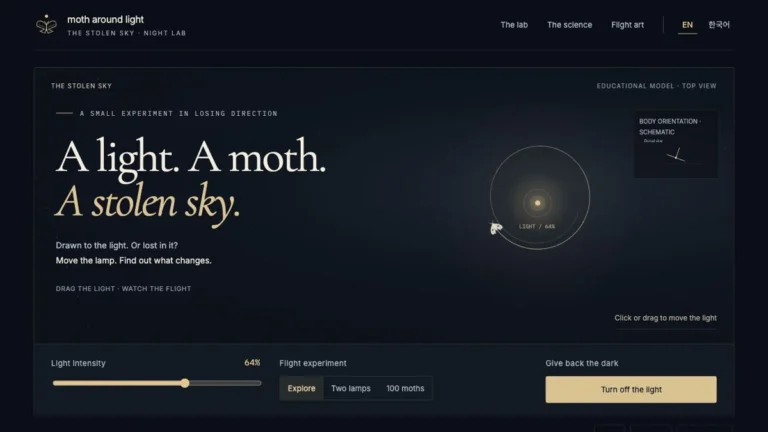
Moth Around Light
Moth Flight Simulator: 7 Essential Checks for Better Learning
Explore Moth Around Light with tested lamp comparisons, three flight hypotheses, share-link checks and actual poster exports. Learn the model’s limits.
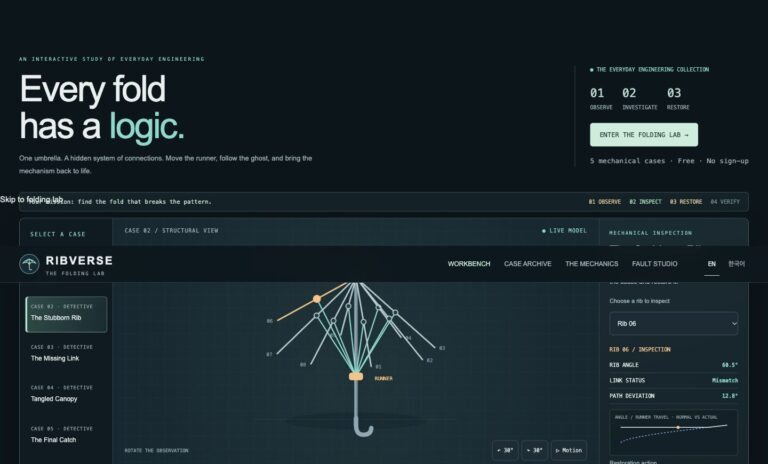
RIBVERSE — The Folding Lab
Umbrella Mechanism: 7 Essential RIBVERSE Lab Checks
Investigate a virtual umbrella linkage with RIBVERSE. Our five-case tests explain ghost paths, matching actions,0° latch faults, completion history and reproducible puzzle links.
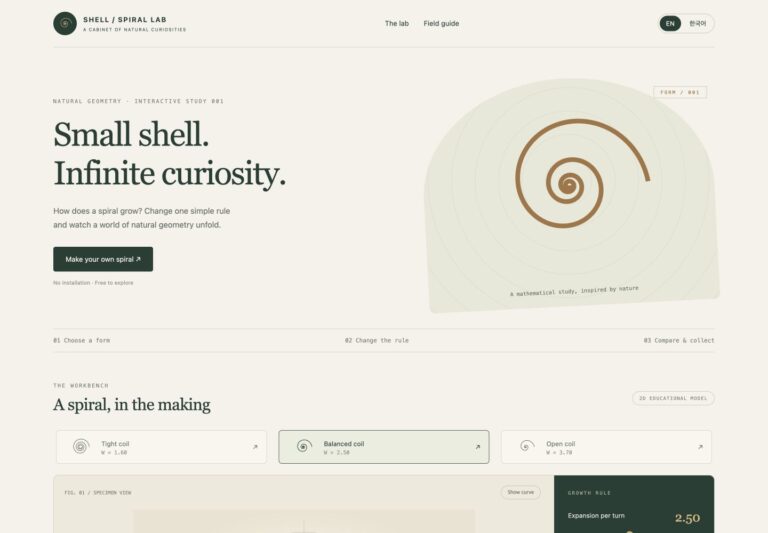
Snail Shell Spiral Lab (SHELL / SPIRAL LAB)
Logarithmic Spiral: 7 Smart Shell Lab Checks
Explore a logarithmic spiral with Snail Shell Spiral Lab. Tested W/N comparisons, fractional turns, saved specimens and link checks explain the mathematics and limits of this 2D model.