Arrival time can change a rhythm before it reaches the listener. BELL TOWER COMPOSER places four virtual bells around a city and connects a 16-step score to distance-based delay. Move the listener, edit the pattern and compare when each bell is struck with when its direct sound is expected to arrive.
Verified 13 November 2026, Asia/Seoul. We operated the English and Korean interfaces and checked displayed timing, editing, save/load and sharing states. We did not independently evaluate audible quality, stereo direction or device latency.
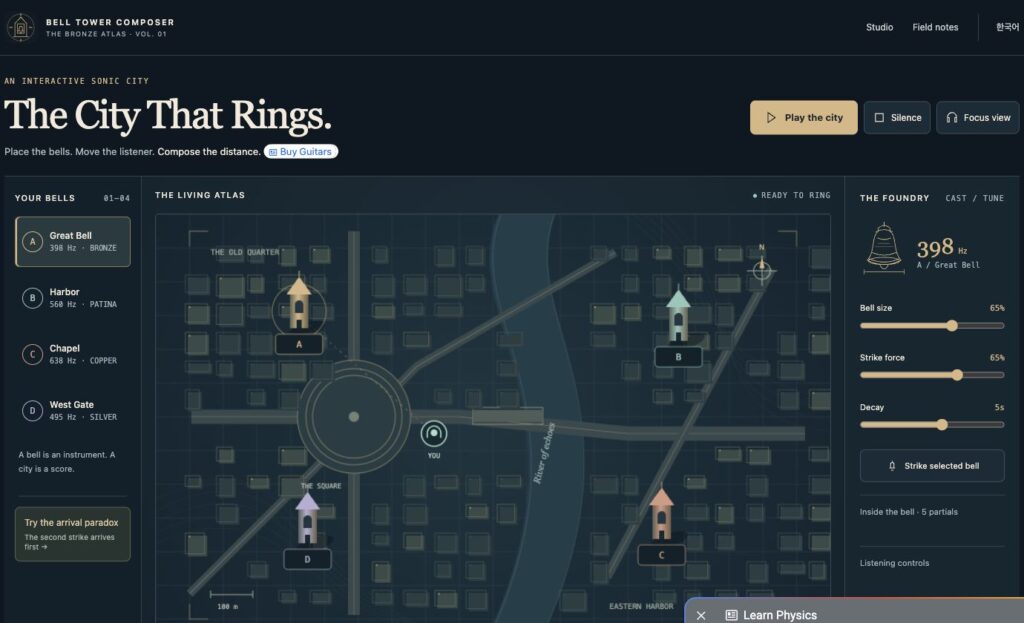
Compose a four-bell city, edit 16 half-beat steps and compare strike times with distance-based arrival. Includes tested save/load, sharing and model limits.
- Brand
- BELL TOWER COMPOSER
- Tool languages
- en, ko
- Verified date
- 2026-11-13
Explore this guide
Key takeaways
The main lesson: a later strike can have an earlier arrival. The built-in example displayed A struck at 0.00s, arriving at 2.92s, and B struck at 1.00s, arriving at 1.29s. That reverses the order shown by strike times alone.
Best for: short composition sketches, rhythm lessons and a visual introduction to propagation delay. Each row is one bell, and each cell represents half a beat. The four instruments have adjustable size, force and decay; the listener and towers can be repositioned.
Keep the boundary clear: direct travel time is geometric, while the bell partials, level changes and echo are simplified artistic models. The buildings do not calculate reflections, occlusion or diffraction. This is not a site-specific noise prediction or a real bell-foundry calculator.
What Bell Tower Composer does
A conventional step sequencer tells you when a note is triggered. This instrument adds a second timeline: when the direct sound reaches a chosen listening point. It helps explain why changing the listener’s position can change the order and spacing of events even when the score remains unchanged.
The interface has a tower library, an illustrated map, a foundry panel and a four-row score. Select A, B, C or D to edit that instrument; choose steps to make a pattern; use the map or precise positioning controls to move a marker. Direct travel time appears beside the map, and an expanded table shows the first strike and its calculated arrival for each row.
The initial bells are Great Bell, Harbor, Chapel and West Gate. On our first English screen their displayed base frequencies were 398,560,638 and 495Hz. These are model settings, not recordings of actual city bells. Three story presets and a separate Change ringing study provide patterns to inspect before making your own.
English and Korean interfaces are available. The English studio is also presented on the linked /p/bell-tower-composer.html page, and the Korean link opens its own page. The source describes browser synthesis without microphone recording. Its host may separately supply advertising or analytics, so local audio processing should not be mistaken for a claim that the whole website makes no network requests.
Set up a useful comparison
Start with one tab, a modest device volume and no competing playback. The source includes Play the city, Silence, Master volume and Mute controls. If a distant bell has not arrived yet, an initial pause is not necessarily a broken score. Use the numerical readout before deciding that the input was ignored.
Open Precise positioning & arrival score under the map. This exposes a marker selector, X/Y sliders and the first-strike and arrival table. Open Listening controls when you need Master volume, Mute or More patterns. Open Inside the bell to inspect the five simplified partials. These disclosures keep the main studio compact, but important comparison conditions are inside them.
For a reproducible test, write down tempo, active steps, loop state and listener location before changing anything. Also note which tower is selected: adjusting size or decay edits that instrument, not all four together. A title such as Editorial arrival study makes a saved example easier to recognize than a generic untitled score.
Change one family of variables at a time. To study propagation, keep tempo and steps fixed while moving the listener. To study score timing, hold the city geometry fixed while changing tempo. To explore timbre, keep those two conditions steady while changing size, force or decay. This separates a timing explanation from a subjective sound preference.
7 steps from strikes to arrival
1. Load the arrival paradox
Choose Try the arrival paradox. It sets a 120BPM, non-looping example with A on step 1 and B on step 5. The displayed distances were 1000m and 100m. We then pressed Silence to stop playback while retaining the readings. The important result was A0.00→2.92s and B1.00→1.29s, with a notice that B arrives first.
2. Compare strike and arrival columns
Expand the precise-positioning section and read both columns. A is struck before B, but it has much farther to travel. C and D showed dashes because the example had no active cells in those rows. The table describes each row’s first strike; it does not list every later repetition or the end of a ringing tail.
3. Edit a single score cell
Turn A / step 2 on, then use Undo and Redo. Our button state changed true, false and true in that order. This confirms the edit history for the tested cell. It does not guarantee that every possible control has identical undo behavior, so keep a saved checkpoint before a larger experiment.
4. Move the listening point precisely
With Listener selected, one right-arrow action on the X slider changed its raw value 150→151 while the displayed distance coordinate changed 300→302m. Focusing the map and pressing Right later changed 151→161, a 20m displayed move. The numeric control and map keyboard action therefore used different increments in this test.
5. Shape the selected bell
Select A and adjust Bell size. Moving the control from 65% to its 95% endpoint changed the displayed frequency from 398 to 203Hz. Larger meant lower in this artistic model. The force and decay controls provide separate ways to shape the event; do not describe the size percentage as a physical diameter or a foundry specification.
6. Save and deliberately replace the pattern
Name the composition, press Save, load a different story preset and press Load. We saved Editorial arrival study with A steps 1/2 and B step 5, then selected the Harbor story. Load restored the title, 120BPM, A size 95, listener X151 and those active cells. This replacement-and-recovery test is stronger evidence than pressing Save without checking the result.
7. Open the copied share link separately
Use Share link, then open the actual copied address in a new tab. Our new page restored the title, selected pattern,120BPM,35% master volume and loop off, while the control still read Play the city. The restored score did not begin automatic playback. Confirm the displayed state before asking someone else to compare your experiment.
Our hands-on results
| Check | Result and significance |
|---|---|
| Arrival paradox | A:0→2.92s; B:1→1.29s Later strike, earlier direct arrival. |
| A step2 / Undo / Redo | On → off → on The tested cell edit was reversible. |
| A size65→95 | 398 →203Hz The model lowered the selected base frequency. |
| Listener X slider | 150 →151;300 →302m Displayed metres differ from the raw slider scale. |
| Map Right key | 151 →161 The tested move changed displayed X by20m. |
| Save / Harbor / Load | Title, tempo, size, X and cells restored Same-browser restoration passed. |
| Fresh share link | Score restored; Play inactive No automatic playback began. |
| Korean390×844 | Paradox and Silence responded; width390px Representative mobile controls worked. |
The initial paradox uses just two active cells. Adding A step 2 created a third active event for our save/load test; that later edited score should not be confused with the unmodified two-event example. The screenshots and timing explanation below identify the original paradox separately from the saved composition.
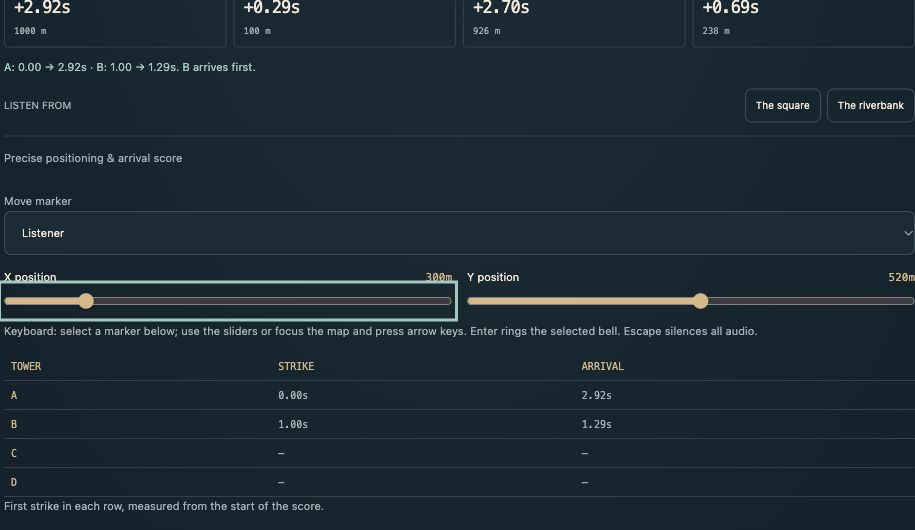
These results establish visible states and arithmetic consistency. They do not establish that a particular headset reproduced every partial or that playback latency matched a reference instrument. Wave rings and status changes are useful interface feedback, but they are not an independent acoustic measurement.
Read the arrival calculation
The page uses direct arrival = strike time + distance/343, with distance in metres and time in seconds. For A,1000/343 is about 2.915s. For B,1+100/343 is about 1.292s. The rounding agrees with 2.92s and 1.29s. B therefore reaches the listener about 1.624s before A even though it was struck one second later.
A useful prediction rule is to compare the strike gap with the travel-time advantage. If B is struck later than A by Δt, B still arrives first when(distanceA−distanceB)/343 is greater than Δt. Here the 900m distance difference corresponds to about 2.624s, comfortably more than the 1s strike gap. This is an independent explanation of the displayed example, not an extra listening experiment.
Each cell is half a beat, so the cell interval is 30/BPM seconds. At 120BPM it is 0.25s. Step 5 lies four cell intervals after step 1, giving the 1s gap in the example. A16-cell cycle spans eight beats, or 4s at 120BPM; at 80BPM the same nominal cycle spans 6s. These are score-duration calculations, not measured audio-file lengths.
For a fixed geometry, raising the tempo shrinks strike gaps but leaves distance/343 unchanged. This can alter event order or crowd arrivals together. Moving the listener changes travel times instead. Those are two different ways to change the arrival pattern, and recording which one you used makes a lesson easier to reproduce.
A repeating trigger grid is also different from the complete sound envelope. Distance delay and decay can extend an event beyond the nominal grid cycle. Consider that possibility before interpreting overlapping rings as an extra active cell. Silence is the practical way to end the current sequence and ringing before starting a clean comparison.
Shape the bell without confusing the model
The source’s simplified partial ratios are 0.5,1,1.2,1.5 and 2, labeled hum, prime, tierce, quint and nominal. The initial A display rounded them to 199,398,478,597 and 796Hz. Inside the bell offers buttons to isolate the modeled partials. Treat those labels as a learning aid rather than a complete description of every real bell.
Size, strike force and decay answer different questions. Size changed the base frequency in our test. Force represents the strength of the event, and decay controls its modeled persistence. Keep the other settings fixed when demonstrating one control. A quiet setting and a distant listener can both reduce the apparent prominence of an event, but their causes are different.
The metal names in the tower library are part of the instrument’s presentation. They should not be read as laboratory evidence that one alloy sounds exactly like the model. The source explicitly calls its partial frequencies, attenuation and short feedback echo artistic simplifications; geometry and tuning of real bells vary.
The map’s buildings make the city legible, but they are scenery. Placing a tower behind a drawn block does not establish a calculated acoustic shadow. When teaching, label the experiment direct-path delay so a listener does not infer an urban sound survey from an attractive map.
Practical score experiments
One-event baseline: start with a sparse row and inspect the displayed travel time before adding other towers. This is a suggested exercise, not a separate test reported here. It gives learners a simple reference for distinguishing a delayed event from a silent or muted one.
Distance-versus-tempo lesson: keep the paradox geometry, calculate the step 1-to 5 gap at a chosen tempo, and predict the order before using playback. Then move the listener and predict again. Record numerical changes separately from a subjective impression of the soundscape.
Composition sketch: use the story presets as starting points, then change a few cells and the title. Widely separated strikes leave more room for propagation and decay; denser patterns make their interaction harder to follow. Saving before a preset change gives you a reversible workflow for exploring alternatives.
Change-ringing introduction: choose Change ringing study under More patterns and inspect the changing order of the four rows. The source presents adjacent-swap plain changes on four virtual bells. It is an educational pattern study rather than a complete method-training environment or an ordinary melody keyboard.
Shared critique: send a neutral-title score link and ask the receiver to confirm title, tempo and active cells before commenting. Agreement about the starting state is more useful than arguing about a result heard under unknown settings. In particular, confirm Mute and Master volume rather than treating silence as a compositional intention.
Save, load and share a score
Save stores a composition in this browser according to the source. Our save/preset/load sequence verified recovery within the same session. We did not test every browser profile, cleared storage or long-term retention. Keep an additional share link or a written settings record if losing the example would interrupt a lesson.
The copied link points to the canonical English studio and includes an encoded score in its URL fragment. Our link contained the composition title, tempo, volume, mute, loop, listener coordinates, four bell settings and the pattern. Encoding does not make those details confidential; anyone who receives the address can read the shared content.
Do not confuse the Share link button with uploading a rendered recording. The tested workflow restored editable settings on a fresh page. We did not verify an audio export, external file format or integration with a production sequencer. The visible workflow is a browser instrument and score link, so that is what this guide describes.
The tested shared page remained idle until a playback action. That is useful when exchanging examples in a lesson or message: the receiver can inspect the map and pattern first. It also means opening the address alone is not a valid test of audible playback.
Limits, privacy and troubleshooting
The publisher states that audio is synthesized in the browser and no microphone is used. We saw no microphone permission request during the tested actions. We did not inspect all network traffic. Advertising or analytics supplied by the host may operate separately, and advertising annotations were visible on the source page.
This is not a physically exact city simulator. The direct-path formula is a simplified fixed-speed model at approximately 20°C, not a weather, terrain or building-acoustics solver. The illustrative echo and relative levels do not justify predicting real-world noise exposure, installation safety or coverage of a proposed tower.
If you hear nothing, inspect Mute, Master volume, device output and browser audio permissions, then use Silence followed by Play. Check the travel-time readout because distant sound is delayed. We verified control responses; actual sound quality, spatial perception, audio-clock accuracy and device latency remain outside our independent observations.
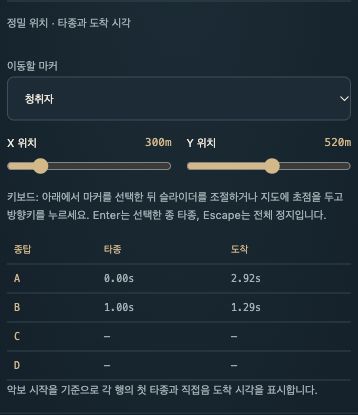
On a narrow screen the source explicitly allows sideways scrolling inside the score. That internal strip should not be confused with the whole document overflowing. Our fresh Korean 390×844 viewport had a 390px document width, and the arrival table remained readable. This was a viewport interaction check rather than a physical-phone audio test.
Related tools
Continue with Field Recording Diorama when you want to explore a layered environmental sound scene after this four-bell exercise. It offers a different composition path; do not transfer this page’s geometric arrival calculation to that tool without checking its own model.
Use POLYRHYTHM ORBIT to isolate pulse relationships before adding spatial delay. A grid rhythm and a listener-dependent arrival rhythm answer different questions, making these tools useful as consecutive lessons rather than interchangeable sequencers.
Open TEMPERAMENT LAB for interval ratios and selected-partial beats. Bell Tower Composer layers simplified partials into an instrument; the tuning lab helps examine another relationship between frequency components. Stop one tool before starting the other so playback does not overlap unintentionally.
Frequently asked questions
Why can the second strike arrive first?
Its shorter propagation time can outweigh its later start. In the supplied example the 900m distance advantage corresponds to about 2.624s, more than the 1s strike delay. Compare arrival times, not just score cell order.
Does the arrival table list every note?
No. Its caption specifies the first strike in each row, measured from score start. Blank rows in the paradox showed dashes. Use the active cells to understand later events and repetitions.
Does a larger bell percentage describe real dimensions?
No. In this model A changed from 398Hz at 65% to 203Hz at 95%. The source calls the control artistic and explicitly says it is not a foundry calculator. Do not use the percentage as a manufacturing measurement.
Can I move the listener without dragging?
Yes. Expand precise positioning and use the marker selector and X/Y sliders, or focus the map and use arrow keys. Our slider step represented 2m, while one tested map Right action represented 20m. Watch the displayed metres rather than assuming identical increments.
Will the receiver hear my score automatically?
Our fresh shared page restored the example with Play the city still inactive. The recipient needed a playback gesture. Confirm the restored title and settings first; a link is not a guarantee of identical device output or listening conditions.
Verification notes and sources
Checked 13 November 2026 in Chrome. We tested the English desktop interface, a separate fresh share page and Korean controls at 390×844. Three real screenshots were retained. Numerical observations, independent calculations and unverified audible behavior are distinguished throughout this guide.
Primary reference: the BELL TOWER COMPOSER studio and field notes, including its expanded model/privacy FAQ. The Korean studio was also operated. Model descriptions are attributed to the publisher; the reported input responses are our own checks.
Begin with the two-event paradox, read both timelines and only then add more bells. A short, well-documented score makes the effect of distance easier to explain.
A RELEVANT NEXT STEP
Tools with a useful connection
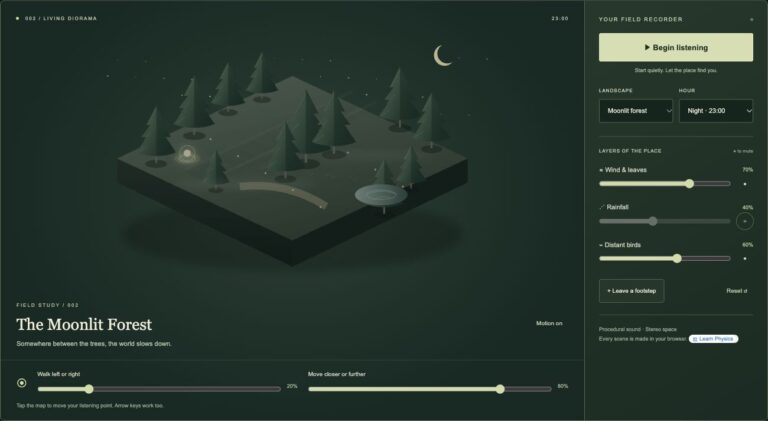
Field Recording Diorama
Field Recording Diorama: 7 Smart Soundscape Checks
Build an imaginary soundscape in Field Recording Diorama. Tested layer mutes, listener controls, Save/Restore and a fresh shared link explain what the scene recipe preserves and why a postcard is not recorded audio.
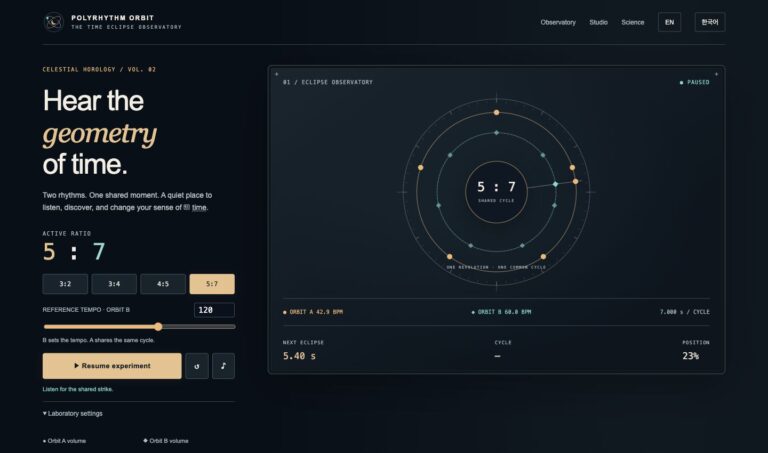
POLYRHYTHM ORBIT
Polyrhythm: 7 Smart Checks for Better Orbit Practice
Explore polyrhythm cycles, onset grids and phase in POLYRHYTHM ORBIT. Checked rates, 6:4 shared positions and fresh-link restoration explain the reference clock and session/export limits.

TEMPERAMENT LAB
Tuning: 7 Smart TEMPERAMENT LAB Checks for Better Comparisons
Compare six tuning systems, inspect interval maps and beat estimates, and build a clearly labeled experimental comma budget in TEMPERAMENT LAB.