
Explore seed dispersal with Seed Pod Pop. Repeated launches, wind comparisons, replay, a grass target and pine humidity tests show how to read this educational model without treating it as a field forecast.
- Brand
- Seed Pod Pop
- Tool languages
- en, ko
- Verified date
- 2026-11-08
Seed Pod Pop is a seed dispersal sandbox for testing how a simplified launch changes when you alter one condition. Choose an illustrative plant model, set power, angle and wind, then launch seven virtual seeds. Read the numerical results, replay the flight and compare a new run with a pinned baseline. Its value is learning how to ask a reproducible question, rather than predicting where a real plant will establish.
Directly checked 8 November 2026 in Chrome. We repeated a fixed-random baseline, changed wind, tested a stronger launch and the grass challenge, checked the pine humidity gate, explored two germination settings, stepped through replay and reloaded the page. The Korean interface was also tested at a fresh 390 px viewport. Numbers below are outputs observed in this simulator, not field measurements or germination trials. The CSV control was clicked, but its downloaded file contents were not verified.
On this page
Key takeaways before the first seed launch
- The official tool name is Seed Pod Pop. It offers English and Korean interfaces and four illustrative plant models.
- At Impatiens, power 65%, angle 40°, wind 0, model mass 1.0, drag 0.15, humidity 30% and random seed 42, two runs both recorded 5.370 m.
- Changing only wind to 4 m/s produced 5.690 m, a displayed increase of 0.320 m against the pinned first run.
- A stronger run reached a farthest distance of 11.951 m yet passed the 7–10 m grass challenge. The objective needs at least one seed in the target; it is not a maximum-distance contest.
- A humid pine attempt did not add a launch. Previous numerical results stayed visible, so a number remaining on screen does not prove a new experiment ran.
- History is visit memory. Our reload returned empty notes and default controls. Record full conditions before leaving.
What this seed dispersal model helps you investigate
The playground links a side-view flight diagram, controls, result counters, a slow-motion replay, a conceptual habitat strip and a target challenge. It helps a learner separate a prediction from an observation: write what should happen, change one parameter and compare the result. An educator can use the same short sequence to discuss experimental control without collecting plants or buying high-speed filming equipment.
The selectable studies are Impatiens, Cardamine, Ecballium and Pine cone. The site describes elastic recoil, rapid valve coiling, pressure-driven ejection and humidity-dependent passive release respectively. These are introductions to different mechanisms, not four calibrated biological datasets. The shared sandbox simplifies flight using a fixed time step, gravity and linear drag. It substitutes illustrative launch settings for the detailed mechanics of a fruit.
This is not a planting-distance calculator, a crop-yield forecast or a source of real germination probabilities. The landing habitats are labeled as a conceptual map. The replay is an animation of model output, not high-speed footage. Those distinctions are useful teaching material in their own right: an attractive visualization can help explain a question while still being a limited representation of nature.
Prepare a fair comparison before pressing POP
Begin with a fresh page and note the selected plant, launch power, angle and wind. Expand Experiment settings to expose mass, drag coefficient, humidity and Fixed random seed. The default values in our fresh visit were Impatiens,65%,40°,0 m/s,1.0,0.15,30% and 42. We report mass and drag as displayed model settings; the interface did not give us a basis to relabel mass 1.0 as a measured one-gram specimen.
Power ranges from 10 to 100%, angle from 5 to 85° and wind from−8 to 8 m/s in the inspected controls. The advanced sliders offer mass 0.5–3, drag 0–0.6 and humidity 0–100%. Those are interface ranges, not recommendations for real materials. We did not test every combination. The germination section has separate soil moisture and light controls; do not confuse its moisture value with the humidity setting that affects the pine release rule.
A fixed random seed is a number used to reproduce the simulator’s variation. It is not the number of biological seeds being launched. Holding 42 constant helps compare matched virtual samples. Repeating that same configuration gives a repeatability check, but it does not supply independent biological replicates. To explore variation across random seeds, change that number in a separate experiment after the matched comparison is complete.
How to use Seed Pod Pop: 7 smart experiment checks
1. Define one question and a baseline
Ask a small question such as whether positive wind changes landing distance at otherwise unchanged settings. Write a prediction before launch. Choose the plant explicitly and record all advanced settings. Our documented baseline above is a reproducible starting example, not a claim that those values describe every Impatiens plant. If someone else is reviewing your work, share the full configuration rather than only the headline distance.
2. Launch and distinguish batch from running total
Press POP. A successful launch releases seven simulated seeds. The first baseline showed 5.37 m,1.30 s and 7 seeds launched; repeating it showed the same rounded distance and 14 in the counter. The field notes recorded 5.370 for both runs. The counter accumulates launches during the visit;14 does not mean a single pod suddenly produced fourteen simulated seeds. Use the notes to identify individual experiments.
3. Pin the reference before changing wind
After the first run, use Pin comparison. Keep the same plant, power, angle, mass, drag, humidity and random seed, then set wind to 4 m/s and launch again. Our third row showed 5.690 m and the comparison text reported Compared with#1:+0.320 m. The main readout showed 5.69 m and 1.30 s. Read this as a local result of this configuration; it is not a universal conversion from wind speed to extra dispersal distance.
4. Inspect the flight with replay controls
The replay section offers 1×,0.25× and 0.1× playback, a scrubber, Replay flight and Next frame. We paused, moved the scrubber to its start and pressed Next frame; the display reported Simulation frame 1. We also selected 0.1×. Slowing observation should not be interpreted as changing the original physical launch parameters. Use a new POP run for a new experiment and replay for inspecting the already generated flight.
5. Read the target rule before optimizing
The challenge asks for at least one seed in the 7–10 m grass zone. We left wind at 4 m/s and raised power to 100%, with the other baseline flight settings unchanged. The notes recorded 11.951 m, the top flight time was 1.88 s and the page reported target success. Since the farthest seed was beyond 10 m, success must be read together with the distribution and the “at least one” instruction rather than judged solely by the largest value.
6. Test release and germination as different rules
Next we selected Pine cone. At power 100%, angle 40°,wind 4,model mass 1,drag 0.15,random seed 42 and humidity 0%, the new row recorded 1.702 m and the flight readout showed 0.75 s. At humidity 100%, POP instead displayed a message that pine scales were closed and suggested lowering humidity below 66%. No sixth row appeared and the total stayed 35. The old 1.70 m result remained. The 66% instruction belongs to this illustrative software gate, not a measured threshold for all pine cones.
Separately, soil moisture 55% and light 60% produced a virtual-sprout message. Moving soil moisture to 0% while keeping light 60% produced the dormant message. These are responses of a simple habitat rule, not observed plant development or a probability estimate. Treat launch success, landing in a target and a conceptual sprout as three different outcomes. A positive result in one panel does not validate the others in nature.
7. Preserve a complete note before leaving
The visible field-note columns are row number, power, angle, wind and metres. They omit plant model, mass, drag, humidity and random seed. Our pine row therefore looked superficially comparable to the 100% Impatiens row despite a changed plant model. Keep an external record of those missing settings. The page says it keeps the last eight launches in this visit; we inspected five recorded rows and did not test that capacity boundary.
Download CSV is available. We clicked it but did not retrieve an inspectable file through this session, so we cannot verify its columns, encoding or complete contents. Independently, reloading returned empty field notes, a zero counter and default controls. Do not treat Pin comparison as permanent storage. Save the information you need in your own notes before refreshing or closing the page.
Actual seed flight results and their limits
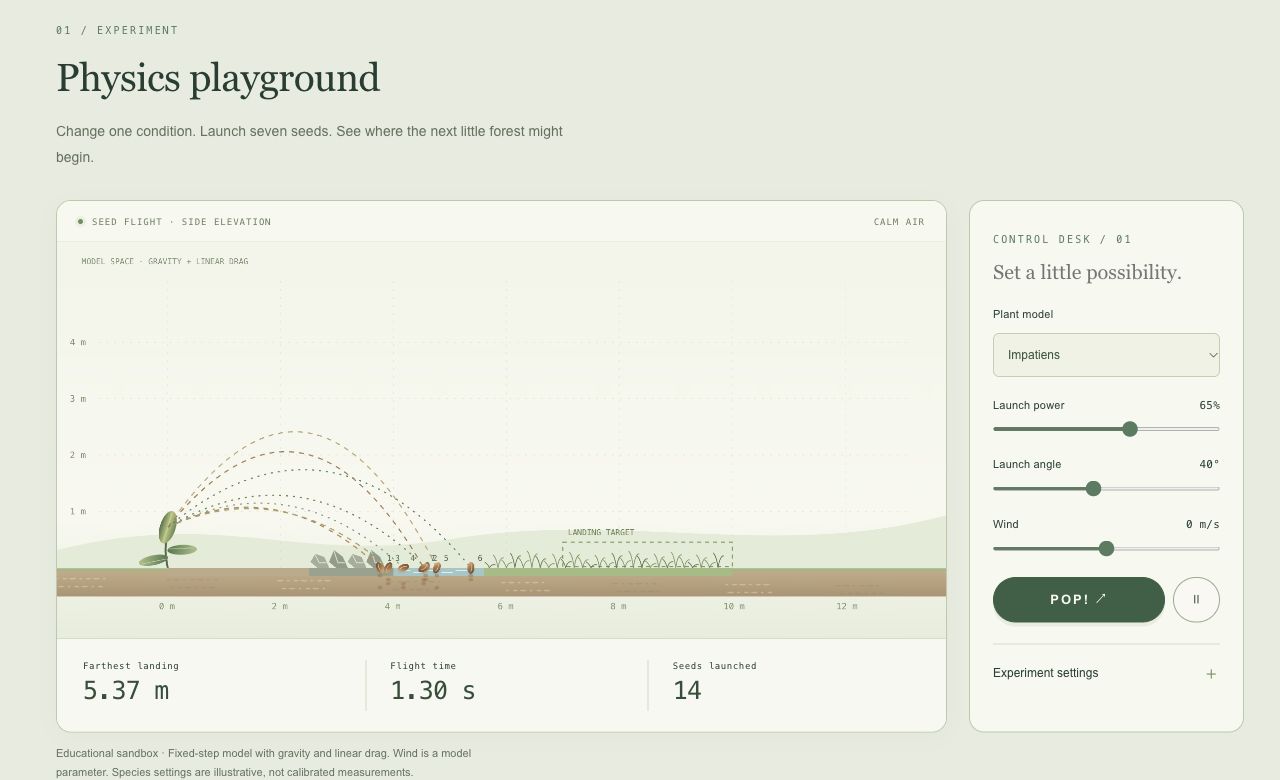
| Run | Changed condition | Recorded result |
|---|---|---|
| #1 Impatiens | Baseline:65%,40°,wind 0; mass 1,drag 0.15,humidity 30%,random 42 | 5.370 m; readout 1.30 s;7 launched |
| #2 Impatiens | Same settings as#1 | 5.370 m; cumulative 14 |
| #3 Impatiens | Only wind changed to 4 m/s | 5.690 m;1.30 s; comparison+0.320 m |
| #4 Impatiens | Power 100%,wind 4; other flight settings as above | 11.951 m;1.88 s;7–10 m target success |
| #5 Pine cone | Plant changed; humidity 0%;power 100%,angle 40°,wind 4,random 42 | 1.702 m;0.75 s; cumulative 35 |
| Attempt at Pine humidity 100% | Humidity only, compared with#5 | Release blocked; no added row; old results remained |
Use the precision carefully. The headline rounded the baseline to 5.37 m while its row showed 5.370 m. Three decimal places in a record do not make a simplified model a millimetre-accurate botanical instrument. Our arithmetic check is 5.690−5.370=0.320 m. It confirms consistency between the recorded values and the comparison text; it is not an independent audit of the integrator or biological assumptions.
The pine result also illustrates a confound. Comparing#4 and#5 as if humidity alone changed would be wrong because the plant selection changed too. By contrast,#5 and the blocked wet attempt isolate the humidity gate in that pine configuration. Record exactly which claim a comparison supports. Describing every difference as an effect of the last slider touched hides the earlier changes that still matter.
Read the history without losing hidden conditions
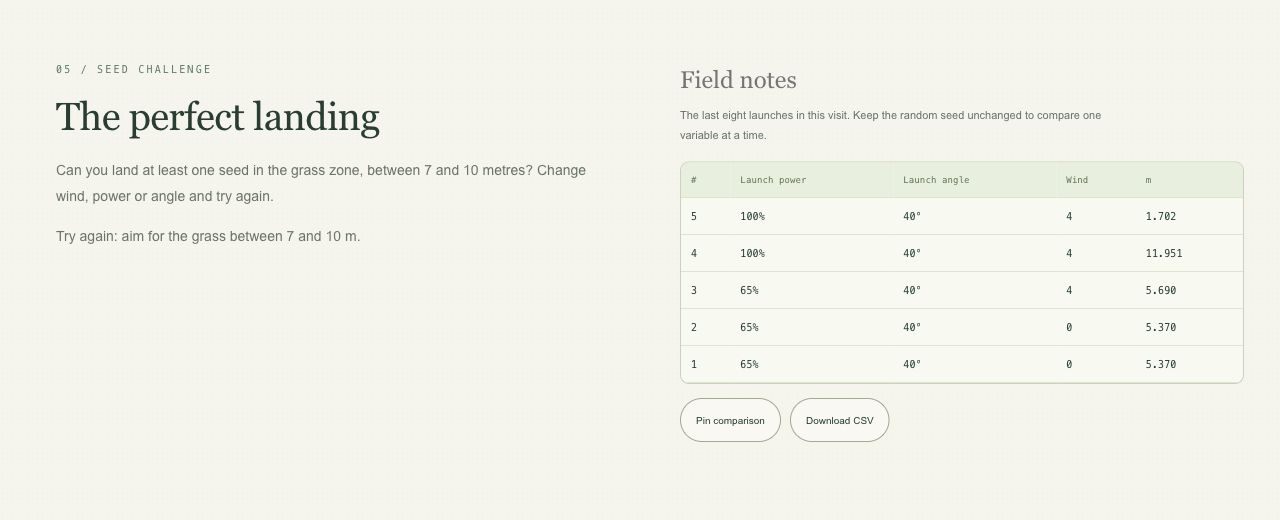
A useful worksheet has more columns than the built-in table: plant, power, angle, wind, mass setting, drag, humidity, random seed, maximum distance, reported flight time and target status. Add a final observation column for messages such as closed scales or dormant habitat. Leave a distance blank when no new run occurred rather than copying the old displayed value into a fresh row.
Separate the latest flight from the accumulated landing map. The map is labeled as an accumulated distribution with a 0–10 m strip, while the high-power row exceeded 10 m. Read precise distances from the numerical record and avoid inferring extra accuracy from the picture’s boundary. The Clear map control is present, but we did not test its full reset semantics, so this guide does not promise which other records it preserves.
For a matched classroom exercise, first repeat one configuration, then compare one altered input, and only afterward explore a different random seed. Ask learners to explain whether they have shown deterministic repeatability, sensitivity to an input or variation across simulated samples. Those are distinct questions. A pair of identical runs may be useful without being evidence that natural seed dispersal has no variability.
How the botanical research differs from this sandbox
The source links real biomechanics research. Hayashi, Feilich and Ellerby’s 2009 Impatiens capensis study investigates energy storage and transfer in exploding pods using physical measurements and high-speed video. That supports the biological background of elastic release. It does not calibrate this website’s 65% power setting or certify its numerical flight outputs.
Eger and colleagues’2022 pine-cone study examines passive scale movement in response to hydration and humidity. It provides a reason to distinguish pine release from an explosive pod. The site’s shared flight display and discrete humidity gate are a teaching simplification, not a substitute for that structural research. We did not reproduce either study or measure real plants.
A practical way to use those links is to ask what the researchers measured that the sandbox leaves out. The answer changes the kind of conclusion you can draw. The animation can introduce motion and experimental design; the linked methods show why a biological explanation needs evidence beyond a convenient slider and a visually convincing trajectory. Avoid presenting a research citation as validation of an unrelated software implementation.
Limitations, privacy and mobile behavior
We tested one reproducible Impatiens baseline and selected pine conditions, not every Cardamine or Ecballium configuration. We did not audit the source code, numerical convergence, full parameter space or all browser engines. Sound has an off/on control, but we did not verify the audio output. Launch power is a model control, not a measurement of how hard a person should touch a real fruit.
Experiment controls run in the browser according to the site. Its FAQ says notes stay in memory for the visit unless exported; our reload observation is consistent with that description. We did not audit all network traffic. Blogger hosting and Google advertising are disclosed separately and advertisements appeared during research. Local control calculations do not imply that the entire page has no external data processing.
On a fresh 390 px Korean page, the bottom POP button launched seven seeds with 5.37 m and 1.30 s and the next-frame control responded. Document width remained 390 px. We did not test every physical phone, touch gesture or assistive technology. Numerical readouts and explanatory text provide useful alternatives to relying only on trajectory colors, but this check is not a complete accessibility audit.
Troubleshooting a seed experiment
| What seems wrong | What to check |
|---|---|
| The old distance remains after POP | Read the release message, total count and newest row; a humid pine attempt may not launch. |
| Repeating gives exactly the same number | Check whether Fixed random seed and all other controls are unchanged. |
| A farthest landing beyond 10 m still wins | The rule requires at least one seed inside 7–10 m, not the farthest seed there. |
| Two rows look identical except distance | Plant and advanced settings are omitted from the visible table. |
| Replay feels slow or stopped | Check pause state, speed and scrubber; replay is not a new experiment. |
| History disappeared | Our refresh cleared the visit; record full conditions before leaving. |
| A sprout is mistaken for a forecast | Read the conceptual-rule notice and separate soil moisture/light from flight settings. |
Related tools for a different model question
- Pond Jar Universe extends one-variable reasoning to a virtual ecosystem with day-by-day changes and matched jars. Use it to compare a flight event with an interacting time-series model, while retaining its biological limits.
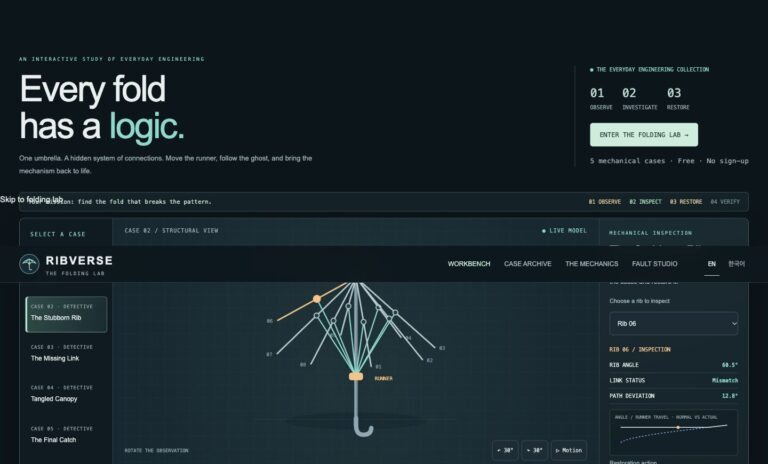
- RIBVERSE umbrella mechanism lab offers another mechanics question: inspect linkage motion, distinguish a symptom from a cause and check a virtual correction. It is a separate lesson, not a way to import seed trajectories.
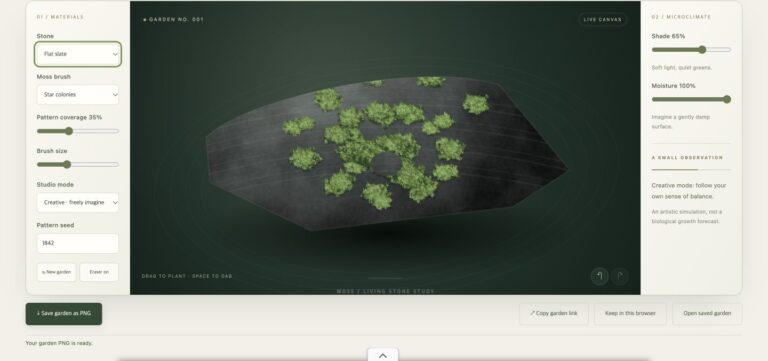
- Moss Carpet Planner suits a follow-up visual nature project with patterns and brushwork. Its imagined conditions are not a cultivation forecast; do not carry Seed Pod Pop’s virtual germination result into real growing advice.
Seed dispersal FAQ
Can I use the distance as a real planting measurement?
No. The source calls its settings illustrative and uncalibrated. Our numbers describe a specific simulator configuration, not a measured species, a gardening recommendation or a predicted establishment radius.
Why will a pine cone not launch?
At humidity 100% our attempt displayed a closed-scales message and did not add a row. The interface advised lowering humidity below 66%. That is the model’s rule, not a universal real-world botanical threshold.
Does a fixed random seed make the experiment scientific?
It makes a simulation easier to reproduce. Good experimental reasoning still requires complete settings, a defined comparison, accurate records and conclusions limited to what was actually tested.
Does pinning save the experiment for later?
It provided a comparison with our first run during the visit. A page reload cleared our records. CSV is available but the file contents were not verified here, so keep a separate complete note.
Start with a prediction, then launch seven seeds
Repeat the documented baseline, pin it and change only one input. Read the newest record and messages before making a claim, then distinguish a model observation from a biological prediction. Seed Pod Pop works best as a small laboratory for careful questions and bounded conclusions.
A RELEVANT NEXT STEP
Tools with a useful connection

Pond Jar Universe
Pond Jar Universe: 7 Essential Experiment Checks
Explore a virtual pond with one-variable comparisons. Our actual tests explain daily indices, DAY11 results, history locks, local saves and the limits of this educational ecosystem model.
RIBVERSE — The Folding Lab
Umbrella Mechanism: 7 Essential RIBVERSE Lab Checks
Investigate a virtual umbrella linkage with RIBVERSE. Our five-case tests explain ghost paths, matching actions,0° latch faults, completion history and reproducible puzzle links.
Moss Carpet Planner
Moss Carpet Planner: 7 Smart Design Checks
Design miniature moss-on-stone artwork with patterns and brushwork. Follow real tests of sharing, local restoration and imagined conditions, with clear botanical limits.