Laundry sunlight planning with Laundry Shadow Planner compares a fixed rack position, one move and a shade-first spot. SunChaser Studio models window light from room measurements, location and date. Use it to choose a position to observe before moving a loaded rack; its exposure scores do not predict drying time.
Verified 19 November 2026, KST. We tested Korean and English controls, rack coordinates, recommendation application, seasonal dates, orientation, laundry-plane height and save/reload. The Korean workbench was also operated at 390×844. The example below uses the model date 17 November 2026; that is separate from our verification date. These are browser-model tests, not measurements of a real room, physical laundry drying or astronomical accuracy.
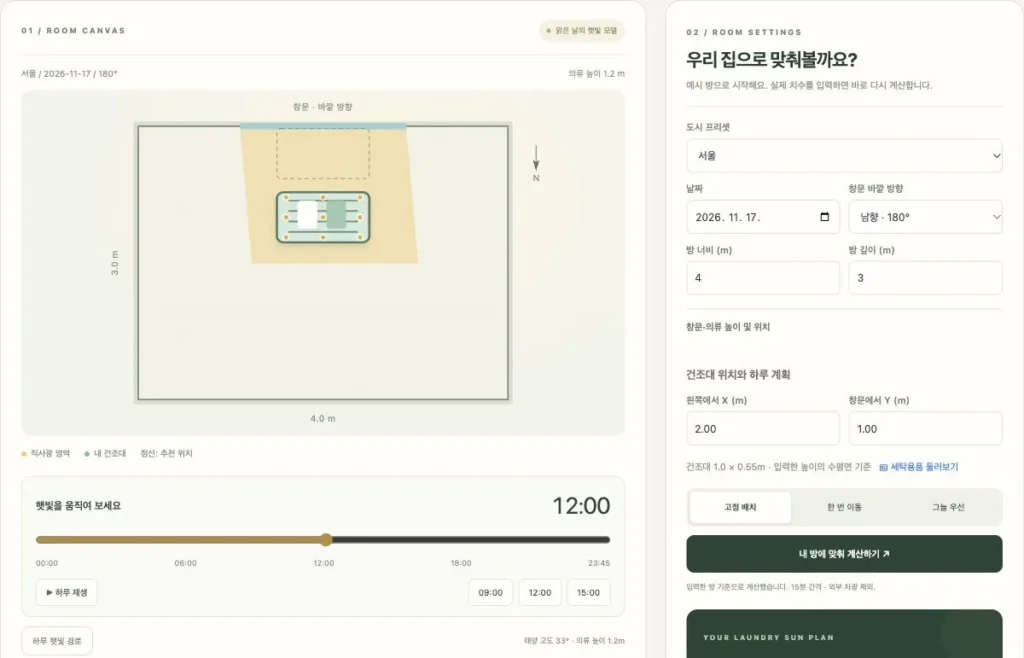
Compare indoor laundry sunlight with Laundry Shadow Planner. Actual Seoul tests explain fixed and one-move plans, summer geometry, shade, local saving and model limits.
- Brand
- Laundry Shadow Planner
- Tool languages
- en,ko
- Verified date
- 2026-11-19
On this page
Key takeaways
In the tested Seoul south-facing example, the current rack received 5h 30m of daily area-weighted exposure. The recommended fixed spot gave 9h 15m, and the one-move plan gave 10h. The useful comparison is therefore a large modeled gain from choosing a better fixed location, followed by a smaller 45-minute equivalent-exposure gain from moving once. None of those values predicts when a towel will be dry.
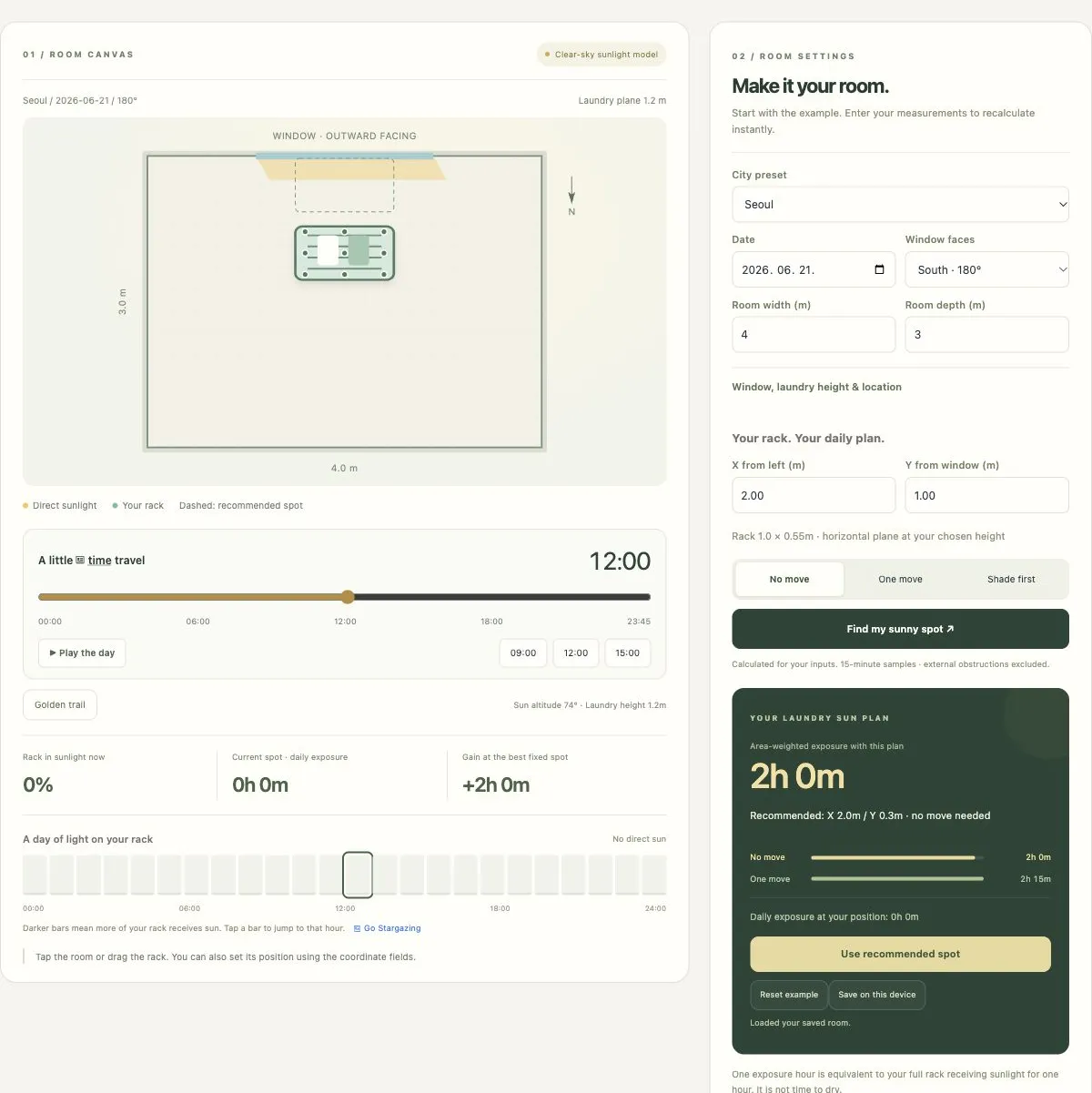
The same room’s June comparison produced only 2h at the best fixed position and zero daily exposure at the original position. Higher summer sun can stay close to the window at the selected horizontal height. A long outdoor day does not guarantee that direct light reaches a drying rack deeper inside the room. Room geometry, window direction and laundry height deserve attention before interpreting a seasonal result.
What this laundry sunlight planner does
The official name is Laundry Shadow Planner, with SunChaser Studio branding. The root opened in Korean, and the navigation linked an English workbench. It uses a rectangular room, a centered window and a fixed 1.0×0.55 m rack represented on a chosen horizontal laundry plane. The canvas draws the sunlight patch and rack; summary cards compare exposure and recommendations. No account was needed for the inspected workflow.
Inputs include a city preset or custom latitude and longitude, date, UTC offset, outward window direction, bearing correction, room dimensions, window dimensions and sill height, laundry-plane height and rack X/Y position. Seoul, Tokyo, London, New York, Sydney and Custom were offered. This is a geometry-based clear-sky comparison. It does not read a photograph of your apartment, discover obstacles or retrieve a forecast for tomorrow’s washing.
No move searches candidate fixed positions. One move proposes two positions and a changeover time. Shade first searches for lower exposure. The source also offers time shortcuts, a 15-minute slider, Play day, Golden trail, seasonal cards and device saving. We verified the manual time controls and recommendations; the full animation behavior was not independently evaluated. We did not find rack-size editing, multiple windows, furniture obstacles or a file-export control.
Prepare room measurements and a useful question
Start with a specific decision: compare the current location with a fixed alternative, or decide whether a midday move is worth arranging. Keep the date, room and window identical while comparing strategies. Changing the city and window width together may produce an interesting picture, but it cannot tell you which change caused the difference. Write down the baseline inputs before trying a different season or orientation.
Use metres for room and window dimensions. For example, a measured 180 cm window is 1.8 m. The room controls accepted 1.5–12 m width and depth; laundry-plane height accepted 0–3 m. Those are interface limits, not a claim that every room within them fits the model. A centered rectangular opening is a poor representation of a corner window, a glazed balcony or several differently oriented windows.
Check the outward-facing direction rather than the direction you face while looking back into the room. South is 180° and north is 0° in the inspected choices. Bearing correction ranged from −45° to +45° and adjusts orientation error; it does not remove the shadow of another building. The source asks users to verify the date-specific UTC offset, including daylight saving. Selecting London in our June state displayed UTC+1, but that single check does not validate every city and date.
7 essential laundry sunlight checks
1. Set place, date and clock assumptions
Choose the city or enter custom coordinates, then confirm the date and UTC offset. A saved example can reopen with an old date. Do not describe its result as today’s exposure until you have checked that field. Record the date beside every comparison so that the seasonal cards are not confused with the currently selected day.
2. Enter the room and window
Measure room width/depth, opening width, sill height and opening height. Open the additional measurement section to reach the hidden fields. Our baseline was a 4×3 m room, 1.8 m window, 0.8 m sill and 1.4 m opening height. Keep those settings together when reproducing the test.
3. Choose the laundry height
Set the horizontal plane used to sample the rack. Our baseline used 1.2 m. This plane simplifies garments hanging at many different heights. In a separate test, raising it to 2.3 m, above our 2.2 m window top, returned zero exposure. That is a model check, not a physical measurement of hanging clothing.
4. Record the current position
Use X from the left and Y from the window, following the canvas. Our current position was X2.00 m, Y1.00 m. Coordinate fields provide an alternative to placing the rack on the canvas. The displayed hundredth-of-a-metre input step is editing precision; it should not be read as centimetre-level certainty in the sunlight estimate.
5. Compare the three strategies
Read No move first, then One move and Shade first without changing the room. Write down the recommended positions and time as well as the headline exposure. A plan that requires a midday move is less useful if everyone is away. A shade-first location may be more relevant for a fabric whose care instructions limit direct sunlight.
6. Apply and inspect the recommendation
Use recommended spot changed the current coordinates to X2.0/Y0.3 in our fixed-plan test, and the current daily value became 9h 15m. Inspect the morning, noon and afternoon views after applying a recommendation. Keep real access, ventilation and furniture clearance in mind; none of those constraints is represented by a clear rectangle in this model.
7. Check another season, then save deliberately
Try a seasonal card with the same geometry and record the new date. Restore the room you want to keep before pressing Save on this device. Saving and experimenting are different actions: we saved the unchanged original, altered height temporarily, and reloaded to confirm that 1.2 m returned. Our tests preserved the original saved room.
Actual Seoul sunlight model results
All rows below use Seoul, a south-facing 180° window and the dimensions stated above unless a row explicitly changes them. The original rack remains X2.00/Y1.00 for comparisons. The numbers are displayed outputs, not field measurements. “Current” is daily area-weighted exposure at that original rack position; fixed and one-move refer to their respective searched plans.
| Model setting | Current / fixed / one move | What to learn |
|---|---|---|
| 17 Nov 2026 | 5h30 / 9h15 / 10h | Improve the fixed spot before adding a move. |
| 21 Jun 2026 | 0h / 2h / 2h15 | Summer sunlight may not reach the interior rack. |
| 21 Dec 2026 | 6h / 9h / 9h30 | Season changes reach and duration differently. |
| 17 Nov, north 0° | 0h / 0h / 0h | Check direction before expecting direct sun. |
| 17 Nov, plane 2.3 m | 0h / 0h / 0h | The test plane was above the window top. |
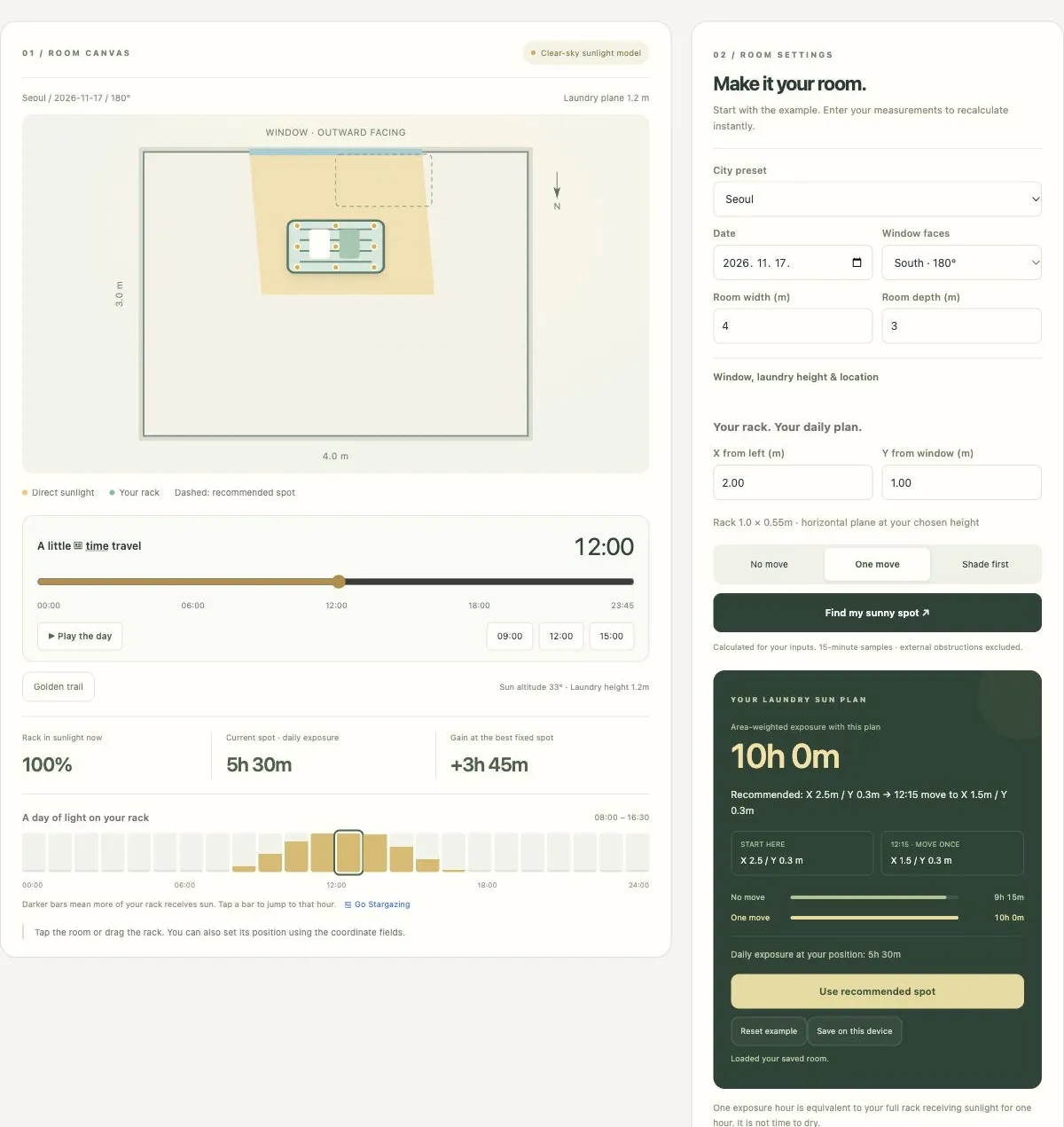
For the November plan, the recommended fixed spot was X2.0/Y0.3. One move instead started at X2.5/Y0.3 and switched at 12:15 to X1.5/Y0.3. Shade first displayed 0h at X1.0/Y2.3. Recommendations describe this simplified room only; the tool cannot see a door opening, a child’s route or a radiator occupying one of those locations.
Read sunlight fractions and equivalent hours
Three outputs answer different questions. The instant sunlit percentage describes the sampled rack at the selected time. Current daily exposure integrates the day at the current position. Gain at the best fixed spot compares that daily result with the fixed recommendation. Moving the time slider should therefore change the first measure without necessarily changing the daily total. In our baseline, 09:00 showed 33%, noon 100% and 15:00 56%, while the daily value stayed 5h 30m.
An equivalent exposure hour weights sunlight by how much of the sampled rack is lit. As explanatory arithmetic, 50% coverage for two hours equals one full-rack equivalent hour. This example explains the unit; it is not an additional app experiment. The calculation does not measure solar energy, fabric temperature, residual water or evaporated mass. Ten exposure hours should never become a promise that a load will dry in ten clock hours.
Why summer can give less indoor sunlight
On the June card at noon, the source displayed a 74° solar altitude, zero current sun and a narrow sunlight patch near the window. The November noon view displayed 33° altitude and full current coverage at the original rack. Both screenshots use the same room and laundry height. The geometry helps explain why the seasonal ranking can differ from the length of the outdoor day.
For intuition, consider a hypothetical vertical cross-section with a window edge 1 m above a horizontal plane. A downward ray at 45° travels about 1 m horizontally before reaching that plane; at 30° it travels about 1.73 m. This simple geometry ignores azimuth, opening boundaries and room clipping. It illustrates reach only and does not independently validate the app’s solar-position calculations or reproduce its full exposure result.
Is one move worth the extra exposure?
The best fixed baseline gained 3h 45m over the original location. The one-move strategy added another 45 equivalent minutes beyond fixed. That comparison suggests a practical order: first decide whether the fixed recommended area is usable, then consider the smaller incremental benefit of moving. A busy household might prefer a workable fixed spot even when a two-position plan wins the modeled total.
Treat 12:15 as a sampled recommendation rather than a physically exact deadline. The source samples time every 15 minutes and searches a candidate position grid. It does not claim a continuous global optimum across every possible coordinate and second. Before adopting the routine, observe the actual patch around that period on a clear day. A schedule should remain useful when the external scene differs from the simplified model.
Shade-first planning and fabrics
Shade first is useful when the question is avoiding direct light rather than maximizing it. Our November result was zero modeled exposure at X1.0/Y2.3, while the fixed and one-move comparison cards still showed 9h 15m and 10h. These cards compare different objectives; zero in shade mode is not automatically a failed calculation. Confirm which mode is selected before copying a headline number.
A zero result does not prove protection from all light or guarantee fabric care. The model addresses direct clear-sky rays on a horizontal sample plane, and real garments have many surfaces. Follow the item’s care label, separate light-sensitive pieces where appropriate, and consider spacing and airflow. The source’s drying guidance also separates ventilation and humidity from exposure; neither indoor humidity nor garment moisture was measured in our tests.
Sunlight model accuracy and the hourly-label discrepancy
The source describes a NOAA solar-position approximation, 15-minute samples and a 3×3 rack exposure sample. It excludes clouds, balconies, window frames, glass transmittance, neighbouring buildings and clothing-to-clothing shading. These omissions can materially change a real apartment’s sunlight. A precise-looking percentage or coordinate cannot compensate for an omitted obstruction. Treat the model as a comparison under stated assumptions, then observe the room.
Observed interface discrepancy: at the original November position, the 09:00 hourly bar was labeled 47%, but selecting it set 09:00 and the current metric displayed 33%. At 15:00 the bar label was 33% and the current metric 56%. Recalculating did not remove the difference. We did not verify the cause or establish that the bars are hourly averages. Use the time-stamped current metric for an exact selected-time comparison, and do not treat bar labels as interchangeable readings.
Local saving, language and privacy
The site states that calculations run in the browser and that Save on this device stores room settings there. Our save/reload check confirmed restoration of the original date, south orientation, 1.2 m plane and X2.00/Y1.00 position after temporary edits. This does not establish cloud synchronization, a portable backup or permanent retention. Browser data removal or a different browser may mean the saved room is unavailable.
English and Korean interfaces were available. The English page also linked a Korean page, while the root used Korean in our session. Local saving does not mean the whole website makes no network requests: the source references Google advertising and its policies. We did not perform a network, security or offline audit. Use a city preset where that is sufficient, and consult the source’s privacy information before assuming anything about third-party requests.
Mobile operation and troubleshooting
At 390×844, the Korean page fitted the viewport without document-level horizontal overflow. We selected One move and operated a rack-coordinate field; the 10h plan and 12:15 change remained visible. The tall workbench requires vertical scrolling. Open the extra measurements deliberately and recheck the date and mode before reading the lower recommendation card. This was one tested mobile viewport, not certification for every device or browser.
If a result is unexpectedly zero, check the selected date, window direction, laundry height and current versus recommended position in that order. A high plane or north-facing November opening can legitimately produce zero in the tested geometry. If a field edit appears uncommitted, inspect the displayed value and changed canvas before drawing a conclusion. If an old room returns on reload, distinguish unsaved changes from the stored configuration instead of assuming automatic saving.
Choose a sunlight model, observation or weather information
Direct observation is the better way to discover an external balcony shadow or another building’s obstruction. Sketch or photograph the actual patch at repeatable times without including private household details unnecessarily. The model is useful for trying seasonal geometry and comparing candidate positions before observation. A weather forecast answers a different question: whether clouds and rain may affect the day, rather than how a centered opening projects light inside the room.
A hygrometer, ventilation assessment or direct check of the fabric addresses conditions missing from a sunlight-only model. None can be replaced by the exposure score. Use the planner to narrow the placement question, observe the real room to check obstruction assumptions, and assess actual laundry separately. This combined workflow avoids both extremes: moving a rack at random and treating a simplified drawing as a completed drying experiment.
Related tools for a shared window area
If plants and laundry share a window area, Succulent Stretch Tracker’s photo-comparison guide offers a separate way to document visible plant changes and light observations after a placement adjustment. Its journal does not calculate laundry exposure or diagnose plant health. Use it only for the plant-record part of that shared-window workflow; keep the two kinds of evidence distinct.
For other household layout tasks, browse the published Home, Living & DIY tools. Choose by the specific next task rather than assuming that every visual planner simulates sunlight. The original workbench links a NOAA solar-calculation reference; we read the source’s method description but did not independently validate that reference against the implementation.
Frequently asked questions
Does it predict how long laundry takes to dry?
No. It compares area-weighted clear-sky sunlight exposure. Fabric, moisture, humidity and airflow are outside the tested numerical model. Exposure gains cannot be converted into minutes saved drying.
Can I use it for a balcony with several windows?
The inspected geometry is a rectangular room with a centered window. Balconies and external obstructions are explicitly excluded. Simplifying that scene may support a rough comparison, but it cannot verify the real shadows.
Why is the current total smaller than the fixed plan?
The current total belongs to the entered rack position. The fixed plan searches other candidate positions. Apply the recommendation if you want to compare the current display at that recommended spot; our baseline then changed from 5h30 to 9h15.
Is the 1.0×0.55 m rack adjustable?
We did not find a rack-size input. The inspected rack uses that fixed footprint on the selected plane. A different physical rack or differently hanging garments may receive a different fraction of direct light.
Is it fully private and offline?
The source states browser-side calculation and local settings storage, and reload restoration worked. We did not verify offline operation or audit network traffic. Advertising and third-party policies remain relevant.
Start with one measured room
Open the workbench, check its date, enter one measured room and compare the current location with No move. Add One move only after checking the incremental benefit and whether the proposed time fits your day. Use the result as a clear, testable sunlight-placement hypothesis, then confirm the real window patch and actual laundry conditions.
A RELEVANT NEXT STEP
Tools with a useful connection
Succulent Stretch Tracker
Photo Comparison: 7 Smart Checks for Better Plant Records
Compare succulent photos with manual references, a local journal and light-observation plans. Actual synthetic +50% measurements, alignment and reload tests explain the numbers, storage and export limits.
STRAPSHIFT
Backpack Fit Tool: 7 Essential Checks for Better Notes
Compare manual strap measurements, photo reference pixels and three-zone packing in STRAPSHIFT. Actual browser tests explain the model and local recipes while keeping real comfort untested.
FELTATLAS
Felt Pad Designer: 7 Essential Checks for Better Fit
Compare four furniture contact shapes and felt pads, inspect geometric coverage and prepare labelled cutting-pattern previews. Includes real fit tests, print calibration and local-save limits.