Kerning Crime Scene is a browser kerning game for inspecting Latin letter pairs. Select a gap, mark it if it looks suspicious, adjust the spacing and submit a case report. Some specimens have no planted error, so leaving a balanced pair alone is part of the exercise.
Verified 14 November 2026, Korea time, in Chrome. We tested VA and AV practice cases, spacing controls and Undo, the reference views, a custom AVATAR link and a fresh Korean page at 390px. The corrected AV replay used a target already revealed in an earlier report; it was not a blind skill test. Screenshots show actual interfaces and results. This library and the original tool share a creator.
Practice optical spacing in Kerning Crime Scene. Actual VA, AV and shared-link tests explain suspect marks, restoration scores, known-target replays and Korean mobile controls.
- Brand
- Kerning Crime Scene
- Tool languages
- en,ko
- Verified date
- 2026-11-13
In this guide
Key takeaways for a kerning game
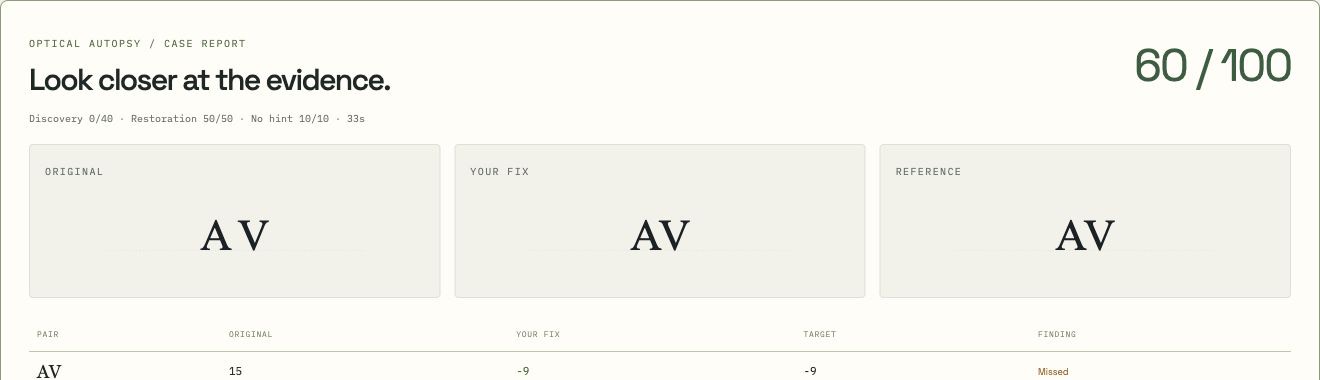
The first useful distinction is selection versus suspicion. Selecting a pair opens its controls. Mark suspect is a separate decision that contributes to discovery scoring. We produced an AV report with the spacing restored exactly to its target but no suspect marked: restoration earned 50/50, discovery earned 0/40 and the total was 60/100 with the no-hint component.
The second distinction is correction versus restraint. In practice case 006, VA began at −9 units and its designed target was also −9. No crime found returned 100/100 without changing the pair. It was a functional test of the no-error path, not proof that every visually quiet-looking specimen should be left untouched.
Finally, a high game score is not a typography certificate. The report explicitly calls its answers designed practice targets, accepts a ±3-unit tolerance and warns that kerning is contextual. The visible letterforms use system fonts and may vary by platform. Carry the habit of inspection into design work, rather than copying one target number into every font.
What Kerning Crime Scene actually does
The official name is Kerning Crime Scene, subtitled The Typographic Forensics Lab. The page offers 30 practice cases across six named error types, a UTC daily case, a local detective record and a custom challenge creator. We inspected the library controls but did not play all thirty cases or validate every difficulty level.
The workbench lets you select a pair from the specimen or pair buttons, mark a suspect, tighten or widen the gap, use a slider, inspect alternate views and submit. The inspected optical-spacing slider ran from −40 to +40 in one-unit steps. These are normalized game units, not a physical measurement or an export specification.
The six teaching themes cover close spacing, excessive separation, diagonal and curved shapes, coordinated multiple gaps and false suspects. The archive has a text search, a difficulty selector and an expansion control. That organization gives you a way to choose a small exercise; the current library uses Latin letters even in the Korean interface.
Prepare to judge the whole word
Start on a stable screen with one short specimen. Look at the whole word before opening the control panel. Decide which gap interrupts the rhythm, or whether none does. This keeps a visible number from becoming your first and only reason to change the design.
Think of adjacent pairs as parts of one word. A diagonal A/V relationship creates a different white shape from a curve under a T. Equal rectangular distances need not look equally spacious. After a local edit, look again at three neighboring letters and then at the complete word. The exercise is useful precisely because perception and a uniform numeric interval are different things.
For a first session, separate learning from measurement. Open a reference if you need to understand the target, but label later replays as informed practice. We saw AV’s target in a report before obtaining a perfect replay. Reporting that replay as an independent eye-training achievement would overstate what happened.
7 essential checks for your first investigation
1. Choose a named case and inspect its label
Open a practice card from the case files. We began with file 006, VA, labeled The False Suspect, and then file 001, AV, labeled The Diagonal Deception. The daily case is labeled separately. Check which kind of case is active before comparing your result with a record or describing it as a daily completion.
2. Select a pair without assuming it is guilty
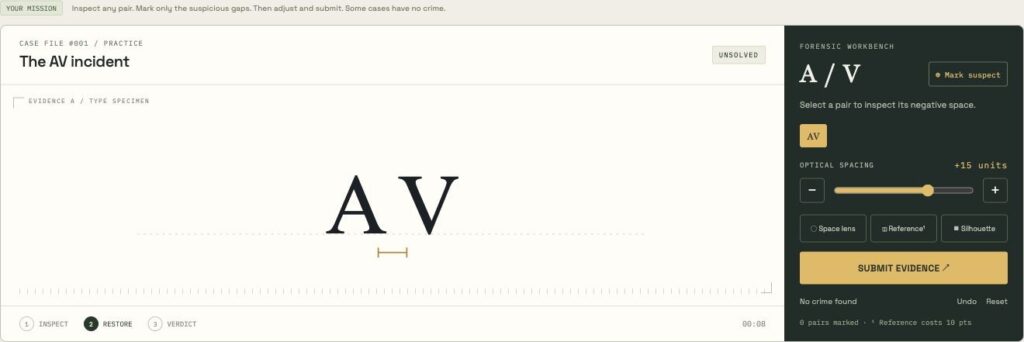
Click its gap selector or pair button. AV’s workbench displayed +15 units. Merely selecting the pair did not count as marking a suspect. Inspect the negative space in the specimen and decide whether the pair needs attention before using the separate mark control.
3. Mark only the gap you intend to investigate
Mark suspect changes to a marked state and adds a dot to the pair selector. Verify the marked-pair count before submitting. A control can toggle an existing mark off as well as on. Our later 60-point report demonstrated why an exact spacing correction does not replace the discovery decision.
4. Adjust in a small, reversible step
Use the minus/plus controls or slider. We tightened AV once and used Undo to return its displayed value to +15. The slider accepted one-unit keyboard steps within −40 to +40. Recheck the word after a local adjustment instead of treating the numeric endpoint as the visual goal.
5. Use a viewing aid with a clear purpose
Space lens, Silhouette and Reference each showed a pressed state when activated in our test. Reference overlays the designed comparison and carries a ten-point no-hint cost. Keep notes about whether you used it. We did not measure whether any viewing aid improves a learner’s perception or accuracy.
6. Submit the report and inspect the components
With AV marked but unchanged at +15 and the reference used, our report was 46/100: discovery 40, restoration 6 and no-hint 0. It exposed the −9 target. On a reopened attempt, marking AV and setting −9 without opening the reference produced 100/100. The target was already known from the earlier report.
7. Practice the no-error decision too
VA’s No crime found path produced original, fix and target values of −9 and a clear finding. The Korean mobile path returned the same 100-point result. This tests restraint within a designed no-error case. It does not establish that every unchanged word is balanced or that the same spacing fits another typeface.
Our actual VA and AV case results
| Case and action | Actual report | What it establishes |
|---|---|---|
| VA / no changes / No crime found | 100; original = fix = target −9 | The designed false-suspect route works. |
| AV / marked / +15 unchanged / reference used | 46 = 40 discovery + 6 restoration + 0 hint | Finding a gap alone is not restoration. |
| AV / marked / −9 / no reference on replay | 100 = 40 + 50 + 10 | The known target can be restored through the controls. |
| AV / unmarked / −9 / no reference | 60 = 0 + 50 + 10; finding Missed | Exact restoration does not earn discovery points. |
These are observed game results, not a study of learning outcomes. We had already seen the AV target before its successful replay. The 60-point result remained a useful demonstration of separate scoring components, even though the final letter placement matched the target. The attached report below preserves that distinction.
We did not use elapsed time as a benchmark. The interface says timing is separate from the point components, and the exercise is about optical judgment before speed. No user group, repeated blind trial or cross-platform score comparison was performed.
Marking a suspect is different from selecting a pair
Selection means “show me this pair.” Suspicion means “I identify this as a planted problem.” The two controls support different parts of the game. Before submission, inspect the marked count and the visual marker on each pair rather than relying on whichever pair is currently selected.
A useful troubleshooting question is whether the report’s low component concerns finding or restoring. If restoration is full but discovery is zero, more slider movement is not the missing action. If discovery is full but restoration is low, adding more marks will not correct the selected gap. Use the component that actually failed to guide the next practice attempt.
Read the score as feedback on a designed exercise
The source’s score explanation allocates up to 40 points to discovery, 50 to restoring all gaps and 10 to solving without the reference. It states that ±3 units are accepted around the designed target. We observed the component totals above, but did not test each tolerance boundary or reverse-engineer the scoring formula.
Reopening a case is useful for learning the controls. It should not be confused with a new unseen test. Our reopened AV report awarded the no-hint component because the reference was not used in that attempt, even though we knew the target from before. Interpret that label as an attempt-level game rule, not evidence of an untouched memory.
Do not turn the score into a universal rule for a logo. A production word depends on the actual typeface, size and use. A low game result can identify a practice question; a perfect result says you met this exercise’s criteria. Neither makes a type design expert-reviewed.
Use the lens, silhouette and reference deliberately
Use a lens to inspect the white shape, a silhouette to reduce visual distraction and the reference to understand the designed answer. We verified activation states and the report’s loss of the no-hint component after reference use. The aids were not tested as independent teaching interventions, and we do not claim a measured improvement from them.
After looking closely, return to the whole specimen. A local gap may feel comfortable on its own but interrupt the neighboring rhythm. Avoid leaving every helper enabled simply because it exists. Choose the view that answers the current question, then check the unassisted word again before making your decision.
The teaching text distinguishes kerning, a particular pair relationship, from tracking across a selection. For implementation context, MDN’s font-kerning reference explains that the CSS property controls use of kerning information stored in a font. The game’s slider is a practice mechanism; it does not generate a production font’s kerning table or a stylesheet.
Create and reopen a link-encoded challenge
Create a crime accepts a word labeled two to eight Latin letters, a pair to disturb and a normalized disturbance value. The page says the untouched word becomes the reference, with community cases explicitly unreviewed. We used AVATAR, selected its V/A pair and kept a disturbance of +20.
Copy challenge link reported that the link was copied. We read the resulting address and opened it in a fresh tab. It loaded AVATAR as Community / Unreviewed, and selecting VA showed +20 units. This verifies creation, link reopening and that pair value; we did not send the challenge to another person or measure how another device rendered it.
The address contained the custom word and gap settings. It is a convenient portable challenge, not a private vault or a public gallery submission. Do not place confidential wording in a link you intend to distribute. The source says there are no uploads or public gallery; we did not audit network implementation.
A community reference is the creator’s starting arrangement, not an expert answer. If a classmate restores it perfectly, the result establishes agreement with that starting point. It does not establish that the arrangement is the best possible spacing. Use custom cases for discussion and comparison, and label their status when showing them to others.
A practical spacing-review worksheet
| Review question | Check | Decision to record |
|---|---|---|
| Is a particular pair interrupting the word? | Inspect contours, then the whole specimen | Name the pair, or explicitly choose no error. |
| Did the report penalize the wrong step? | Separate discovery from restoration | Fix the missing action instead of chasing the total. |
| Does the idea transfer to a real heading? | Use the actual font and intended size | Review the real design separately from the practice target. |
For a short session, write one observation before changing the slider and one after submitting. Explain whether the gap looked open because of a diagonal, curve or neighboring shape. This proposed note-taking routine was not tested with learners; it is a way to make your own practice decisions reviewable.
For a group exercise, let participants inspect the same specimen independently before showing a reference. Discuss the words they use to describe the negative space. A known-target replay can be valuable practice if it is labeled honestly. There is no need to present it as evidence of improved visual skill.
Browser records, UTC days and privacy
The FAQ says scores, solved-case IDs and daily streaks stay in this browser’s local storage. There is no game account or global leaderboard. We saw two closed cases and a best score of 100 on a fresh Korean page after English testing. This confirmed local continuity in that session, not cloud synchronization or a cross-device account.
The daily header explicitly uses UTC. At our 14 November Korea-time check, it displayed 13 November UTC, which was consistent with the current UTC day. We played practice cases and did not test a midnight rollover or daily-streak progression. Keep the stated timezone in mind before interpreting a date as stale.
Shared links contain custom words and gap settings according to the FAQ; Blogger and Google advertising may separately process cookies or identifiers. We did not audit traffic or storage code. Clearing site data is described as removing local records, but we did not erase the detective record. Advertising overlays appeared and could obscure controls during research.
Korean controls and mobile inspection
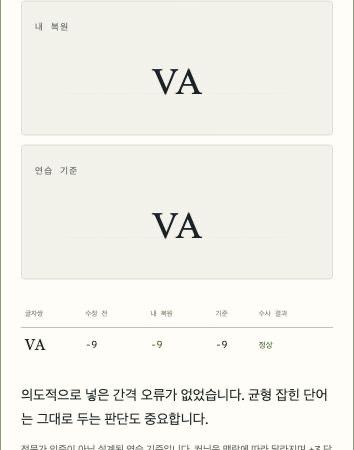
A fresh 390 × 844 Korean load had a 390px document width. We opened the VA false-suspect case, chose No crime found and inspected the 100-point result. The report stacked the comparison specimens vertically and kept the pair table available. This was responsive Chrome testing, not a physical phone or every browser.
The Korean controls translate the lesson and scoring explanations, but the cases remain Latin-letter exercises. The FAQ explicitly distinguishes them from spacing Hangul syllable blocks. Do not expect a Korean interface to imply Korean-script kerning assessment. Our AVATAR creator test also used Latin letters, as required by its visible input label.
Where the exercise stops
System fonts can change letter contours across platforms. The same numerical value is therefore not a universal optical measurement. We did not upload custom fonts, inspect a professional font file or verify production design output. No exported logo or kerning table was produced by this review.
The library and targets are designed exercises. Thirty cases and six themes do not make a complete typography curriculum, and this review did not assess educational effectiveness. Multiple-suspect cases, all difficulty filters and all target tolerances remain outside our direct play test. Use the stated limits when deciding how much the result can tell you.
For a real heading, begin with the actual font’s built-in behavior and inspect it at its intended size. Then compare the local pair and the whole word. This is a practical review suggestion, not a universal numeric recipe. The game is strongest as a prompt for observation, especially when you can explain why you changed something or left it alone.
Move from practice to a fictional cover
PULP COVER PRINTER is a relevant next stop for a fictional magazine heading. It offers masthead, headline and typography controls. Use it to ask whether a title remains readable in a complete composition after thinking about local gaps here. Its overall spacing controls and the game’s individual pair exercise solve different problems; no automatic exchange was tested.
If your goal is a production logo rather than practice, use a design environment that supports the real font, output format and review size you need. Do not assume the game can export the corrected specimen as a finished brand asset. Keep the practice report as a learning record and evaluate the actual design independently.
Frequently asked questions
Does selecting a pair mark it as suspicious?
No. Selection opens the workbench; Mark suspect is separate. Our exact-target but unmarked AV report earned full restoration and zero discovery points. Check the marked count before submitting.
Why can doing nothing score100?
Some cases intentionally contain no planted spacing error. VA case006 returned original, fix and target −9 with a clear finding after No crime found. The lesson is to inspect before correcting, not to change every specimen.
Are these Korean-script spacing exercises?
No. English and Korean interfaces are available, but the current cases use Latin pairs. The source says Hangul block spacing involves different principles and is not scored here as Latin kerning.
Does a perfect replay prove improved judgment?
Not by itself. Our perfect AV replay used a target already revealed in a report. It verified restoration and scoring behavior. It was not a blind before-and-after study or a professional assessment.
Start by deciding whether anything is wrong
Start with one short pair and decide whether anything is wrong before moving it. Mark a genuine suspect, make a reversible adjustment and read the report by component. A useful kerning game session ends with a reason for your decision, including the decision to leave a balanced gap alone.
A RELEVANT NEXT STEP
Tools with a useful connection
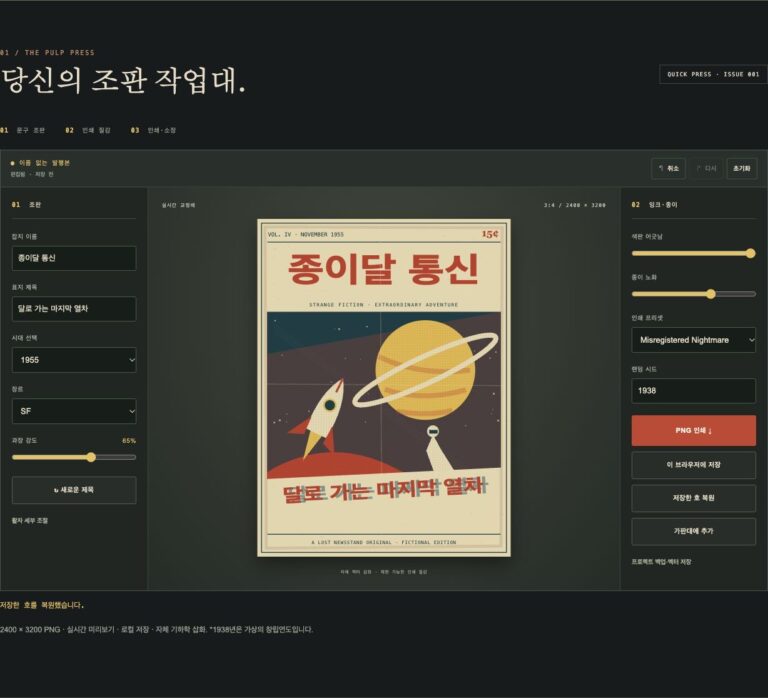
PULP COVER PRINTER
Pulp Cover: 7 Essential Checks for Better Fictional Issues
Make a fictional pulp cover with PULP COVER PRINTER. Actual English and Korean tests explain print presets, local restore, newsstand issues, story templates and unverified export results.
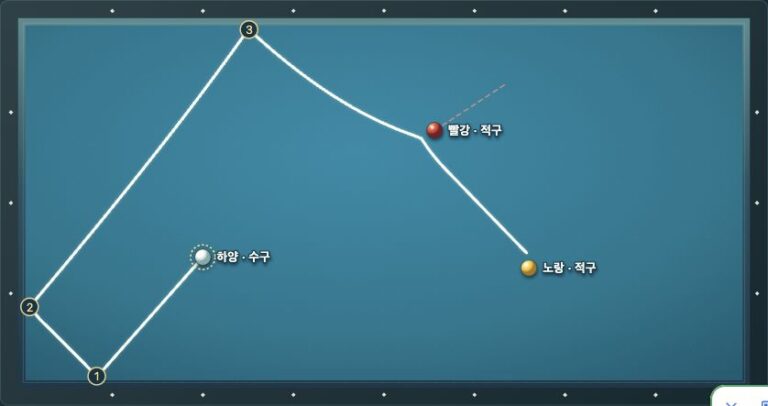
쓰리쿠션 길 안내소
3 Cushion Simulator: 7 Smart Practice Checks
Compare experimental three-cushion routes, save a position and calculate points per inning with 쓰리쿠션 길 안내소. Korean interface; actual table accuracy is unverified.
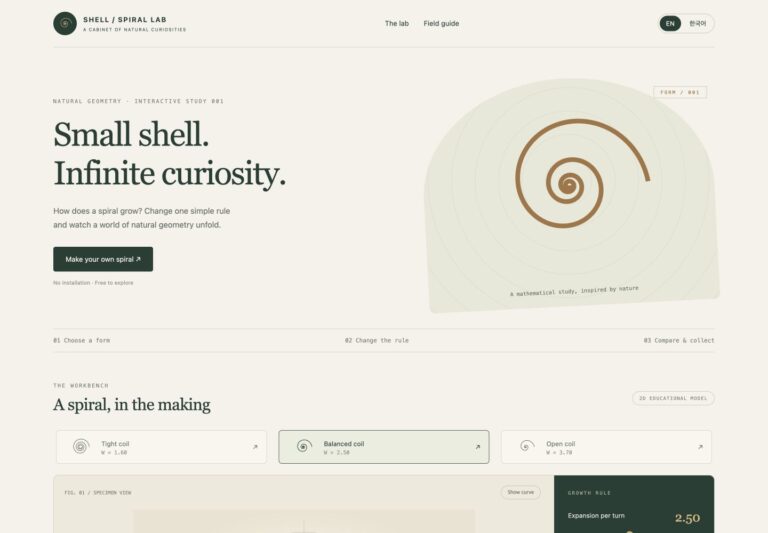
Snail Shell Spiral Lab (SHELL / SPIRAL LAB)
Logarithmic Spiral: 7 Smart Shell Lab Checks
Explore a logarithmic spiral with Snail Shell Spiral Lab. Tested W/N comparisons, fractional turns, saved specimens and link checks explain the mathematics and limits of this 2D model.