POLYRHYTHM ORBIT is a polyrhythm practice instrument that divides one shared cycle into two pulse streams. Use rings and a common grid to inspect onsets, set Orbit B as the tempo reference and slow the pattern before tapping.
Verified 12 November 2026. We operated English and Korean controls, checked ratio/phase grids and rates, independently calculated the same examples, and loaded a copied settings link in a fresh tab. We did not evaluate audible output or download-file contents. This library and the original tool share a creator; the guide is an editorial investigation rather than an independent endorsement.
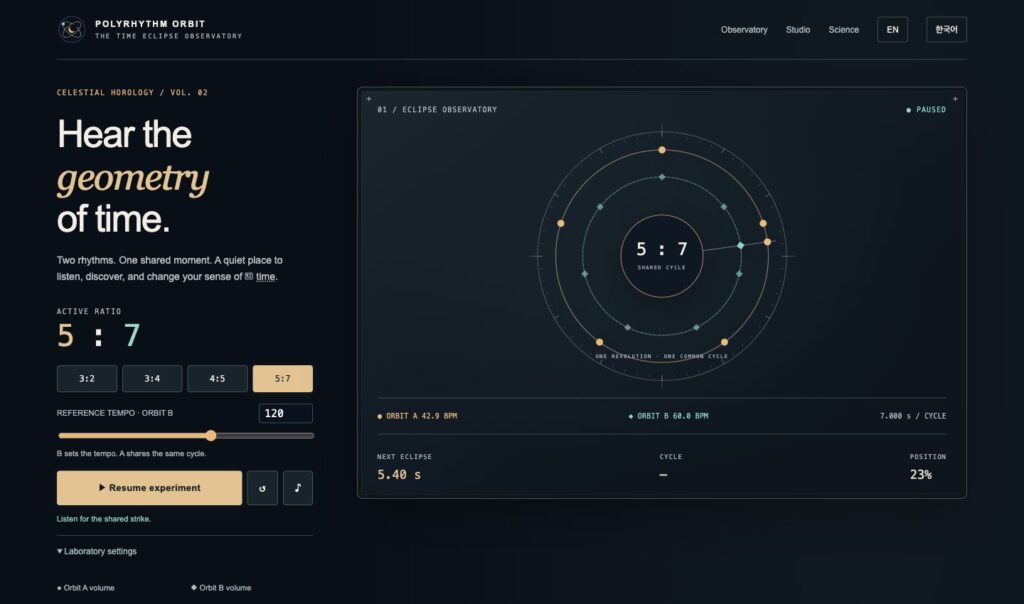
Explore polyrhythm cycles, onset grids and phase in POLYRHYTHM ORBIT. Checked rates, 6:4 shared positions and fresh-link restoration explain the reference clock and session/export limits.
- Brand
- POLYRHYTHM ORBIT
- Tool languages
- en, ko
- Verified date
- 2026-11-12
In this guide
Key takeaways
Name the polyrhythm reference before reading BPM. The input belongs to Orbit B. At 3:4 with B90 and speed 1×, the displayed common cycle was 2.667 seconds and A67.5 BPM. At 0.5×, the same reference setting produced 5.333 seconds, A33.8 and B45.0. The effective rate changes with speed even though the entered B reference remains 90.
A polyrhythm grid division is not necessarily a strike. The default polyrhythm has 12 divisions, six distinct onset positions, seven individual A/B strikes and one shared position. Confusing those counts can make a correct diagram look inconsistent. Inspect one cell at a time before trying to count every visible mark as an audible event.
A copied link restored ratio, reference BPM, phase and speed. It did not restore the tested sound palette, grid-click option, focus/accent state or input offset in a fresh tab. Save an accompanying note for those conditions. SVG and PNG exports reported preparation, but no files were received for inspection; a fingerprint on screen is not proof of the downloaded artifact.
What POLYRHYTHM ORBIT helps you inspect
Polyrhythm practice can become confusing when a learner hears two pulse streams but cannot describe the span they share. This tool gives both streams one common cycle and a visible time hand. Fixed dots and diamonds identify onsets; the moving hand is a position guide. The problem to solve is where the events occur, not whether two decorative objects happen to cross.
The instrument offers 3:2, 3:4, 4:5 and 5:7 presets, plus custom pulse counts from 2 to 12 per orbit. The laboratory also exposes separate volumes, three sound palettes, quiet grid clicks, an optional coincidence chime, a reduced-motion control and exact-grid phase adjustment for B. We tested selected routes rather than every custom ratio, option combination or boundary.
The polyrhythm microscope is particularly useful for a teacher or learner separating a rhythm’s actual attacks from the empty time between them. A rest cell still represents elapsed time. A simultaneous mark combines two streams at one moment. That distinction supports hand coordination and an explanation of the pattern without pretending that every grid line should sound.
The studio adds visual following, an explicit accent experiment, a hidden-ratio challenge, onset fingerprints and tapping observations. Each answers a different question. A changed perceptual experience would need a listener’s own judgment; a successful UI action only confirms the control and state. Our tests did not establish learning gains, subjective ease or the accuracy of headphone output.
Choose the reference before counting
Begin with a written setup: ratio a: b, B reference BPM, speed multiplier and B phase. Set phase 0 for the first polyrhythm comparison. Add whether grid clicks, coincidence chime and accent are enabled. A single number such as “90 BPM”does not describe the entire experiment, because the two streams can have different effective pulse rates.
Keep a short example stable. First inspect the default 3:4 grid with sound stopped, then use Begin experiment when ready. We observed an OBSERVING state, a progressing cycle/position display and signed tapping feedback after playback started. We did not capture the speaker signal, so these are interface and timing-model observations rather than a listening review.
After entering a BPM, verify the Tempo slider and live rate readouts. In our interaction, entering 120 left the displayed rate at the earlier 90 until a native up/down step committed the control; then A180/B120 and 2.000 seconds appeared for 6:4. This is a reason to confirm visible results, not to assume that every visitor’s ordinary typing has the same issue.
Choose a viewing and listening condition before judging a difference. Grid clicks and the optional eclipse chime add sounds beyond the two streams. Accent changes the audio balance by design, while Pure mode is described as a visual-only change. A comparison that changes several of those together cannot isolate a polyrhythm perception question.
7 checks from ratio to a repeatable experiment
1. Establish ratio and a shared boundary
Choose 3:4 in the instrument. On the 12-division grid, A occupies zero-based positions 0, 4, 8 and B occupies 0, 3, 6, 9. The next boundary at 12 starts the next cycle; it is not an extra strike inside the current one. Use this half-open view of a loop when writing down the events.
2. Set B tempo and inspect the effective rates
For a reference setting B90 at 1×, expect the four B pulses to occupy 4×60/90 seconds. We observed 2.667 seconds and A67.5/B90.0. Select 0.5× and check that the cycle doubles rather than assuming that the ratio changed. Our display became 5.333 seconds and A33.8/B45.0.
3. Use the microscope before speeding up
Select a named cell or use Step+1 while paused. We selected UI division 8 of 35 in 5:7 and then advanced once. Inspect time read 8, the visible position was 23%, and the next coincidence was 5.40 seconds away in the seven-second cycle. That is index 8/35, not the eighth zero-based event or a new strike at every step.
4. Change phase with a prediction
Use a custom 6:4 pattern at B120. At phase 0 the calculated common positions are 0 and 6. Shifting B by one shared-grid step moved its displayed simultaneous marks to UI cells 5 and 11, or zero-based 4 and 10. Counts remained 12 divisions, 8 unique positions and 2 coincidences. A shift need not eliminate a shared onset.
5. Compare following and accent as separate tests
Follow A in Pure mode, keeping the polyrhythm sound conditions stable, then decide whether to try Accent. We observed the status change from audio-unchanged wording to an audio-balance-change experiment when the checkbox was selected. We did not assess whether a listener experienced a perceptual flip or whether one focus made the polyrhythm easier.
6. Start before tapping and clear between trials
A pad before playback asked us to start first. After starting, native F/J key taps produced signed offset and mean absolute offset feedback; one readout showed B−181 ms and mean 139 ms. These untrained automation taps were not an ability test or a latency calibration. Clear observations returned an explicit cleared message before the next comparison.
7. Share the setup and preserve the missing context
Copy experiment link produced a 6:4/B120/phase 1/speed 0.5 URL. A fresh tab restored those values and the four-second cycle. Sound palette, grid clicks, follow/accent state and input offset were at their receiving defaults. Include a settings note, and inspect any exported file yourself before treating a picture as a complete, reusable polyrhythm session.
Compare the displayed cycle with a separate calculation
For a reference B tempo T and speed multiplier s, the nominal duration is C=b×60/(T×s). The effective B rate is T×s, and A is T×s×a/b. We calculated these outside the webpage and compared the rounded values with visible interface readouts. This checks the stated arithmetic model, not real-time audio execution.
| Setup: ratio · B reference · speed | Cycle seconds | Effective A/B BPM |
|---|---|---|
| 3:4 ·90 ·1× | 2.667 | 67.5 /90.0 |
| 3:4 ·90 ·0.5× | 5.333 | 33.8 /45.0 |
| 6:4 ·120 ·1× | 2.000 | 180.0 /120.0 |
| 6:4 ·120 ·0.5×; phase 1 | 4.000 | 90.0 /60.0 |
| 5:7 ·120 ·0.5× | 7.000 | 42.9 /60.0 |
| 5:7 ·90 ·0.25×; Korean mobile | 18.667 | 16.1 /22.5 |
The table records configurations whose rates/cycles we checked in the interface, with separate arithmetic as a cross-check. Speed multiplies both streams together, so it preserves the ratio. A33.8 is a rounded display of 33.75, not a new fractional ratio or evidence of drift. Distinguish a rounded label from a measurement of the sound’s interval.
A useful contrast is the shared-cycle polyrhythm versus different bar lengths over one pulse. This tool’s a: b setting divides the same span into a and b equal parts. It should not be described as two separate 3-beat and 4-beat bars continuing until a twelve-pulse realignment. The reference and the counted span answer different questions.
Grid divisions, strikes and simultaneous positions
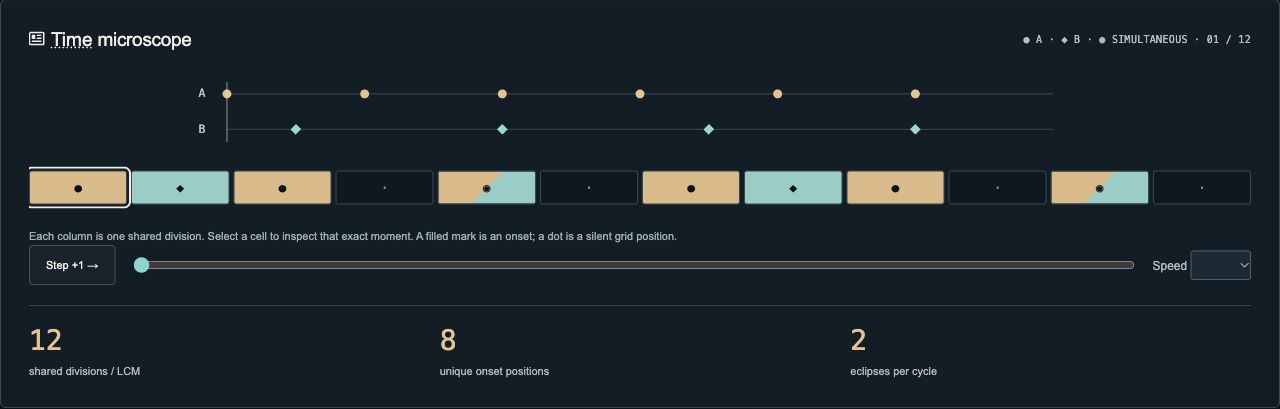
For 3:4 at phase 0, LCM(3, 4)=12 supplies a common measuring grid. The union of A{0, 4, 8} and B{0, 3, 6, 9} is {0, 3, 4, 6, 8, 9}: six moments containing seven individual strikes. One moment has both voices. The instrument’s 12, 6, 1 labels therefore describe different properties, not three competing totals for the same thing.
| Counting language | 3:4 phase 0 result | How to use it |
|---|---|---|
| Grid divisions | 12 | Measure where time falls, including rests |
| Individual A/B strikes | 3+4=7 | Count the two streams separately |
| Distinct onset positions | 6 | Count shared time points once |
| Simultaneous positions | 1 | Find where both start together |
| UI cell versus math index | cell 1=index 0 | Subtract one when comparing labels with index lists |
The polyrhythm grid’s one-based/zero-based distinction is easy to miss. UI division 5 in the 12-cell pattern corresponds to math index 4; it is an A-only onset at phase 0. In the shifted 6:4 example the same UI cell contains both streams. Carry the ratio and phase with the cell number, because a cell label alone does not identify a universal rhythm event.
For 5:7, the 35 shared divisions contain 11 distinct onset positions at phase 0. That is not 35 audible attacks. We checked the grid count and displayed 11/1 values after the guided 5:7 action. Keep grid clicks off when your listening question concerns only the two streams, then use them as a separate measuring aid if useful.
A phase shift can move a coincidence without removing it
The 6:4 test adds a case beyond the coprime presets. A occupies 0, 2, 4, 6, 8, 10 on a 12-cell cycle. At phase 0, B occupies 0, 3, 6, 9, sharing 0 and 6. After B moves one step, its positions are 1, 4, 7, 10, sharing 4 and 10. We independently generated those sets and matched the shifted cells in a fresh restored polyrhythm interface.
The important result is limited and concrete: this tested integer-grid shift moved the coincidence locations but left the count at 2. It does not show that every conceivable phase system or continuous-time shift has the same outcome. The control here shifts B in exact shared-grid steps. Read the actual grid after a change rather than inferring a new collision count from the word “phase.”
The screenshot’s inspector initially sits at index 0 even though the next shared position is elsewhere. That is not a failed eclipse. The current time hand and the fixed polyrhythm onset markers have different jobs. Tempo, ratio and phase changes are documented as restarting the cycle, so use a fresh baseline when comparing a revised polyrhythm configuration.
Keep visual focus separate from an audio accent
Pure Gravity Flip changes the visual guide according to the source; Accent deliberately changes sound balance. We switched Follow A and enabled Accent, and the status identified that difference. A listener’s experience of the same pattern can be explored, but we did not verify an auditory effect, a clinical perception result or an improvement in coordination.
For a controlled comparison, keep the palette and two volumes stable, leave the optional third chime off and decide whether grid clicks are part of the question. Then switch following alone. If you add Accent too, label the result as a different condition. A visual emphasis setting is not a new tempo reference: B remains the reference in both cases.
Treat taps and blind answers as observations
Tap observations are comparisons with a nearest modeled pulse, not a calibrated musician score. We verified the start gate, F/J input feedback and clearing action. Signed offset and mean absolute offset answer different questions: one includes direction, while an absolute average does not. The displayed values from our arbitrary taps should not become a claim about human accuracy.
We set an input offset of 50 ms as a parameter, not as a measured correction. No device latency was measured, and a changed entry alone cannot establish that a phone or Bluetooth path is calibrated. Use an explicit record of any offset when comparing sessions. That value did not travel in our copied four-parameter link.
The Blind Orbit test refused a ratio choice before challenge start. Starting it hid the ratio/instrument behind a listening-only view. We then guessed 3:4 without an auditory judgment; feedback revealed 4:5. This verifies gating, concealment and answer feedback, not rhythm recognition. Treat challenge results as session observations with a reason for the choice.
The MDN audio-timeline reference explains that currentTime belongs to an audio context’s timeline and can be used for scheduling. That is different from proving an exact arrival time at a speaker or finger. The source likewise warns about device, audio and input latency. Our checks did not measure those delays or inspect a hidden runtime clock.
A settings link is not a complete session
Our copied polyrhythm fragment contained r=6:4, bpm=120, phase=1 and speed=0.5. The fresh page restored a 6:4 pattern with 12 divisions, 8 unique onset positions, 2 coincidences and a 4.000-second cycle. The effective rates were A90/B60. The page remained awaiting observation rather than automatically starting playback, so loading and playing are separate actions.
We had selected Studio Clicks, grid sound, Follow A, Accent and input offset 50 before copying. The receiving page showed Wood/Bell, unchecked grid/Accent, Follow B and offset 0. Those direct differences demonstrate why the link is a parameter recipe rather than a complete polyrhythm session snapshot. We did not test persistence of every other option or a cross-device restore.
A useful polyrhythm handoff note lists the four linked polyrhythm settings plus palette, volumes, optional sounds, visual/accent condition and input offset. Add whether the recipient should inspect a cell, listen to a stream alone or tap a specific part. The link restores timing geometry; the note communicates the experiment and any conditions outside the fragment.
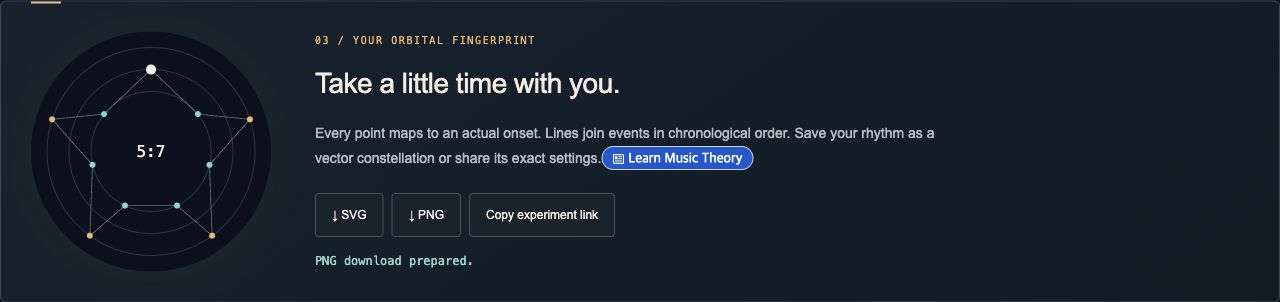
A polyrhythm fingerprint is a visual signature of onsets: angle represents time, radius identifies the streams and chronological lines connect events according to the source. It is not an audio waveform, a performance recording or a graph of planets. We inspected the visible polyrhythm figure but did not validate every exported point or inspect the saved vector structure.
Export, audio, privacy and mobile limits
The polyrhythm SVG and PNG buttons each reported that a download was prepared. Our browser tools received no file after each attempt. File dimensions, vector markup, transparency and exported labels therefore remain unverified. This could reflect delivery limitations of the verification setup; it does not prove failure for all users. Check the actual result in your own image/vector viewer.
The source describes local sound synthesis and says shared settings live in the URL fragment, with no recorded audio or rhythm upload. We entered numeric parameters and used a copied link; no microphone permission was requested. We did not audit network traffic. Blogger and advertising services may process visit data separately, so local synthesis is not an anonymous-visit guarantee.
At a fresh 390×844 Korean viewport, document width was 390 px. We selected 5:7, 0.25×, advanced one cell and verified 35 grid buttons. At B90 the displayed cycle was 18.667 seconds with B22.5 BPM. The floating mobile play/pause button changed state correctly. This was responsive emulation, not physical-touch, speaker-output or every-device testing.
Advertising overlays and shopping links appeared during investigation. We closed an overlay to continue using the controls and kept ads distinct from fingerprint exports. The reduced-orbital-movement option is present, but a comprehensive assistive-technology audit was not performed. Sound palettes, very high subdivision counts and all browser/background-audio cases were not exhaustively tested.
Related tools for the next musical question
Bubble Wrap Orchestra helps arrange an eight-beat step pattern when the next question is composition rather than a shared-cycle ratio. Recreate a simple timing idea deliberately; its pattern links were not imported into this tool. An eight-step sequencer and a polyrhythm grid are different representations, not automatically compatible projects.
PEDAL GHOST is useful for separating note onset from the sound that continues after release. Once you understand where attacks fall, investigate sustain and harmony clearance as a different question. Its event postcards and modeled release traces do not calibrate this instrument’s tap timing or transfer automatically into it.
Tea Ripple Piano offers a short melodic-sketch and replay workflow. Use it to preserve a small phrase after a timing study, checking its own saved-take and live-layer boundaries. We verified no automatic transfer of ratio settings, audio files or projects between these tools.
Frequently asked questions
Does 3:4 mean that A is 90 BPM too?
No. In this interface B is the reference. At B90 and 1×, A displayed 67.5 BPM over the same 2.667-second cycle. At 0.5×, the effective rates halve together while the ratio remains 3:4.
Why are 12 grid divisions not 12 sounds?
Some divisions are rests and one can contain both streams. For 3:4 phase 0 there are seven individual strikes at six distinct positions, with one simultaneous position. Use the grid as a ruler.
Will shifting phase remove every coincidence?
Not in our 6:4 one-step test. Shared positions moved from 0/6 to 4/10 and the displayed coincidence count remained 2. The control uses exact shared-grid steps; inspect the actual pattern.
Does the share link preserve all my practice settings?
Our link restored ratio, B tempo, phase and speed. The tested palette, grid sound, follow/accent and input offset returned to receiving defaults. Keep an accompanying note for a reproducible comparison.
Did the review verify audio accuracy and exported files?
No. Interface geometry, states and separate arithmetic were checked. Audible output, latency, SVG contents and PNG contents were not independently inspected. Export-prepared and playback states are not those measurements.
Make one shared cycle clear
Choose one ratio, name B as the reference and inspect a shared cycle before increasing difficulty. Predict a few onsets, compare them with the cells and save the conditions that matter. A clear polyrhythm question is more useful than a faster tempo or a prettier fingerprint without an explanation.
Verified 12 November 2026. Visible UI tests, independent calculations, publisher descriptions and unverified audio/export results are distinguished throughout.
A RELEVANT NEXT STEP
Tools with a useful connection
PEDAL GHOST
Pedal Ghost: 7 Smart Checks for Better Piano Sustain
Explore piano pedal release with modeled traces, sostenuto capture and event postcards. Checked controls and shared replay explain the graph, register, quiz and audio/export limits.
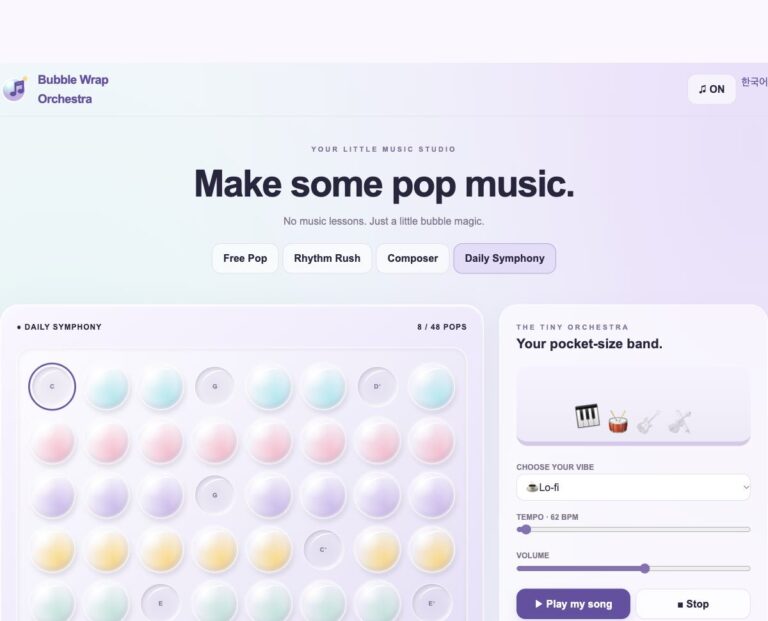
Bubble Wrap Orchestra
Bubble Music Maker: 7 Essential Pattern Checks
Create eight-beat bubble patterns in Bubble Wrap Orchestra. Tested Composer toggles, Lo-fi62 BPM link restoration,100-point Rhythm Rush and daily edits, with clear audio and export limits.
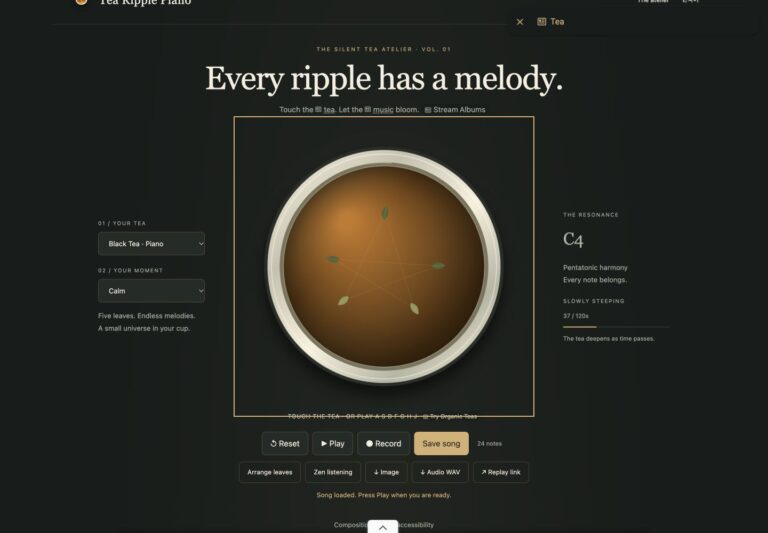
Tea Ripple Piano
Tea Ripple Piano: 7 Smart Recording and Replay Checks
Create short melodies by playing a virtual tea cup. This guide tests recording, local restoration, replay links and live layers, and explains which output preserves your next idea.