The Last Slice Problem is a free pizza game about the awkward final piece. Guess which fictional friend wants it, choose an action, and compare the ending with your expectations.
Hands-on check: 11 November 2026. English and Korean screens tested in Chrome, including a fresh 390px mobile viewport. This is entertainment, not a psychological assessment.
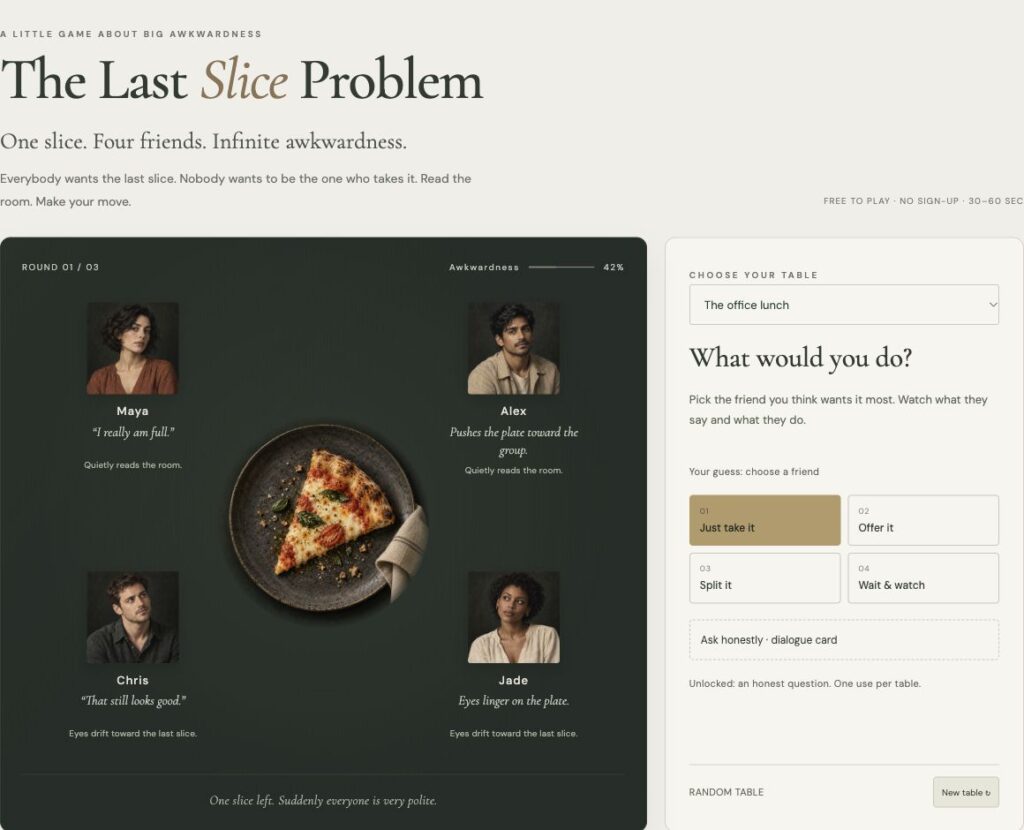
A hands-on pizza game guide: read four fictional friends, make a guess, compare real test results and use the daily dilemma without mistaking scores for psychology.
- Brand
- The Last Slice Problem
- Tool languages
- en, ko
- Verified date
- 2026-11-11
In this guide
Key takeaways
A useful session takes one table and a short conversation: separate what a character actually said from what you inferred. The best takeaway is a clearer question to ask, rather than a higher empathy number.
At a glance: six table settings, four main actions, an optional character guess, three-round display, a daily dilemma, and an honest-question card unlocked after two completed tables. The source advertises 30–60 seconds; reading the explanation and comparing choices naturally takes longer.
No sign-up, name or email was requested during play. The site says game choices run in the browser and stores completion counts and preferences locally. Blogger hosting and Google advertising are separate data considerations; “no account” does not mean “no cookies.”
What this pizza game does
Four named characters—Maya, Alex, Chris and Jade—sit around a single remaining slice. Their remarks, glances and reactions change as you act. You can select the person you think wants it most, take the slice yourself, offer it, split it, or wait and observe. The ending reveals fictional private wishes alongside a short personality label and three game scores.
The problem it makes playable is familiar: a group can keep deferring even though someone wants the food. That makes it a compact conversation starter for friends, a casual English/Korean reading activity, or a light break between tasks. It does not allocate real food, calculate pizza portions, evaluate manners objectively, or identify anyone’s true feelings.
Its strongest design choice is the gap between visible cues and the eventual reveal. A polite sentence is not enough to know a character’s appetite. Treat that uncertainty as the subject of the activity. In real life, give people a comfortable way to answer and respect a clear refusal; the simulated reveal is not evidence that a real person is concealing a wish.
Controls and useful features
| Control | What to expect |
|---|---|
| Choose your table | Friends, office, first date, family, roommates, or etiquette nightmare. These are fictional scene presets. |
| Character buttons | Record your guess. The selected name appears in the choice panel. |
| Take / offer / split | Make a decision that ends the current table and leads to feedback. |
| Wait & watch | Advance the scene and read updated cues; waiting is an action, not an undo. |
| Honest-question card | Unlock after two completed tables; one use per table, then the control becomes disabled. |
| Daily dilemma | Start a dated table; the tested URL included daily=2026-11-11 and scene=1. |
| Sound / motion | Optional sound toggle and reduced-motion control. Silent play worked. |
The result area provides Empathy, Awareness and Awkwardness values, character explanations, Copy result and Save card buttons, and a new-table control. The percentages and personality names belong to the game. There is no verified clinical scale, real-world benchmark or cross-player ranking in this review.
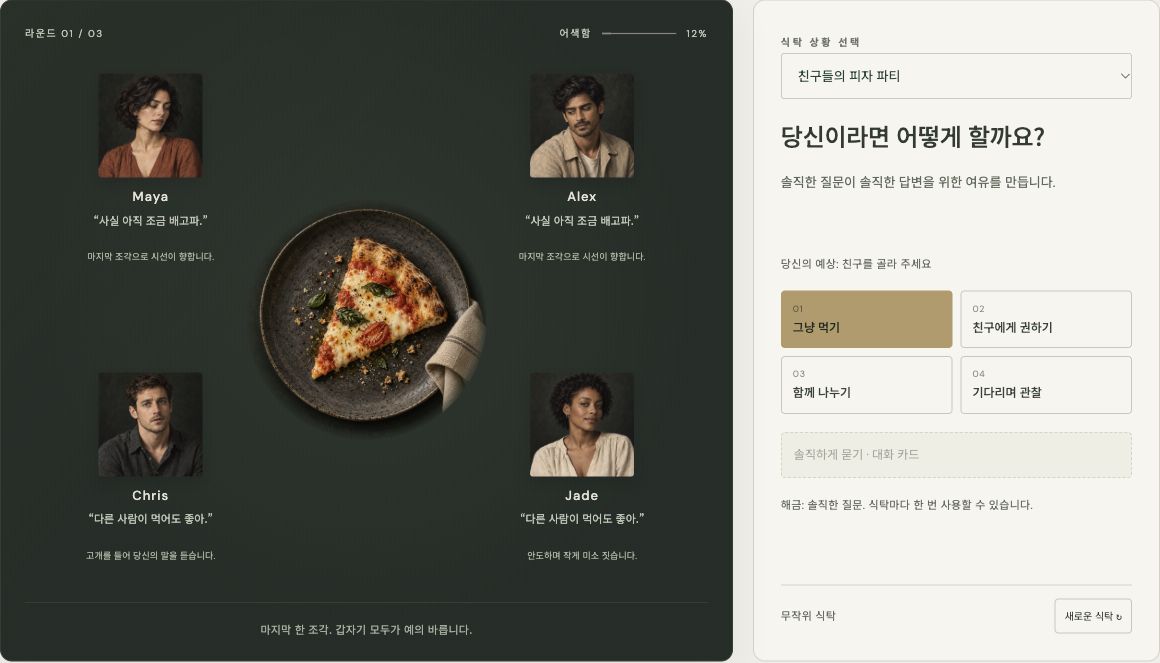
English is available at the root address. The header opens a Korean page at /p/ko.html with translated instructions, choices and endings; character names and the main brand remain in English. We observed the completed-table count and unlocked card carrying across the two language pages in the same browser.
How to play: 7 practical steps
1. Set the language and the purpose
Open the original link above and use 한국어 if that is easier to read. Decide whether you want a quick solo choice or a conversation with another person. You need a browser and an internet connection to load the page, not a photo, document or personal profile. Start with sound off if you are sharing a room.
2. Choose a scene before making assumptions
Use Choose your table to select one of the six settings. Friends’ pizza night is the simplest introduction; The office lunch makes a useful discussion prompt about hesitation in a shared space. Changing settings or creating a new table changes the situation, so record the setting if you plan to compare results later.
3. Read all four characters, then make a guess
Read both the quotation or action and the smaller descriptive line. Click a character to register your expectation. Check the “Your guess” label rather than assuming that selecting a face has already given that person the slice. A guess and a final action are separate inputs.
4. Choose an action deliberately
Just take it, Offer it and Split it resolve the decision; Wait & watch lets the interaction develop. In our office test, one wait advanced the display from round 01 to round 02 and refreshed the cues. Write down a reason before pressing if you want to compare reasoning with a friend. Do not expect to undo the choice after the ending.
5. Use the unlocked question when available
After two completed tables, a dialogue-card button appeared. On a new table, Ask honestly changed the dialogue into more direct expressions of hunger or willingness to leave the slice. The card then became disabled for that table. It gives another kind of clue; you still choose an action afterwards.
6. Read the reveal before starting again
After the ending appears, scroll to the result section. Compare your selected name with the character marked “wanted it most,” then read all four explanations. The reveal is more informative than the headline label because it shows which part of your expectation was mistaken. Give the result a moment to appear before assuming it failed.
7. Compare a daily table or begin a fresh one
New table starts another situation. Play today opens the dated daily mode; the date is displayed in UTC. If comparing with someone elsewhere, use the same displayed date and scene, preferably before either person has read the reveal. Do not assume the same local calendar day means the same UTC challenge.
Copy result and Save card are available, but our export check was incomplete: the clipboard contents were not verified, and no downloaded file was captured within eight seconds even though the Korean page displayed a saved-card message. If keeping a record matters, confirm the file or copied text yourself. A screenshot and a written note are useful alternatives.
What happened in our hands-on test
These observations were made on 11 November 2026 in Chrome. They are examples from the tables we actually played, not controlled comparisons of every preset or promises about your next random table.
| Test | Observed outcome |
|---|---|
| Friends + Maya guess + Split it | The Slice Diplomat; Empathy 72, Awareness 55, Awkwardness 6. Alex was revealed as wanting the slice most. |
| Office + Wait & watch | Round 01 changed to 02 and the visible cues changed. |
| Office + Alex guess + Offer it | Alex accepted; the table completed and the completion count reached 2. |
| Next table + Ask honestly | Direct answers appeared; the dialogue card became disabled after one use. |
| Office + Just take it | A completed ending said someone had hoped for another offer. |
| Daily mode | Displayed 2026-11-11 UTC, with daily and scene parameters in the URL. |
| Korean at 390px | Split completed; a Korean result showed 72 / 55 / 13. Document width stayed 390px. |
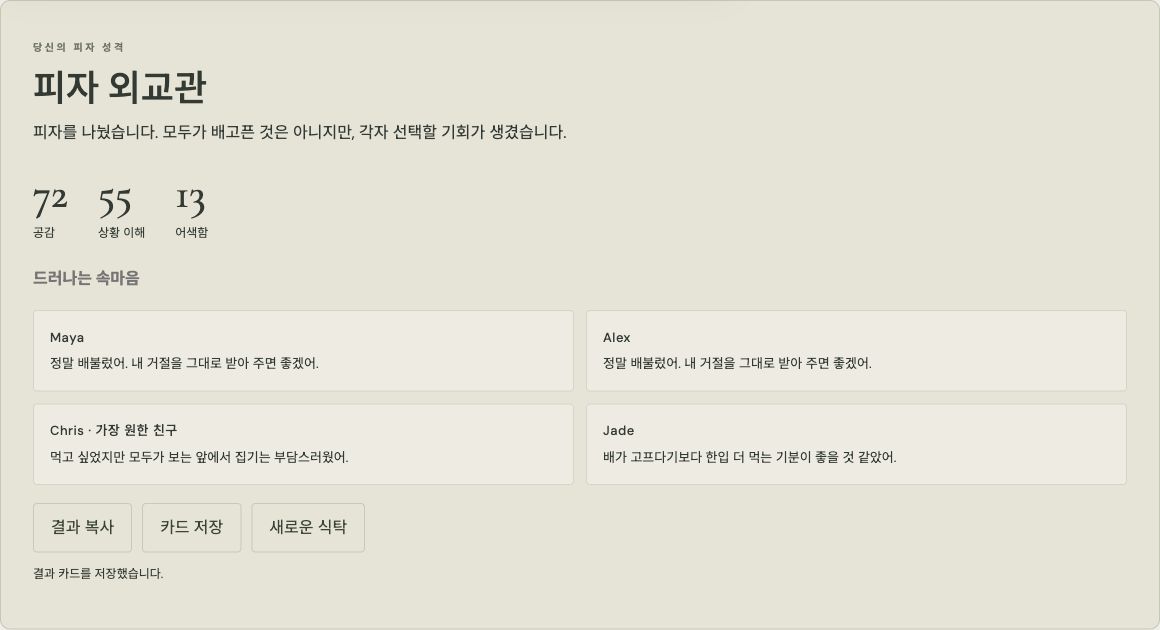
Two split decisions produced different awkwardness values, while the displayed empathy and awareness values matched. That does not establish a formula: the tables and language runs were not a controlled experiment. It does show why copying our numbers as a guaranteed result would be misleading.
The first guess also missed the person marked as wanting it most. That is a useful small failure to discuss: choosing a socially comfortable action and accurately predicting the hidden preference are different tasks. A favorable label does not prove that every inference was correct.
Better ways to use a short session
A five-minute conversation starter
One person reads the table aloud, everyone privately chooses a character, and the group agrees on one action before seeing the ending. Afterwards ask: “Which exact sentence influenced you?” and “What did we add that the screen never said?” This is a suggested activity, not a feature that collects group votes. Nobody needs to disclose a personal experience.
Keep the discussion about fictional choices. Avoid asking colleagues to explain why their score is lower or assigning them a personality label. If a participant would rather watch, let them skip the prediction and simply read the reveal. The value lies in comparing interpretations, not putting anyone on the spot.
An English/Korean reading exercise
Read a character line in the language you are learning, explain its literal meaning, then describe two possible interpretations. Open the other language page to compare the wording of controls and feedback. New random tables may differ, so do not treat two unrelated scenes as a sentence-for-sentence translation test.
Useful pairs include Offer it / 친구에게 권하기 and Wait & watch / 기다리며 관찰. Ask whether a phrase describes an action, a visible reaction or an inferred motive. This keeps the exercise concrete and avoids turning vocabulary practice into a claim about cultural etiquette.
A more useful comparison than chasing a score
Keep a small note with columns for date, scene, selected friend, action, reveal and your reason. For a fair discussion, agree on the date and setting first. If one player uses the honest-question card and another does not, note that difference: they made their decisions with different information.
A new random table is not a reset of exactly the same underlying people. Changing both the setting and the action cannot isolate the effect of one choice. Use repeated play to generate questions and stories, rather than claiming that one action always raises empathy by a fixed amount.
Limitations, privacy and troubleshooting
The limits that affect interpretation
The characters and their hidden wishes are invented. Scores are not validated measurements of empathy, awareness, social anxiety or suitability for a role. The review did not test every preset, all three waiting stages, all endings, sound playback, or every browser. Mobile checks used a responsive Chrome viewport, not a physical-phone compatibility lab.
The source’s short play-time claim covers the game’s intended pace, not a timed guarantee from our tests. Some outputs appear after a brief transition. The most prominent practical limitation in this session was the unverified export: a visible success message alone does not prove that the browser delivered a usable file.
Local game records and advertising
The source privacy panel says completion counts, unlocked dialogue cards, and sound/motion preferences are stored on the device when browser storage is available. We observed counts surviving navigation between language pages. That supports continuity in this session; it does not guarantee synchronization between devices or browsers.
The page says choices run in your browser, but Blogger hosts it and Google AdSense may use cookies and process advertising data. We saw advertising frames. We did not independently inspect network traffic or audit storage contents. Consult the source privacy panel and Google’s partner-site privacy explanation before treating the page as private or offline.
Clear game data is offered in the privacy section. The source explicitly distinguishes clearing game records from clearing Google cookies. We did not clear the accumulated records as part of this review. If you use a shared browser, check its privacy controls separately and avoid typing personal information into unrelated advertising forms.
If something seems stuck
A disabled action after an ending normally means the table is finished; use New table. A disabled honest-question card can mean it has already been used. A missing card early in play can mean fewer than two tables are complete. Read the short message under the buttons before reloading and losing the current scene.
On a narrow screen, the controls sit below the character area, so scroll down to find the action panel and then the result. Reduced motion is available near the lower section. If saving or copying fails, verify the browser’s download or clipboard outcome directly, then use a manual note. Do not repeatedly trigger exports without checking what arrived.
Related tools for another awkward moment
Continue only if you want another short fictional interaction. Awkward Goodbye changes the question from sharing food to ending a conversation. It is a natural next stop when your discussion moves from offering something to leaving politely.
Gift Opening Theater focuses on the response to an awkward gift, useful for comparing a courteous reaction with a clear statement of preference. Accidental Eye Contact offers another brief social scenario when you want to talk about ambiguous cues. These published guides cover separate games; none verifies a real person’s thoughts.
Frequently asked questions
Is this a pizza calculator or recipe tool?
No. Food provides the setting for a decision game. There are no verified dough calculations, calorie estimates, delivery orders or real meal-allocation features in this review. Use it for a short fictional dilemma, not kitchen planning.
Do I have to guess a friend before choosing?
The interface prompts you to select a friend and displays the guess separately from the action. Our tested sequences selected a friend first. Follow that order if you want to compare your prediction with the reveal; clicking a character alone does not finish the table.
Is splitting always the correct answer?
The split runs we observed received a diplomatic ending, but that is not a universal etiquette rule. The characters, their wishes and the scene can differ. In a real meal, ask what people want, accept a clear no and accommodate practical preferences rather than copying a game score.
Can friends play together online?
We verified a shared daily challenge entry point and result controls, not live multiplayer, an online lobby or synchronized voting. Compare choices in conversation or with your own notes. Confirm any exported card before relying on it for sharing.
Does Korean require a separate account?
No account was requested on either language page. Korean is a header link on the source. In our browser the completed count and card unlock carried across languages, but the new table itself could differ; do not expect your current random scene to remain identical.
What should I do with a low score?
Treat it as feedback within one fictional story. Read the character explanations and consider a different question you could ask next time. The numbers do not diagnose a trait, prove poor manners, or justify judging someone else.
Try a table, then compare your reasoning
Play one table, make a prediction before the reveal, and describe what evidence changed your mind. If you take one idea back to a real meal, make it a clear, pressure-free question and room for an honest answer.
A RELEVANT NEXT STEP
Tools with a useful connection
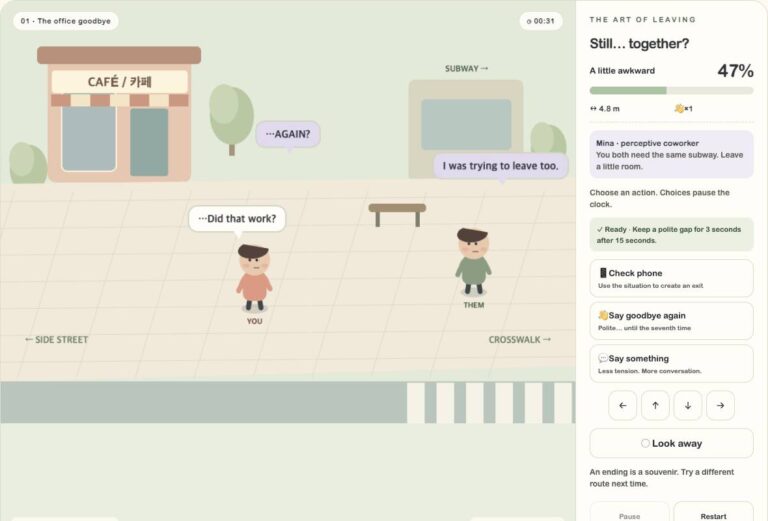
Awkward Goodbye
Awkward Goodbye: 7 Essential Exit Checks
Play Awkward Goodbye with routes, context actions and paused dialogue choices. Our completed 32-second office escape explains peak awkwardness, stage stamps, ending collection, the POV mirror and export limits.
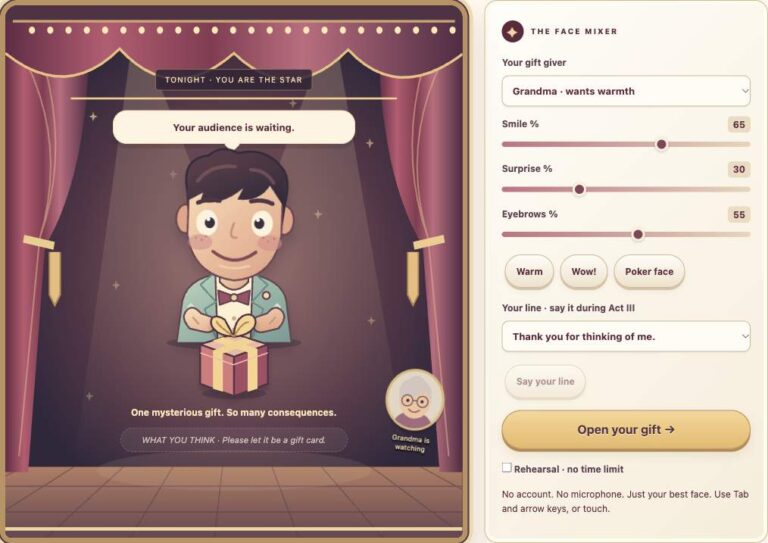
Gift Opening Theater
Gift Reaction Game: 7 Smart Checks for Awkward Gifts
Play a manual puppet gift-reaction comedy in timed or rehearsal mode. Actual 91/99-point rehearsals, the final-reply wait and an inspected PNG ticket explain timing, output differences and limits.
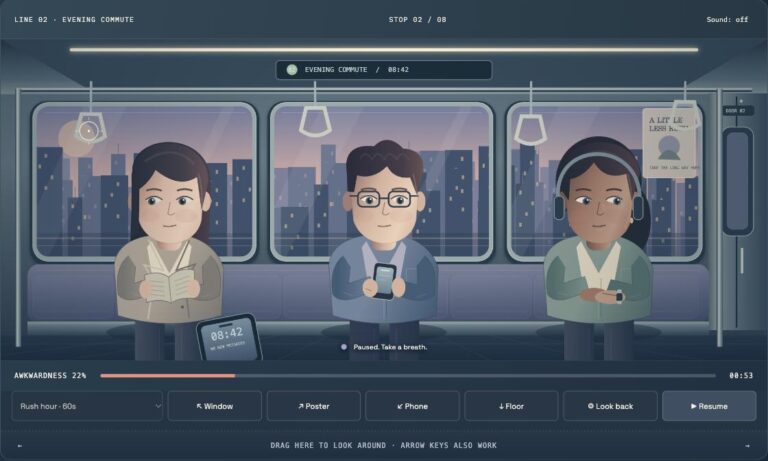
Accidental Eye Contact — LOOK AWAY.
Accidental Eye Contact: 7 Useful Checks for a Better Commute
Play a camera-free subway eye-contact game with four modes, named gaze controls and humorous commuter reports. Tested controls, sharing limits and mobile layout.