Fly catching game The Uncatchable Fly asks for two decisions: predict coffee, cookie or apple, then strike during the real landing window. Mind vs Wings turns a quick browser break into a comic contest of observation and timing.
Verified 11 November 2026 (KST). We tested actual controls and completed result screens. The recorded low scores are interface checks, not player benchmarks. Successful catch bonuses, hardware vibration and receipt of an exported PNG were not independently confirmed.
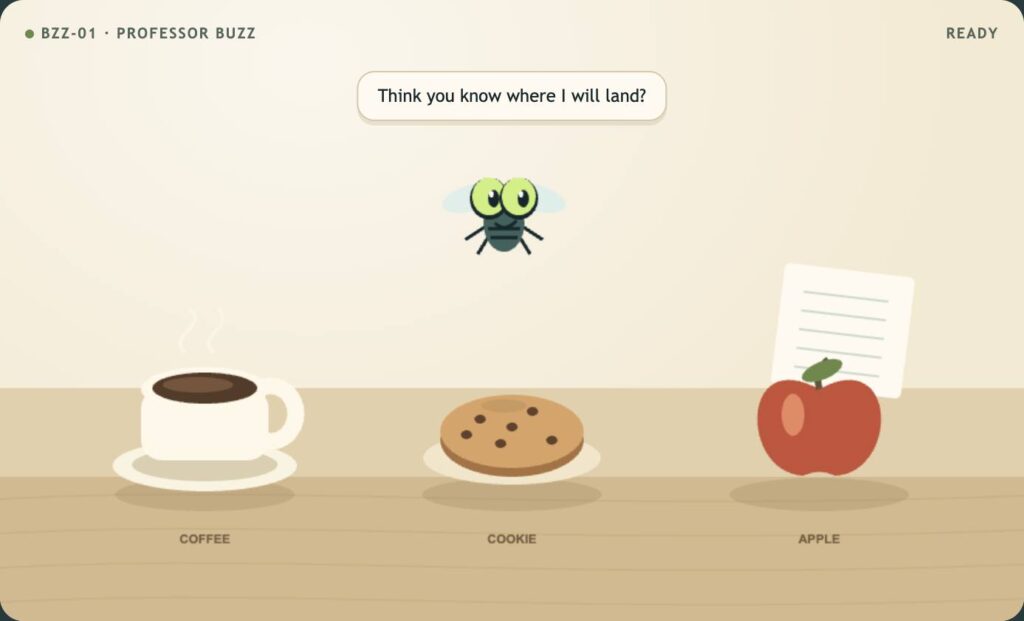
Predict a fly’s landing, wait out a bluff and make one timed strike. Tested Mind Duel and Korean Daily Fly reports explain accuracy, catches, reaction displays, mobile controls and sharing limits.
- Brand
- The Uncatchable Fly — Mind vs Wings
- Tool languages
- en, ko
- Verified date
- 2026-11-11
On this page
Key takeaways
- Predict a location and time a strike. A correct prediction alone does not catch the fly.
- The first location choice locks for that round. The source says the target is fixed before selection; habits affect later Mind Duel rounds rather than moving the current target.
- Daily Fly is described as a ten-round UTC-date challenge without adaptive memory. Record the displayed UTC date when comparing attempts.
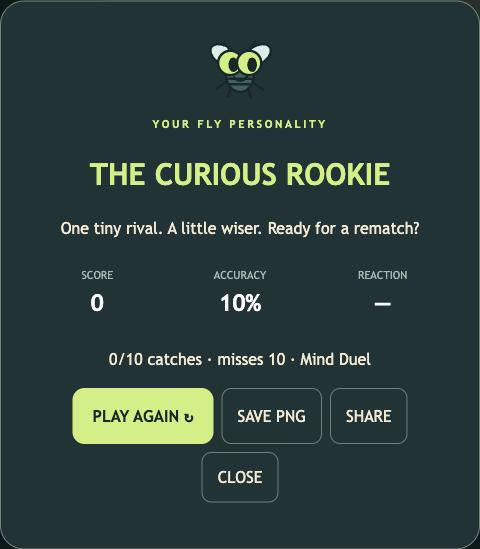
- Our limited-input Mind Duel ended with score 0, accuracy 10%, reaction— and 0/10 catches. This demonstrates why the result measures should be read separately.
- A deliberate immediate strike on the Korean Daily page produced TOO EARLY and disclosed the actual landing. The 390-pixel layout had no horizontal overflow.
- SHARE displayed a manual page-address instruction in our browser. SAVE PNG displayed a download-start message, but file receipt was not confirmed.
What this fly catching game actually does
The official game name is The Uncatchable Fly, with the subtitle Mind vs Wings and a rival called BZZ-01. Three illustrated objects form the landing choices: coffee, cookie and apple. The arena sits above the prediction buttons and a large SLAP control. Round, streak and score readouts track the current ten-round session, and the final report adds accuracy, reaction time and a playful type.
The practical problem is finding a short, self-contained interaction that rewards waiting instead of constant tapping. You do not need to install an application or submit a personal story. In our browser session no account was required. The attraction is the tension between committing to a location and resisting a premature slap, rather than an open-ended grind or a real pest-control task.
It is also more specific than a simple reaction timer. In a basic timer, the stimulus and response can be the only decision. Here, the chosen destination must match as well as the strike timing. A fake approach can tempt an early input. That extra condition explains why a plausible reaction can still fail and why looking only at the total score hides useful information.
Mind Duel or Daily Fly?
| Mode | Source description | Best comparison to make |
|---|---|---|
| Mind Duel | Ten rounds; repeated predictions affect later destination preferences through simple rules | Compare your own decision habits while acknowledging that later conditions adapt. |
| Daily Fly | Ten rounds; UTC-date seed; no adaptive memory | Use the same displayed UTC date for an informal shared challenge; do not assume a local calendar date is sufficient. |
Mind Duel is the normal game. The source explains that repeatedly selecting the same location reduces the fly’s preference for it in later rounds. It also explicitly says the destination, fake and timing for the current round are chosen at its start. Those are documented rules, not an independent code audit. A taunt claiming the fly knows you is part of the presentation, not evidence of mind reading or a learning model trained on personal data.
Daily Fly removes that adaptation according to the source, so it is the more sensible mode for discussing a shared daily pattern. We opened and played it in Korean, but did not establish that every device and attempt produced an identical full sequence. Treat the repeatability description as a source feature with that verification boundary.
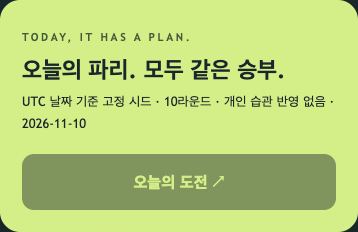
UTC matters for readers in Korea and other time zones. A session reviewed on 11 November in Korea can still show 10 November in UTC; our captured card did exactly that. Compare the date printed on the card, not the date on a friend’s phone alone. A score from a different UTC seed should be labelled as a different challenge rather than silently added to the same comparison.
7 essential checks for better play
1. Prepare a short session and choose a language
Open the original site and select EN or KO. The Korean game translates the prediction choices and instructions, while some phase labels and result headings remain English. Keep that mixed interface in mind: TOO EARLY is a timing outcome, and the nearby Korean sentence explains it. Start when you can see the arena and buttons together comfortably.
2. Pick a mode before chasing a score
Use the normal Play Now entry for Mind Duel, or Challenge Accepted in the Daily panel. Both mode starts were available while idle and disabled during our active session. Decide whether you want a varied adaptive game or a date-labelled daily comparison. Changing modes and input methods at once makes informal progress harder to interpret.
3. Watch before locking a location
The source advises reading body direction and the final approach before choosing coffee, cookie or apple. Your first prediction locks for the round. We confirmed that selecting coffee put it into a pressed state and disabled the other two choices. Repeatedly tapping another object afterward is not a way to revise that same prediction.
4. Separate a fake dive from a real landing
The instructions identify the green ring and LAND! signal as the real landing cue, and warn that a first dive can be fake. These visual cues matter more than the rival’s taunt. We did not measure exact landing-window durations or validate every rival’s timing. Use the screen feedback rather than an invented fixed number of milliseconds.
5. Make the single strike deliberate
Use SLAP, or the documented Space shortcut, during the real window. The location must also be correct. The game is designed around one strike in a round; an early slap is not a harmless practice press followed by another chance. In our Korean test, choosing cookie and striking immediately produced TOO EARLY with actual landing apple.
6. Read the revealed landing and outcome
After the attempt, the status line tells you where the fly actually landed and whether the outcome was early, wrong or missed. Use that feedback to distinguish a location error from a timing error. Do not infer that a disabled SLAP button always means the interface is broken: it was disabled before prediction and after an attempt in our observed states.
7. Review the full report before replaying
At the end of ten rounds, note mode, date if daily, score, accuracy, reaction display and catches. Then use the result dialog’s replay or close control. A report label such as THE CURIOUS ROOKIE describes this playful game output. The source explicitly says these types are not psychological diagnoses.
Our actual browser test results
Our English Mind Duel included limited inputs and periods of observation while we inspected the interface. It reached round 10/10 and FINISHED, then opened a result dialog showing THE CURIOUS ROOKIE. The score was 0, accuracy 10%, reaction—, catches 0/10 and misses 10. This is a verified end-screen example, not a controlled test of skill or a claim that a typical first-time player gets that result.
| Test | Observed output | Supported conclusion |
|---|---|---|
| English location choice | Coffee pressed; Cookie and Apple disabled | The first prediction locked the other choices. |
| Completed Mind Duel | Score 0; accuracy 10%; reaction—; 0/10 catches; 10 misses | A correct-location measure can exist without a successful catch. |
| Korean Daily immediate strike | Cookie selected; TOO EARLY; actual landing Apple | An immediate strike was rejected as too early. |
| Completed Korean Daily observation | Score 0; accuracy 0%; reaction—; 0/10 catches | The daily mode also produced a report; this was not a high-score run. |
| SHARE | Copy the page address to share | A manual instruction appeared; automatic copying was not confirmed. |
| SAVE PNG | Result image download started | The page acknowledged a download start; a received file was not verified. |
The source FAQ says each catch earns 500 points plus speed and streak bonuses. We did not independently verify a successful catch, a numerical reaction average or bonus coefficients. Accordingly, this review explains that documented scoring structure without presenting a fabricated successful run or an “optimal” score calculation.
An advertising interstitial appeared during the visit and was dismissed through its own Close control. No advertisement was clicked. This is relevant to troubleshooting: a page-covering ad can prevent the game controls from being available even when the underlying round continues to show a state. Clear the overlay and check the actual phase rather than spending an input on an obscured screen.
Read accuracy, reaction and catches separately
Prediction accuracy answers a location question: how often did the chosen destination match? The source defines it against all rounds, not only the ones you happened to attempt. Catches answer a combined-condition question: did the prediction match and was the strike made in the real landing window? Total score adds the scoring rules on top of those successes.
Our 10% accuracy with 0/10 catches is therefore not a contradiction. Under the documented ten-round accuracy definition,10% corresponds to one correct location across the session. That does not establish a catch because the timing condition can still fail or no qualifying strike can be made. A sparse-input test also includes missed opportunities, which is why it cannot be used as a clean reaction-time benchmark.
Reaction is another denominator. The FAQ describes an average of strikes made after real landing, rather than an average of every click or a timing score inferred from prediction accuracy. Our result showed a dash. Report that as no numeric reaction value displayed; do not turn it into 0 ms, “instant response,” or a successful-catch time.
For a useful personal comparison, keep the whole line: mode, daily date if applicable, input method, score, accuracy, reaction and catches. A higher score alone cannot tell you whether you read more destinations correctly, struck more quickly or built a streak. Likewise, a fast qualifying reaction value does not automatically establish high overall prediction accuracy.
A useful practice routine
A sensible first session has an observation goal. Learn the three destinations, locate SLAP and watch how a prediction locks. Let the status feedback explain one mistake at a time. You can deliberately explore an early strike as an interface lesson, but label it that way in a record rather than comparing its score with a sincere full attempt.
For the next session, change one behavior. For example, keep the same input method and wait for the real visual cue instead of reacting to the first dive. Record the mode and Daily date first. This is a suggested routine for readers, not an additional experiment we claim to have completed. We did not demonstrate a measured improvement from following it.
The rival roster provides hypotheses to watch: Professor Buzz emphasizes direction, Bluff Master warns about a false first dive, Flash Wing describes a short window, Lazy Larry encourages patience, and King BZZ combines tricks in the final two rounds. These are the source’s character descriptions. They are not measured rankings of difficulty or guarantees of exact timing in each browser.
If a comparison matters to you, separate exploration from assessment. A run interrupted by reading the instructions, trying a comfort setting or dismissing an ad is still a valid interface experience, but it is not the same condition as ten attentive attempts. Keep the result for what it shows instead of deleting context to make the number look more impressive.
Controls, comfort and common mistakes
The source documents keyboard 1,2 and 3 for locations and Space for the strike. We directly tested the labelled buttons; we did not certify the complete keyboard-only path or assistive-technology experience. The arena’s text alternative describes the flight and three landing spots, but the actual landing signals are visual. A fast moving canvas game remains a different accessibility task from a static form.
Sound starts off according to the FAQ, and the initial Sound and Haptics checkboxes were unchecked. The Korean Less motion checkbox could be checked in our test. That confirms the setting control responded; it does not establish that every motion was removed. Haptics are explicitly device-dependent, and neither audible sound nor physical vibration was verified during this review.
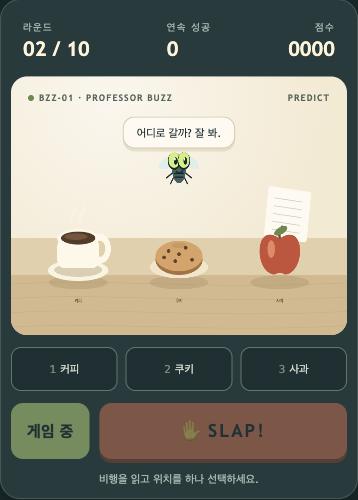
If the game feels too small, first consider the usable arena and control layout rather than treating zoom as a scoring trick. In our freshly loaded 390 × 844 Korean viewport, the document width was 390 pixels and the buttons remained visible without horizontal scrolling. Some object labels inside the drawing were small. The separate large buttons provide a clearer target than tapping the illustration itself.
If a choice will not change, it may already be locked. If SLAP is disabled, inspect whether you have made a prediction or the attempt has ended. If an ad covers the controls, close the ad using its actual close control. The source says switching tabs pauses the game, but we did not run a controlled elapsed-time test of that behavior; do not substitute an assumption for an observed phase.
Limitations, saving and privacy
There is no global leaderboard according to the source. Personal bests are browser-local, and the FAQ names localStorage. We did not create a positive best and verify it after reload or on a second device. Treat another browser, cleared site data or private browsing as separate persistence conditions. Clearing local records is a reset control, not a backup feature.
The game asks for no name or email in its described flow, and we played without supplying either. The source states that result images are generated on the device, while Blogger and enabled Google ads may process cookies and device information. We observed advertising. Local game records and a locally generated image do not establish that the hosted page has no third-party processing. See the source-linked Google Privacy Policy for that service context.
Sharing needs a separate check from the game ending. In our browser, SHARE displayed “Copy the page address to share,” and we did not confirm a newly copied result URL. A manually copied page address opens the game; we did not establish that it transfers your score or replays the session. SAVE PNG acknowledged a download start, but the actual file was not inspected. The screenshots in this article are our captures, not proof of a completed built-in export.
This review did not test every browser, offline play, a physical touch device, full accessibility, audio output, haptics or the underlying target-selection code. It also did not measure cognitive ability or psychological traits. Simple-rule adaptation and comic personality labels should remain descriptions of a game, not claims about a person.
Related timing games
- For finding a shared ready moment across several characters, read Group Photo Chaos. It moves the timing problem from one deceptive rival to an animated group portrait.
- For deciding when to respond rather than when to strike, try Conversation Collision. It uses response choices in a five-round comic conversation.
- For a gaze-choice theme, see Accidental Eye Contact. Its subway setting offers a different interaction, including an unscored mode described in that guide.
Frequently asked questions
Is The Uncatchable Fly an AI that reads my choice?
The source describes a simple-rule behavior system, with targets fixed at the start of each round and adaptation affecting later Mind Duel rounds. We did not audit the implementation. The comic taunts should not be treated as proof of mind reading or current-round target changes.
Why can accuracy be positive when I caught nothing?
Location accuracy and successful catches are different measures. Our completed Mind Duel showed 10% accuracy with 0 catches. A location match without the required strike timing does not satisfy the combined catch condition.
Does the reaction dash mean zero milliseconds?
No numeric reaction was displayed in our result. The FAQ defines a post-landing strike average; a dash should be retained as a missing numeric output, not rewritten as a measured instant response.
Which date should friends compare?
Use the UTC date displayed in Daily Fly. During our 11 November KST review, the card showed 2026-11-10. We did not verify full multi-device sequence equality, so do not claim more than the documented date-seed behavior.
Can I play in Korean on a phone?
Korean controls worked in a freshly loaded 390-pixel browser viewport. Buttons fit without page overflow, and an immediate strike produced translated feedback. Physical touchscreen behavior, sound and vibration were not tested.
Can I share a score image?
A SAVE PNG control exists and reported that a download started. Confirm a real file before promising an image. SHARE fell back to a manual page-address instruction in our browser, so automatic score-link copying was not verified.
Start one deliberate ten-round game
Start with one deliberate ten-round session. Keep destination choice, timing and result interpretation separate, and choose Daily Fly only when its UTC date matches the comparison you want. The useful outcome is a clear understanding of the game’s feedback, even when the fly wins.
A RELEVANT NEXT STEP
Tools with a useful connection
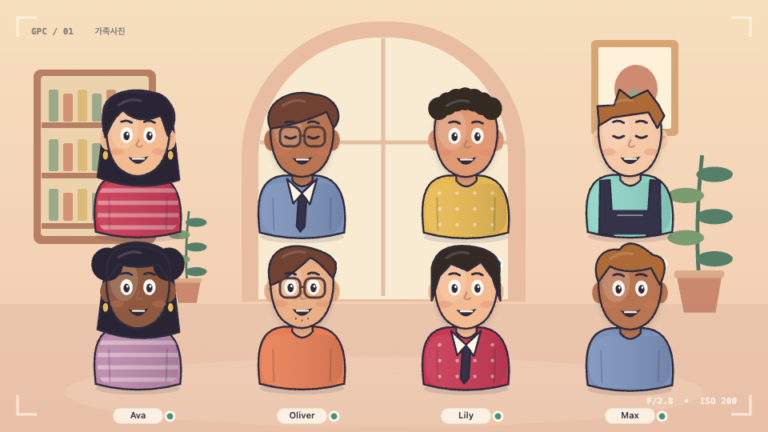
Group Photo Chaos
Group Photo Game: 5 Fun Ways to Master the Timing
Catch the shared ready moment in an animated group portrait. A tested guide to timing, shutter delay, replay and reading the score.
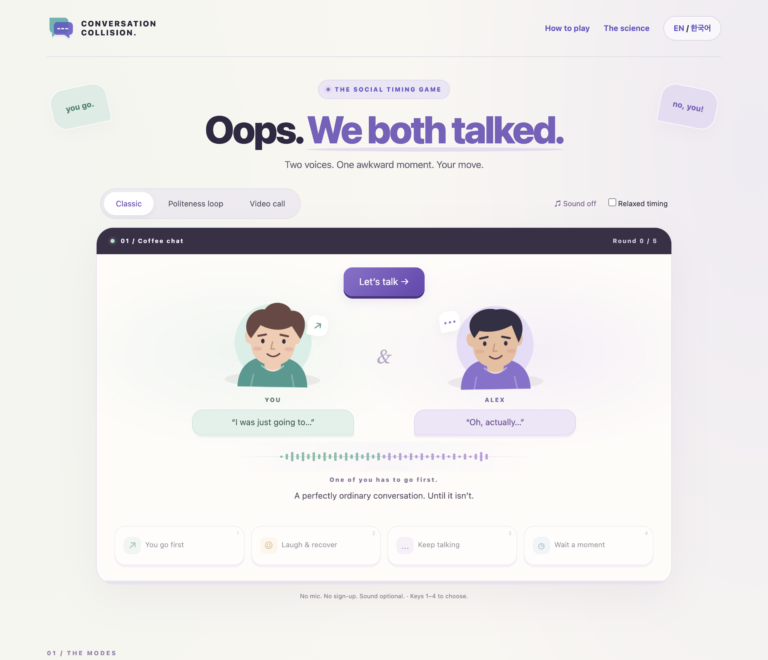
Conversation Collision
Conversation Collision: A Conversation Timing Game in 5 Steps
Explore overlapping speech through a five-round conversation timing game. Compare four responses, three modes and our matched English/Korean tests without treating scores as a personality assessment.

Accidental Eye Contact — LOOK AWAY.
Accidental Eye Contact: 7 Useful Checks for a Better Commute
Play a camera-free subway eye-contact game with four modes, named gaze controls and humorous commuter reports. Tested controls, sharing limits and mobile layout.