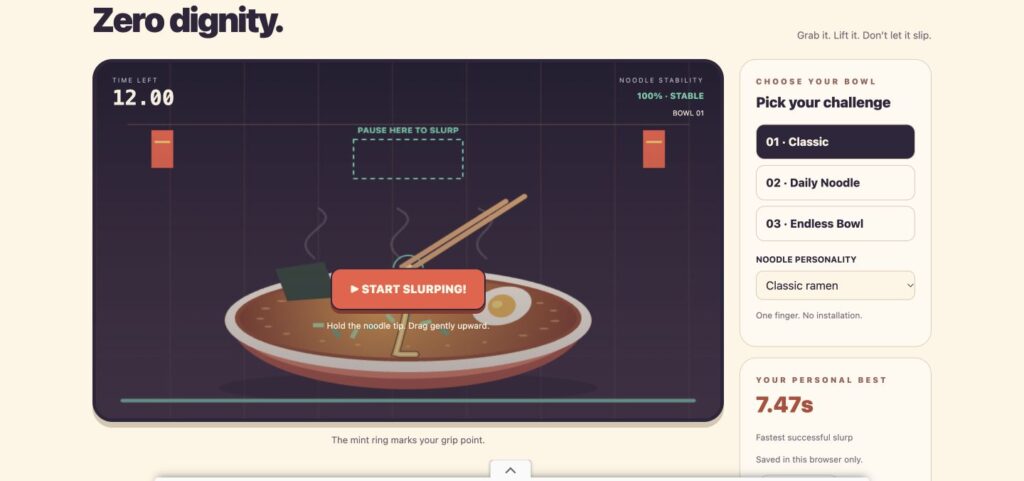
Catch the final noodle, stop inside the target and compare three arcade modes. Read actual keyboard and pointer tests, receipt interpretation, local-record behavior and sharing limits.
- Brand
- Last Noodle
- Tool languages
- en, ko
- Verified date
- 2026-11-07
Last Noodle is a short browser game about catching the final strand above a ramen bowl. Grip the mint ring, move into the upper target and stay there long enough to finish. This guide explains seven control checks, compares the three modes and interprets actual success and failure receipts without treating a game counter as a real-world measurement.
Table of Contents
Key takeaways
- The target matters more than height alone. One overshoot test ended in failure even with DELIVERED 100% and stability 100%.
- Keyboard play is available. Focus the game, press Space to grip, use arrow keys and stop inside the mint target. The source documents another Space press as release.
- Modes answer different questions. Classic is a timed attempt, Daily fixes conditions for the displayed UTC date, and Endless tracks consecutive bowls.
- Results are personal and local. We observed saved records after reload. Share was unavailable in the tested Chrome session, and the exported PNG card was not independently inspected.
1. Decide what this noodle game is for
Last Noodle is an original browser arcade with the subtitle The Final Slurp. Its central problem is deliberately small: move a slippery strand carefully enough to complete one short action. It suits a quick play break or a focused experiment with the game’s controls. It is not a noodle recipe, a cooking timer or a realistic chopstick simulator.
The useful appeal is the gap between a simple instruction and a slightly awkward movement. Pulling upward is easy to understand, but a successful attempt also needs a stable finish inside a bounded target. You can learn the rule quickly, then decide whether to repeat the same setup, try a different noodle personality or continue through more bowls.
The tested game required no installation or account. The main URL opens English, with dedicated English and Korean pages available through EN and KO. The Korean page translates the instructions and result messages, although some interface labels and mode names remain in English. Both versions exposed the same keyboard application label on the game canvas.
Treat the physics label as a description of the arcade’s stylized motion. We did not validate a physical model, real chopstick technique or a training benefit. The practical question is whether the controls make sense and whether the receipt explains what happened in the game. That is the scope of the tests below.
2. Read the noodle controls before starting the clock
| Control or display | What to do with it | Useful distinction |
|---|---|---|
| Mint grip ring | Catch the moving tip | The bowl and chopsticks are not the grip point |
| Upper mint target | Move the held tip into it and pause | Going higher can overshoot the goal |
| Stability | Watch the in-game grip state | A high percentage does not itself complete a round |
| Space and arrows | Focus the canvas, grip, then move | Space on another focused control can do something else |
| Receipt | Read outcome, elapsed time, delivered amount and shake | A progress value is not the same as a success verdict |
Before pressing Start, locate the target and the ring. If an advertisement covers the lower game area, use its explicit close or collapse control and check the layout again. Ads appeared during our investigation, including an overlay between interactions. The experience should not be described as ad-free just because the game has no entry fee.
For pointer play, the source instructs you to press the tip, keep holding and drag upward. Releasing drops the noodle. A short, controlled path is easier to evaluate than a large sweep. Because the ring moves, an old position is not a reliable place to begin the next attempt; look for the current ring each time.
Keyboard play provides another route. Put focus on the canvas, press Space to grab and use the arrows to move. The Korean guide explicitly describes a second Space press as releasing. We directly tested Space followed by arrow movement; we did not use a keyboard shortcut as a substitute for examining the current target.
Keep setup separate from the timed round. Select the mode and personality first, then start when you are ready. The sidebar personal-best label changes with the context: timed modes showed fastest successful slurp, while Endless showed most consecutive bowls. A number without its mode and noodle selection is an incomplete comparison.
3. Make the final noodle movement in seven checks
- Choose a baseline. Start with Classic and Classic ramen, then keep that combination fixed while learning. Do not change the personality after every failure if you want to understand one setup.
- Find the finish area. Identify the mint rectangle above the bowl before pressing Start. Your aim is a controlled stop inside that area, not the top edge of the canvas.
- Start and establish the grip. Press the current ring with a pointer or focus the game and press Space. Check that the tip responds before making a large movement.
- Lift with a small correction available. Move upward while watching the ring. Stop before crossing the upper boundary and use a shorter correction if necessary.
- Pause inside the target. Let the game recognize the steady finish. Do not release the pointer simply because the tip has reached roughly the right height.
- Read the outcome first. SLURP SUCCESS means a completed attempt; NOODLE WINS means the noodle beat the player. Then read the time, delivered value, shake and mode or bowl count.
- Change one thing for the next attempt. Keep the same setup and adjust the stopping point, or deliberately switch modes for a different question. Preserve the useful receipt before retrying if you need a visual record.
The important control adjustment in our keyboard tests was stopping. A long upward hold took the tip beyond the target. A shorter hold followed by a pause produced a success. The exact duration is not a universal recipe: our interactions included different waits, modes and screen sizes, so use visual position rather than memorizing our key-hold time.
If arrows appear ineffective, check focus before assuming the game is broken. Space can activate a selected button or scroll a page when the canvas is not focused. Likewise, a pointer movement outside the actual ring can fail to establish a grip. Diagnose the starting condition before changing difficulty.
4. What the actual noodle tests showed
We exercised the English and Korean interfaces in Chrome on 7 November 2026. Tests used real browser controls, native pointer dragging and keyboard input. We recorded the displayed receipts. These are functional observations, not a controlled speed benchmark; pauses between test actions affected the total time.
| Test | Observed output | What it establishes |
|---|---|---|
| Classic overshoot | NOODLE WINS;12.02s; DELIVERED 100%; SHAKE 0; stability 100% | Full delivered progress and high stability did not replace the target finish |
| Classic keyboard finish | Earlier success 7.47s; later success 1.65s; delivered 100%; shake 0 | A focused Space/arrow attempt and a pause could complete the game |
| Daily on 7 November 2026 UTC | Personality locked to Slippery ice noodle; success 1.43s | The displayed daily setup was fixed and a round completed |
| Korean 390px fresh load | Daily success 1.60s; document 390px; canvas 352×470 | The narrow layout and keyboard route worked in emulation |
| Endless | Advanced to BOWL 02; best1 bowls; later receipt BOWLS 1 | A successful bowl continued the run and contributed to the consecutive count |
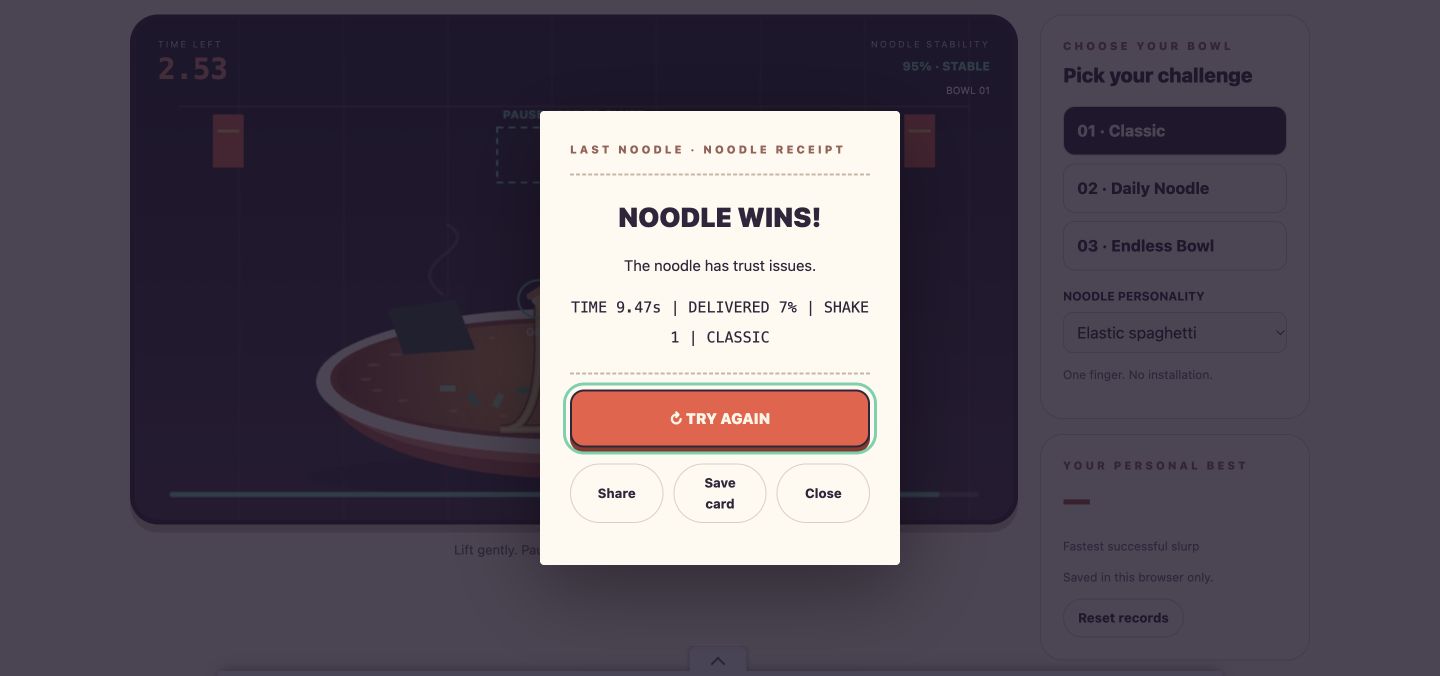
| Elastic pointer drag and release | Failure 9.47s; delivered 7%; shake 1; stability 95% observed | The pointer interaction affected play; a high remaining stability did not prevent failure |
| Local records | Reloaded Korean Classic showed 1.65s; Daily retained 1.43s | Observed records persisted in this browser and across its language pages |
| Share and Save card | Share said Sharing unavailable; Save card was activated | Sharing did not complete in this session; file contents remain unverified |
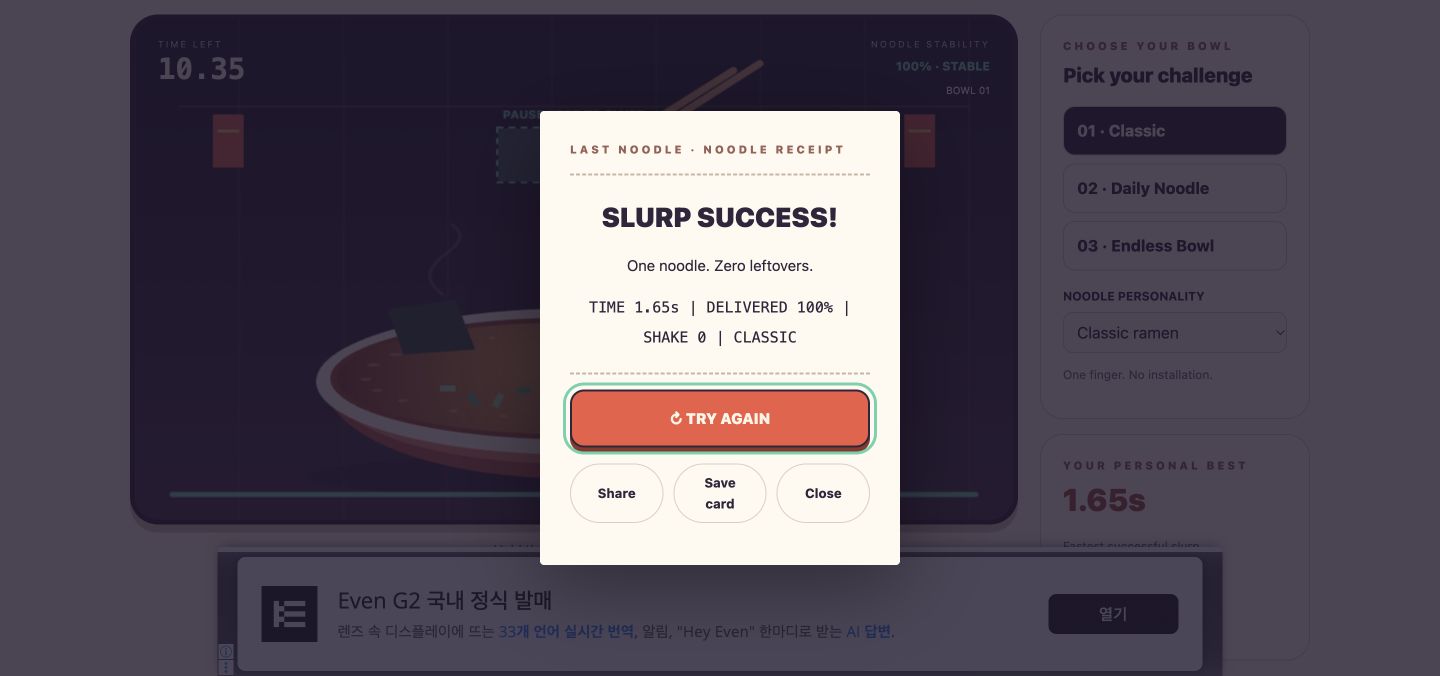
The earlier 7.47-second success included time spent inspecting the screen before finishing. The later 1.65-second attempt began movement promptly. The difference does not establish a measured improvement in skill, a device advantage or an ideal strategy. Both receipts are useful evidence that the success path worked, with their test context attached.
The pointer test combined a fast diagonal drag and release. We observed a 95% stability state, followed by a failure receipt with shake 1 and delivered 7%. Because more than one input condition changed, this is not a controlled measurement of collision damage, slip probability or the isolated effect of release. The source’s instruction to keep holding remains the clearest rule for normal pointer play.
We did not test every browser, complete a long Endless run or audit the underlying timing and scoring algorithms. Audio remained off throughout the tests. The sound control was visible, but sound playback was not evaluated. These limits prevent a short browser review from turning into claims about platform-wide reliability or calibrated performance.
Keyboard support does not establish a fully nonvisual experience. The canvas exposed a Space-and-arrows label, and time, stability and results appeared as text. The moving ring and target position still required visual judgment in our tests. Screen-reader-only completion was not evaluated; keyboard availability is an alternative input route, not a verified claim of complete nonvisual accessibility.
5. Choose a noodle mode for the comparison you want
| Mode | Useful reason to choose it | Comparison to avoid |
|---|---|---|
| Classic | Learn a fixed mode with a selected personality | Treating different personalities as equivalent time trials |
| Daily Noodle | Repeat the displayed UTC-date setup | Assuming your local midnight defines the challenge date |
| Endless Bowl | Explore consecutive successes and continued play | Comparing a bowl count directly with a Classic completion time |
Classic: understand the stop before chasing time
Classic supplies the straightforward twelve-second challenge. The personality selector offers Classic ramen, Slippery ice noodle and Elastic spaghetti. The source describes the first as balanced, ice as slippery and spaghetti as long and elastic. We selected and played different personalities, but did not measure a complete difficulty ranking or numerical differences in their motion.
Start with one combination until you can explain a failure. Our initial Classic ramen record appeared when that personality was selected, while Elastic spaghetti showed a blank personal best before a successful elastic attempt existed. This is a reason to keep the selection with any recorded result rather than reporting a context-free “best time.”
Daily: use the displayed UTC date
On 7 November 2026 UTC, Daily selected Slippery ice noodle, disabled the personality selector and displayed Same seed · unlimited practice. The dedicated guide says the date determines the shared conditions. We verified that day’s label and locked selection, not a multi-day sequence or identical play on several independent devices.
If comparing attempts with someone else, note the UTC date shown in the game, the mode and the input method. A different local date does not necessarily mean a different displayed challenge. Unlimited practice describes the opportunity to retry; it is not a verified worldwide competition or an uploaded leaderboard.
Endless: read the count and the current bowl separately
In Endless, one successful finish advanced the live display from BOWL 01 to BOWL 02 with the message that the next bowl was a little harder. The saved personal best showed 1 bowls. When that run later failed, the receipt reported BOWLS 1. The current bowl number and completed-bowl count therefore should not be read as the same quantity.
The observed Endless run was short. We did not establish every later difficulty step, an upper limit, or a fixed per-bowl time allowance. Use the remaining-time display during play instead of assuming the next bowl always starts a fresh twelve-second budget. That keeps the guide tied to what the interface actually showed.
6. Read the noodle receipt and preserve a useful result
Start with the verdict. The playful phrase NOODLE WINS is a failure for the player. A 100% delivered result can coexist with that failure, as our overshoot test demonstrated. The stability meter, delivered percentage and shake count describe different parts of the attempt; none should be promoted into a single universal score.
Receipt TIME is elapsed play time. In the 1.65-second success, the game behind the receipt displayed 10.35 seconds left. Reading that remaining value as the completion time would invert the result. For a note or screenshot, keep the verdict, mode, personality, date when relevant and input method beside the displayed time.
Shake is an in-game counter with no physical units or standard test protocol supplied in the inspected guide. Our keyboard overshoot had shake 0 despite losing. Do not use it to rate a person’s hand steadiness or to claim a real-world ability change. It is useful for discussing the game’s own attempt, with the same setup retained.
The receipt offers Retry, Share, Save card and Close. Retry immediately began another attempt in our tests, so be ready to play before using it. Share returned “Sharing unavailable. Save your card instead.” in this Chrome session, and we did not observe a copied result in the clipboard. This is a tested limitation, not a claim that sharing fails on every platform.
Save card is described by the source as PNG output. We activated the button but did not independently inspect a downloaded file, its dimensions or its contents. The images in this article are actual browser screenshots. If you need a card for a message or a document, open your saved file and inspect it before relying on the result; a button press alone is not proof of a usable export.
The source says personal bests and sound preferences are stored in this browser and that clearing browser storage removes game records. We observed persistence after reload, including the Korean page reading the Classic 1.65-second record. No record-import or account-sync control was visible. A saved image is evidence of a result, not a demonstrated method of restoring the game’s local record store.
7. Keep the session focused and understand the limits
A useful first session can stop after one explained failure and one successful finish. Keep Classic ramen fixed, identify whether the problem was grip, overshoot or releasing, then change only the relevant action. If you switch mode, personality and input method at the same time, the next receipt will not explain which change mattered.
For a casual comparison, use the same mode and personality and state the input method. Keyboard and pointer attempts are different control situations, and our tests were not timed as a standardized competition. The game is suitable for playing with its rules; there is no demonstrated transfer to cooking technique or a validated measurement outside the game.
At a fresh 390px Korean viewport, the page width stayed390px and the canvas measured352×470. We completed a Daily round through the keyboard route and saw a localized success receipt. The source documents mouse, touch and keyboard support. A physical touchscreen, device-specific finger accuracy, offline play and multiple browser engines were not tested.
The publisher’s English gameplay and privacy notes say no account is needed, local records and sound preferences are stored in the browser, and existing Google advertising services may use cookies under their policies. We read that notice and observed local records; we did not conduct a network or storage audit. Do not infer that the entire page makes no external requests.
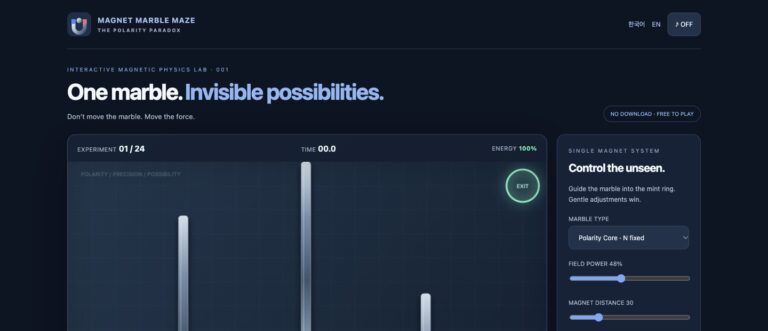
For a different kind of control problem, try our published Magnet Marble Maze guide. There you move a magnet to influence a marble rather than directly holding a noodle tip. It is a separate spatial puzzle, not an export destination or a proven training progression. Browse Games, Learning & Experiments for other published introductions.
Frequently asked questions
Why did I lose with stability 100% or delivered 100%?
Those values are not the success verdict. The instructed finish requires a steady pause inside the target. Our upward overshoot lost at 12.02s despite both high values, so check position and the actual outcome label first.
How do I play without dragging?
Focus the game canvas, press Space to grip and use the arrow keys. Stop when the ring reaches the target. The source documents pressing Space again to release. We completed Classic and Daily through keyboard input.
Why is the noodle selector disabled in Daily?
Daily fixes the setup for the displayed UTC date. On the tested date it selected Slippery ice noodle. Use Classic or Endless if you want to choose a personality manually.
Does BOWL 02 mean I completed two bowls?
Not in our observed run. After completing the first bowl, the next live bowl was BOWL 02 while the best count and eventual receipt showed one completed bowl.
Is my best time a world ranking?
The source explicitly calls these personal browser records, not a verified global leaderboard. We confirmed local persistence, not account synchronization or a competitive ranking service.
Can I share or export the result?
The buttons are offered, but Share was unavailable in our Chrome test. Save card was activated without independent file inspection. Check the actual saved output before sending it, and do not treat a screenshot as a restorable record backup.
Try one controlled noodle attempt
Choose Classic ramen, find the target, grip once and make a deliberate stop. Read the verdict before judging the percentages, then keep the setup fixed for one useful adjustment. That is enough to understand the challenge without mistaking a playful receipt for more than it measures.
Verified 7 November 2026 UTC. Evidence: actual English/Korean game interaction, displayed receipts, record persistence and screenshots. Physical touch, exported PNG contents, sound playback, cross-browser behavior and a network/storage audit were not independently verified.
A RELEVANT NEXT STEP
Tools with a useful connection
Magnet Marble Maze: The Polarity Paradox
Magnet Marble Maze: 7 Smart Checks for Better Control
Move a magnet to guide a marble through a 2D puzzle. Our guide tests polarity, pulse, rewind, Maker completion and sharing, while separating game outputs from real magnetic measurements.
쓰리쿠션 길 안내소
3 Cushion Simulator: 7 Smart Practice Checks
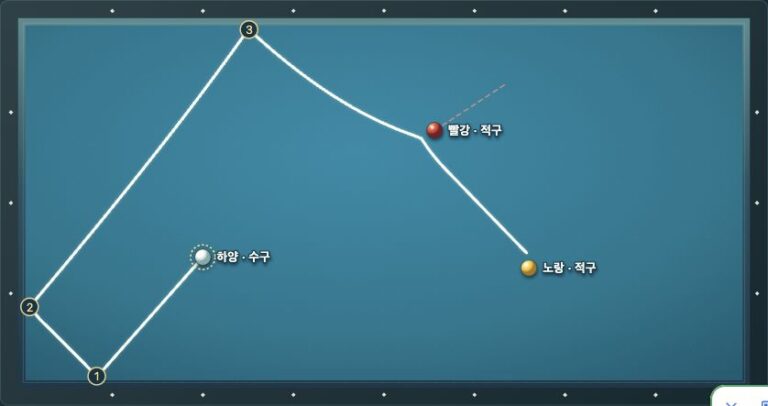
Compare experimental three-cushion routes, save a position and calculate points per inning with 쓰리쿠션 길 안내소. Korean interface; actual table accuracy is unverified.

Group Photo Chaos
Group Photo Game: 5 Fun Ways to Master the Timing
Catch the shared ready moment in an animated group portrait. A tested guide to timing, shutter delay, replay and reading the score.